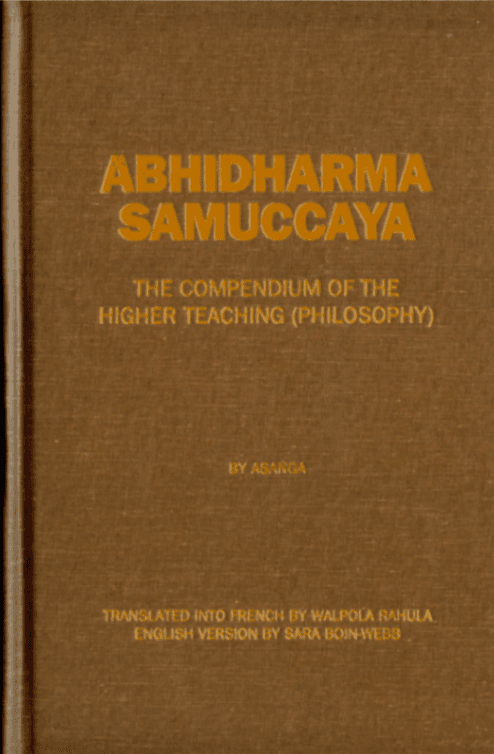
Abhidharmasamuccaya: The Compendium of the Higher Teaching (Philosophy)
Introduction
Abhidharmasamuccaya occupies a central position in the development of Yogācāra scholasticism. The introductory study identifies Asaṅga as a major systematizer of Mahāyāna and founder of the Yogācāra/Vijñānavāda tradition, traditionally associated with Maitreya and closely connected with the intellectual career of his brother Vasubandhu. The work adapts the analytical discipline of earlier Abhidharma while reorganizing it within a Mahāyāna framework. Its detailed classifications of the aggregates, elements, sense-spheres, mental processes, Four Noble Truths, spiritual attainments, persons, and modes of doctrinal analysis demonstrate that Yogācāra philosophy emerged through both continuity with and reinterpretation of earlier Buddhist scholastic traditions. For researchers in Buddhist philosophy, the text is especially valuable for studying the relationship among Abhidharma, Yogācāra psychology, cittamātra, non-self, dependent origination, and the path to liberation.
The work is divided into two major parts: Lakṣaṇasamuccaya, the “Compendium of Characteristics,” and Viniścayasamuccaya, the “Compendium of Determining.” The first part analyzes the fundamental categories of Buddhist experience—the five skandhas, eighteen dhātus, and twelve āyatanas—from multiple perspectives. It considers such distinctions as conventional and ultimate, conditioned and unconditioned, worldly and supramundane, spatial and temporal, and relates these analyses to dependent origination and the denial of an enduring self.
The second part is organized around doctrinal determination. Its longest opening chapter analyzes the Four Noble Truths—duḥkha, samudaya, nirodha, and mārga. Subsequent chapters address the determination of the teaching, spiritual attainments, classifications of persons, comprehension, and dialectical or analytical method. The structure shows the characteristic Yogācāra effort to integrate Abhidharma classification, phenomenology, psychology, epistemology, and soteriology within a single doctrinal framework.
The text is particularly significant for tracing the transformation of earlier Abhidharma categories within Mahāyāna thought. Asaṅga employs inherited analytical schemes while reinterpreting them through such concerns as cittamātra, non-self, the bodhisattva path, and the Yogācāra understanding of liberation. It therefore serves as an important bridge between classical Abhidharma analysis and the mature scholastic philosophy of Mahāyāna Buddhism.
Copyright Notice
This material is provided solely for academic research, study, and religious practice purposes under Article 25 of Vietnam's Intellectual Property Law. Reproduction, distribution, or commercial use is strictly prohibited.
If you are the author, translator, publisher, or rights holder and believe this content has been posted without proper authorization, please contact us and we will promptly review and remove or restrict access.
Documents
Abhidharmasamuccaya: The Compendium of the Higher Teaching (Philosophy)
11.9 MB
Keywords
Sách đọc nhiều nhất
The Buddha’s Ancient Path
Piyadassi Thera
The Questions of King Milinda, Part II
F. Max Müller (Editor)

A Taste of Freedom
Venerable Ajahn Chah / Phra Bodhinyana Thera
Buddhist Meditation: An Anthology of Texts from the Pāli Canon
Sarah Shaw (General Editors: Charles S. Prebish and Damien Keown)