English
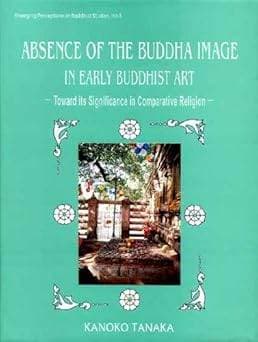
Absence of the Buddha Image in Early Buddhist Art: Toward its Significance in Comparative Religion
Kanoko Tanaka
English
Book
D.K. Printworld (P) Ltd., New Delhi.
1998
204 pages
11.7 MB
Introduction
Chapter I. Introduction: Defines the absence of the Buddha image as a visible fact and critiques the assumption that early Buddhist art is incomplete without Buddha images.
Chapter II. Visible Facts: Studies stūpa art, vedikā design, stūpa motifs, narrative composition, Buddhist monuments, devotees, symbolic motifs, and parallels with early Christian art.
Chapter III. Possible Interpretations: Interprets the absence of the Buddha image from religious, artistic, dramatic, and political perspectives, with reference to Buddhist texts and ritual contexts.
Chapter IV. The Concept of the Empty Throne: Analyzes the empty throne in Buddhism and compares it with Zoroastrianism, Judaism, Christianity, Islam, and Sikhism.
Chapter V. Conclusion: Summarizes the religious and comparative significance of the absence of the Buddha image.
Visual Materials: Includes lists and guides to tables, figures, illustrations, and plates.
Copyright Notice
This material is provided solely for academic research, study, and religious practice purposes under Article 25 of Vietnam's Intellectual Property Law. Reproduction, distribution, or commercial use is strictly prohibited.
If you are the author, translator, publisher, or rights holder and believe this content has been posted without proper authorization, please contact us and we will promptly review and remove or restrict access.
Documents
Absence of the Buddha Image in Early Buddhist Art: Toward its Significance in Comparative Religion
11.7 MB
Keywords
early Buddhist artBuddha imageaniconismstūpa artempty thronecomparative religionBuddhist symbolism.
Sách đọc nhiều nhất
The Buddha’s Ancient Path
Piyadassi Thera
Book·10.7 MB
229 pages1979223
The Questions of King Milinda, Part II
F. Max Müller (Editor)
Book·20.8 MB
427 pages1894208

A Taste of Freedom
Venerable Ajahn Chah / Phra Bodhinyana Thera
Book·1.2 MB
104 pages1980207
Buddhist Meditation: An Anthology of Texts from the Pāli Canon
Sarah Shaw (General Editors: Charles S. Prebish and Damien Keown)
Book·17.5 MB
253 pages2006204