
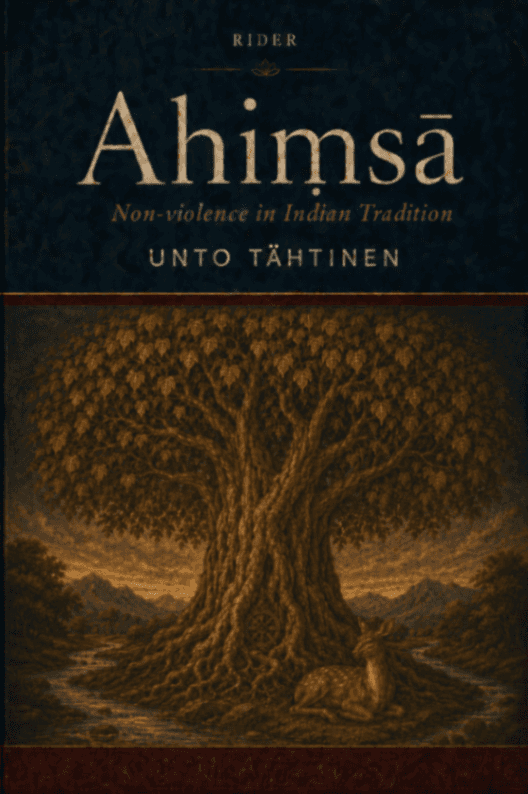
English
Ahiṃsā: Non-Violence in Indian Tradition
Unto Tähtinen
English
Book
Rider and Company, London
1976
142 pages
5.5 MB
Introduction
The book opens with a Preface that identifies six broad philosophies of non-violence in Indian thought: Jainism, Buddhism, the Vedas, the Dharmasāstras, the Purāṇas, and the modern Gandhian tradition, while also stressing the contemporary relevance of non-violence for peace, social conflict, structural violence, and environmental protection. Chapter I, “Two Definitions of Ahimsa,” distinguishes ahiṃsā as physical non-injury from the popular sense of non-killing, and contrasts Vedic and ascetic interpretations. Chapter II, “Hiṃsā,” examines violence as fact, suffering, killing, self-violence, motive, and unavoidable injury. Chapter III, “The Roots of Ahimsa,” studies historical, karmic, metaphysical, social, and epistemological foundations of non-violence. Chapter IV, “The Nature of Ahimsa,” analyzes whether non-violence is negative or positive, absolute or relative, individual or social, and how it is observed through body, speech, and mind. Chapter V, “Ahimsa and Other Moral Norms,” relates non-violence to self-control, forbearance, friendliness, compassion, truthfulness, non-stealing, bhakti, and the hierarchy of virtues. Chapter VI, “Ahimsa and War,” discusses kingship, armed force, peace, and Pāli Buddhist views on war. Chapter VII, “Ahimsa and Crime,” treats protection, self-defense, punishment, expiation, and non-violent treatment. Chapter VIII, “Ahimsa and Sub-Human Beings,” studies plants, animals, vegetarianism, and the moral status of different forms of life. Chapter IX, “Contemporary Ahimsa,” presents Aurobindo, Gandhi, Vinoba, and Sarvodaya, especially the expansion of non-violence into politics, economics, social reform, and global peace. The Appendix discusses the pre-Aryan origin of the ascetic idea of ahiṃsā.
Copyright Notice
This material is provided solely for academic research, study, and religious practice purposes under Article 25 of Vietnam's Intellectual Property Law. Reproduction, distribution, or commercial use is strictly prohibited.
If you are the author, translator, publisher, or rights holder and believe this content has been posted without proper authorization, please contact us and we will promptly review and remove or restrict access.
Documents
Ahiṃsā: Non-Violence in Indian Tradition
5.5 MB
Keywords
AhimsaNon-ViolenceIndian EthicsBuddhismJainismGandhiVegetarianism.
Sách cùng tác giả

Sách đọc nhiều nhất
Buddhist Meditation: An Anthology of Texts from the Pāli Canon
Sarah Shaw (General Editors: Charles S. Prebish and Damien Keown)
Book·17.5 MB
253 pages2006200
The Buddha’s Ancient Path
Piyadassi Thera
Book·10.7 MB
229 pages1979197

A Taste of Freedom
Venerable Ajahn Chah / Phra Bodhinyana Thera
Book·1.2 MB
104 pages1980197
The Questions of King Milinda, Part II
F. Max Müller (Editor)
Book·20.8 MB
427 pages1894197