English
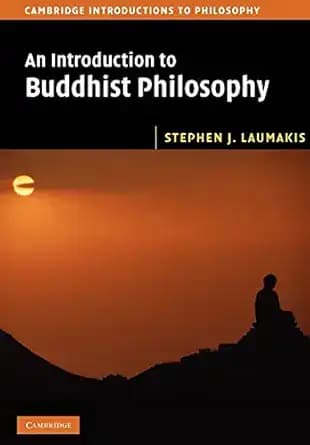
An Introduction to Buddhist Philosophy
Stephen J. Laumakis
English
Book
Cambridge University Press, Cambridge; New York
2008
301 pages
1.4 MB
Introduction
The book is organized into three major parts: A Sketch of the Buddha and the Dhamma, Details of the Dhamma, and Development of the Dhamma/Dharma. Each chapter includes key terms, doctrinal explanations, selected primary-source materials, and philosophical analysis.
Part I: A Sketch of the Buddha and the Dhamma
Chapter 1: The Life of Siddhattha Gotama
This chapter introduces the historical Buddha through a philosophical reading of his life. Laumakis discusses the difficulty of reconstructing the Buddha’s biography with certainty, while still accepting that Siddhattha Gotama was a historical figure. The chapter presents the major traditional elements of his life: privileged birth, the Four Sights, renunciation, study with ascetic and meditative teachers, rejection of both sensual indulgence and extreme self-mortification, realization of the Middle Way, enlightenment, teaching career, and final death.
The chapter does not treat the Buddha’s life merely as sacred biography. It reads the narrative philosophically: Siddhattha’s life embodies the very insights he later taught, especially impermanence, suffering, non-attachment, interdependent arising, the Middle Way, wisdom, and liberation. The key point is that the Buddha’s life and teaching mutually illuminate one another.
Chapter 2: The Contexts for the Emergence of Buddhism
This chapter places Buddhism within the broader Indian intellectual world. Laumakis explains the pre-Vedic, Vedic, and post-Vedic religious-philosophical contexts from which Buddhism emerged. Important terms include Vedas, Brahman, Upaniṣads, ṛta, karma, saṃsāra, mokṣa, yoga, and varṇa.
The chapter shows that Buddhism arose during a period of social, economic, political, and religious transformation in ancient India. Siddhattha Gotama inherited a world of ritual sacrifice, speculative philosophy, ascetic practice, rebirth theories, and debates about liberation. Buddhism is therefore presented both as a continuation of Indian philosophical concerns and as a critical response to them.
Chapter 3: The Basic Teachings of the Buddha
This chapter introduces the foundational doctrines of early Buddhism. Laumakis explains the Middle Way, the Four Noble Truths, and the Noble Eightfold Path. The chapter also introduces key Buddhist terms such as dukkha, taṇhā, anattā, nibbāna, wisdom, moral excellence, meditation, and interdependent arising.
The chapter’s emphasis is practical and philosophical. The Buddha is presented as diagnosing the human condition: suffering exists, suffering has causes, suffering can cease, and there is a path leading to its cessation. The teaching is not merely theoretical; it is a path of transformation involving ethical conduct, meditative discipline, and insight.
Chapter 4: One Buddhism or Many Buddhisms?
This chapter addresses the diversity of Buddhist traditions. Laumakis asks whether Buddhism should be understood as one coherent philosophical system or as a family of related but distinct traditions. The chapter introduces broad developments in Theravāda, Mahāyāna, and Vajrayāna Buddhism.
The chapter is important because it prepares the reader for the later historical development of Buddhist philosophy. It shows that Buddhist thought is not static. Different traditions preserve, reinterpret, expand, and sometimes contest earlier teachings while still claiming continuity with the Buddha’s Dharma.
Part II: Details of the Dhamma
Chapter 5: Kamma, Saṃsāra, and Rebirth
This chapter examines Buddhist moral causality and rebirth. Laumakis explains kamma/karma as intentional action and its consequences, not as fatalism. Karma links conduct, mental intention, future experience, and rebirth.
The chapter also discusses saṃsāra, the cycle of birth, death, and rebirth. The philosophical issue is how continuity across lives can be explained without a permanent self. This prepares the reader for later discussions of no-self and dependent arising.
Chapter 6: Interdependent Arising
This chapter focuses on paṭicca-samuppāda / pratītya-samutpāda, usually translated as dependent origination or interdependent arising. Laumakis treats this doctrine as one of the most important philosophical insights of Buddhism.
The chapter explains that things do not exist independently or in isolation. They arise through causes, conditions, relations, and processes. This teaching functions as a Buddhist theory of causality and also as the basis for understanding suffering, selfhood, karma, rebirth, and liberation.
Chapter 7: Impermanence, No-Enduring-Self, and Emptiness
This chapter examines three interrelated Buddhist doctrines: impermanence, no-enduring-self, and emptiness. Laumakis explains that all conditioned phenomena are changing, unstable, and dependent. Because persons are also conditioned processes, Buddhism denies a permanent, independent, unchanging self.
The chapter also introduces emptiness as a further development of this insight. Emptiness does not mean nothing exists. Rather, it means that things lack independent, fixed, self-sufficient essence. This chapter provides the conceptual bridge from early Buddhist analysis to later Mahāyāna philosophy.
Chapter 8: Mokṣa and Nibbāna
This chapter examines the Buddhist goal of liberation. Laumakis compares broader Indian ideas of mokṣa with the Buddhist idea of nibbāna/nirvāṇa. In Buddhism, liberation means the end of suffering through the extinguishing of greed, hatred, and delusion.
The chapter clarifies that nibbāna is not simply death, annihilation, or withdrawal from life. It is the cessation of the conditions that produce suffering. Philosophically, the chapter asks how liberation is possible if the self is not permanent and if all phenomena arise dependently.
Part III: Development of the Dhamma/Dharma
Chapter 9: Bodhidharma’s and Huineng’s Buddhisms
This chapter turns to Chinese Chan Buddhism, especially the figures of Bodhidharma and Huineng. Laumakis presents Chan as a distinctive development of Buddhist philosophy emphasizing direct insight, meditation, non-attachment to words, and awakening to one’s true nature.
The chapter likely discusses the transmission of Buddhism into China and the transformation of Indian Buddhist ideas within Chinese intellectual and religious contexts. Bodhidharma represents the early Chan emphasis on meditation, while Huineng becomes central to the later rhetoric of sudden awakening.
Chapter 10: Pure Land Buddhism
This chapter introduces Pure Land Buddhism, a major Mahāyāna tradition centered on devotion to Amitābha Buddha and aspiration for rebirth in the Pure Land. Laumakis explains how Pure Land practice developed as a path accessible to ordinary practitioners.
The philosophical importance of this chapter lies in the contrast between self-power and other-power, meditative insight and devotional trust, individual effort and reliance on Amitābha’s vow. Pure Land Buddhism expands the meaning of Buddhist practice beyond monastic meditation and scholastic analysis.
Chapter 11: Tibetan Buddhism
This chapter presents Tibetan Buddhism as a complex development of Indian Buddhist philosophy, Mahāyāna ethics, tantric practice, monastic scholarship, meditation, ritual, and lineage transmission.
Laumakis introduces the distinctive features of Tibetan Buddhism, including its synthesis of Madhyamaka philosophy, bodhisattva practice, Vajrayāna methods, guru-disciple transmission, and sophisticated scholastic debate. The chapter situates Tibetan Buddhism within the wider development of the Dharma after its movement beyond India.
Chapter 12: Two Forms of Contemporary Buddhism
The final chapter examines two contemporary Buddhist figures: the Dalai Lama and Thich Nhat Hanh. These two figures represent different but influential modern forms of Buddhism.
The Dalai Lama is associated with Tibetan Buddhist philosophy, compassion, ethics, interreligious dialogue, and global responsibility. Thich Nhat Hanh represents engaged Buddhism, mindfulness, peace work, interbeing, and the application of Buddhist practice to modern social life. The chapter shows how Buddhist philosophy continues to develop in response to modern global concerns.
Supplementary Materials
The book concludes with a Glossary, Bibliography, and Index. These materials make it useful as an introductory academic textbook for students of Buddhist philosophy, comparative philosophy, and religious studies.
Copyright Notice
This material is provided solely for academic research, study, and religious practice purposes under Article 25 of Vietnam's Intellectual Property Law. Reproduction, distribution, or commercial use is strictly prohibited.
If you are the author, translator, publisher, or rights holder and believe this content has been posted without proper authorization, please contact us and we will promptly review and remove or restrict access.
Documents
An Introduction to Buddhist Philosophy
1.4 MB
Keywords
Buddhist PhilosophyStephen J. LaumakisDependent ArisingNo-SelfNirvāṇa.
Sách đọc nhiều nhất
The Buddha’s Ancient Path
Piyadassi Thera
Book·10.7 MB
229 pages1979223
The Questions of King Milinda, Part II
F. Max Müller (Editor)
Book·20.8 MB
427 pages1894208

A Taste of Freedom
Venerable Ajahn Chah / Phra Bodhinyana Thera
Book·1.2 MB
104 pages1980207
Buddhist Meditation: An Anthology of Texts from the Pāli Canon
Sarah Shaw (General Editors: Charles S. Prebish and Damien Keown)
Book·17.5 MB
253 pages2006204