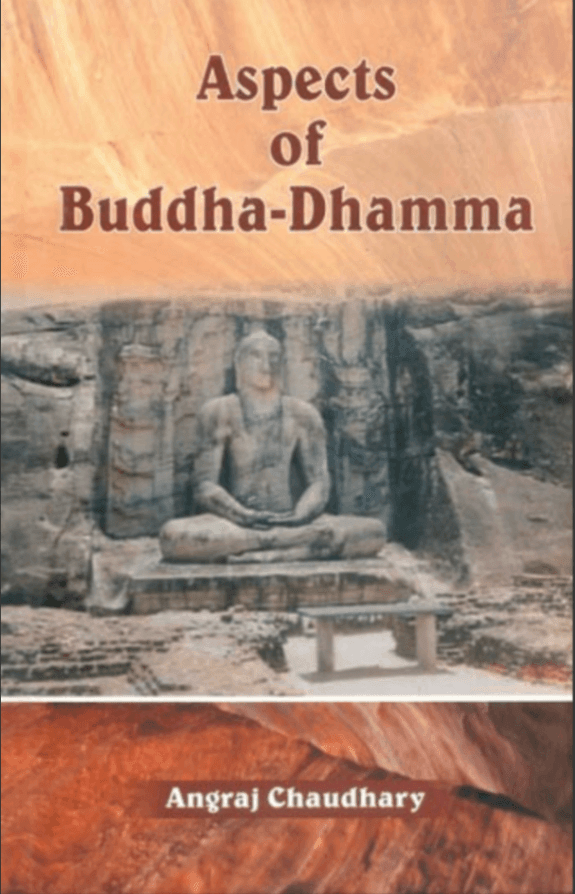
Aspects of Buddha-Dhamma
Introduction
The thirty-five essays are arranged broadly into eleven thematic groups. The first groups deal with the nature and spiritual foundations of Buddha-Dhamma; subsequent groups examine social philosophy, modern problems, education, cardinal doctrines, ethicalization, mind and Vipassanā, Pāli literature, and Buddhist aesthetics. He explicitly links the Buddha’s teachings to both individual spiritual transformation and wider social concerns such as poverty, governance, human dignity, ecological balance, education, and peaceful coexistence.
A major concern of the book is the practical character of Buddha-Dhamma. Chaudhary repeatedly presents the Buddha’s teaching as an “action-plan” rather than merely a speculative philosophy. Essays such as “Why Dhammacakkam?”, “Nature of Buddha-Dhamma,” “Spiritual Foundation of Buddha-Dhamma,” and “Walking on the Eightfold Path is True Dhamma” examine the relationship between ethical discipline (sīla), concentration (samādhi), wisdom (paññā), dependent origination, impermanence, craving, and liberation. The author stresses experiential understanding, especially through Vipassanā, rather than purely intellectual knowledge.
Another substantial group of essays addresses the Buddha’s social philosophy. Themes include equality, freedom, justice, human rights, social harmony, material prosperity, good governance, tolerance, altruism, karma and rebirth, and the rejection of caste-based inequality. Further essays examine bioethics, transplantation of human organs, ecology, education, the Four Noble Truths, Brahmavihāra, anattā, dependent origination, mental cultivation, Vipassanā, and the contribution of Pāli literature to Indian and world culture. The collection thus presents Buddha-Dhamma as an integrated ethical, philosophical, contemplative, and social system.
The author relies extensively on the Pāli Tipiṭaka and related commentarial literature. The abbreviation section lists sources including the Aṅguttara Nikāya, Dīgha Nikāya, Majjhima Nikāya, Saṃyutta Nikāya, Suttanipāta, Dhammapada, Jātaka, Vinaya Piṭaka, Visuddhimagga, Milindapañha, and numerous Aṭṭhakathā works. This textual grounding gives the essays a strongly canonical and Theravāda-oriented framework.
Copyright Notice
This material is provided solely for academic research, study, and religious practice purposes under Article 25 of Vietnam's Intellectual Property Law. Reproduction, distribution, or commercial use is strictly prohibited.
If you are the author, translator, publisher, or rights holder and believe this content has been posted without proper authorization, please contact us and we will promptly review and remove or restrict access.
Documents
Aspects of Buddha-Dhamma
135.8 MB
Keywords
Sách đọc nhiều nhất
The Buddha’s Ancient Path
Piyadassi Thera
The Questions of King Milinda, Part II
F. Max Müller (Editor)

A Taste of Freedom
Venerable Ajahn Chah / Phra Bodhinyana Thera
Buddhist Meditation: An Anthology of Texts from the Pāli Canon
Sarah Shaw (General Editors: Charles S. Prebish and Damien Keown)