
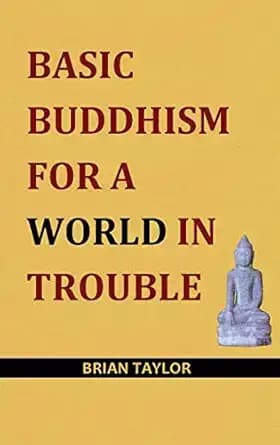
English
Basic Buddhism for a World in Trouble
Brian F. Taylor
English
Book
Universal Octopus
2016
72 pages
778 KB
Introduction
The book opens with Introduction, where Taylor describes the contemporary world as deeply troubled: war, suicide bombings, riots, prisons, psychiatric hospitals, crime, racial hatred, violence, and economic instability. From this point, he introduces Buddhism as an answer to suffering. He contrasts ordinary freedom, understood as the ability to follow desire, with genuine freedom, understood as freedom from desire-driven suffering.
Chapter 1: What Is Buddhism?
This chapter defines Buddhism as a method for ending suffering. Taylor explains suffering through the six sense doors: eye, ear, nose, tongue, body, and mind. Bodily and mental suffering arise because beings grasp at sense objects and cling to experience. The analogy of grasping a red-hot poker is used to show how suffering arises from craving and clinging. Nibbāna is described as a timeless state of peace and happiness, obscured by sense perceptions and thoughts, much like a cinema screen obscured by moving images.
Chapter 2: The Living Waters of Buddhism
This is one of the book’s central conceptual chapters. Taylor compares Buddhism to pure water: refreshing, life-sustaining, and clear in its original form. As water can be mixed with tea, coffee, beer, paint, or poison, Buddhism can be mixed with national, cultural, artistic, philosophical, or ceremonial elements. The chapter distinguishes “basic Buddhism” from Mahāyāna, Theravāda, Yogācāra, Zen, national Buddhist cultures, Buddhist art, literature, iconography, and ritual. Taylor’s main argument is that the essence of Buddhism is not culture, philosophy, or ceremony, but the method leading to “unshakeable liberation of mind.” He cites MN 29 to stress that the goal of the holy life is liberation, not alms, honor, fame, morality, concentration, or knowledge as ends in themselves.
Chapter 3: Getting Started
This chapter introduces the Five Precepts as the gateway to the Buddhist path. Taylor argues that Buddhism begins by identifying and removing causes of suffering within one’s own thought, speech, and action. The Five Precepts are presented as a practical commitment to abstain from killing, stealing, sexual misconduct, lying, and intoxicants that lead to carelessness. By keeping the precepts, the practitioner begins to reduce harm to self and others, clears the conscience, and prepares for Insight Meditation.
Chapter 4: The Five Buddhist Precepts
This chapter gives a fuller explanation of the precepts. Taylor frames them through the principle of moral reciprocity: one should not do to others what one would not want done to oneself. The precepts are described not merely as rules, but as intentions and promises made to oneself. The author explains each precept in practical terms: respect for life, respect for property, sexual responsibility, truthful speech, and abstention from intoxicants. He argues that if the precepts were widely practiced, war, serious crime, and the need for armies, prisons, courts, and policing would be radically reduced.
Chapter 5: Buddhism and Drugs
This chapter focuses on the Fifth Precept. Taylor argues that alcohol and drugs lead to carelessness, and carelessness produces suffering. He discusses substances such as alcohol, cannabis, opium, heroin, cocaine, mescaline, amphetamines, and LSD. The chapter uses a strong cause-and-effect framework: intoxicants first appear pleasurable, but later produce dependence, illness, loss of judgment, damaged relationships, financial hardship, relapse, and social harm. The illustrations on pages 28–29 show a fish caught by bait, visually reinforcing the idea that pleasure can conceal danger. Another illustration on page 32 uses a smoking image to underline the self-deceptive rationalizations surrounding harmful habits.
Chapter 6: The Practice
This chapter moves from outer morality to inner purification. Taylor argues that keeping the precepts restrains harmful actions, but deeper practice must address the mental impulses that precede those actions. The method recommended is Insight Meditation. The practitioner notes, with full awareness, whatever arises at the six sense doors: seeing, hearing, smelling, tasting, touching, and thinking. The aim is to observe experience before it develops into grasping, reaction, speech, and action. The chapter explains that all activities have a mental and physical aspect, and that “mind comes first.” Through practice, the meditator sees how character is constructed from repeated thought patterns and how future character can be reshaped through present awareness.
Chapter 7: Stopping the Mind
This short poetic chapter reflects on the problem of mental proliferation. The “spider mind” piles thought upon thought and becomes trapped in its own web. The chapter presents stopping not as violent suppression but as a skillful letting go of phenomena. It functions as a literary bridge between general practice and the detailed meditation method that follows.
Chapter 8: The Method in Detail
This chapter gives practical instructions for Insight Meditation. Taylor begins with the condition that the practitioner must understand and keep the Five Precepts. Sitting meditation is taught through awareness of the rising and falling of the abdomen: “rising” on the in-breath and “falling” on the out-breath. When thoughts, feelings, pain, hearing, or seeing arise, the meditator notes them without following them. The same principle applies to standing and lying down meditation. In walking meditation, the practitioner notes the movement of the feet, beginning with “left goes thus” and “right goes thus,” then later observing more detailed movements such as lifting, pressing, reaching, and lowering. The illustrations on pages 42 and 46–48 depict basic meditation postures and walking/standing forms, making the method more accessible to beginners.
Chapter 9: The Three Characteristics
This chapter explains the three marks of conditioned phenomena: impermanence, not-self, and unsatisfactoriness. Impermanence means that all phenomena arise, remain briefly, and pass away. Not-self means that neither body nor mind contains a permanent, unchanging self. Unsatisfactoriness means that conditioned existence cannot provide lasting fulfillment because everything pleasant changes, everything unpleasant causes pain, and even neutral experience fails to satisfy. Taylor connects these doctrines directly to meditation: through repeated observation at the sense doors, the meditator sees that all phenomena share these three characteristics. This insight weakens desire and opens the way toward Nibbāna.
Chapter 10: Stages of Progress
This chapter describes meditation as a backward journey into the roots of self and experience. Taylor compares the process to entering a cave that leads toward the center of a mountain. Along the way, the practitioner may encounter many interesting experiences, but must not become distracted by them. The essential task remains the same: to examine how the mind reaches toward sense objects because it finds them desirable, and then to see that such grasping causes suffering.
Chapter 11: Here
This chapter, indicated in the table of contents, continues the book’s emphasis on immediacy and present-moment practice. The core implication is that liberation is not found in abstract speculation or distant metaphysical systems, but in direct observation of experience here and now.
Chapter 12: Epilogue
The epilogue brings together the book’s practical vision: Buddhism is a path that must be practiced directly, not merely admired, studied, or culturally decorated. The author’s consistent emphasis is that the reader must begin now, with precepts, mindfulness, and insight into the arising and passing of phenomena.
Chapter 13: Appendix
The appendix likely supports the preceding practical teachings and reinforces the book’s basic orientation toward Buddhist discipline, meditation, and liberation.
Overall, Basic Buddhism for a World in Trouble is a direct, practice-oriented introduction to Buddhism. Its tone is urgent, simple, and uncompromising. It is especially useful for readers seeking a non-academic explanation of Buddhism as a path of ethical restraint, mental training, insight, and liberation from suffering. Its value lies in its clarity: the book reduces Buddhism to a practical sequence—understand suffering, keep the precepts, observe mind and body, see the three characteristics, let go of craving, and realize Nibbāna.
Copyright Notice
This material is provided solely for academic research, study, and religious practice purposes under Article 25 of Vietnam's Intellectual Property Law. Reproduction, distribution, or commercial use is strictly prohibited.
If you are the author, translator, publisher, or rights holder and believe this content has been posted without proper authorization, please contact us and we will promptly review and remove or restrict access.
Documents
Basic Buddhism for a World in Trouble
778 KB
Keywords
Basic BuddhismFive PreceptsInsight MeditationNibbāna
Sách đọc nhiều nhất
The Buddha’s Ancient Path
Piyadassi Thera
Book·10.7 MB
229 pages1979223
The Questions of King Milinda, Part II
F. Max Müller (Editor)
Book·20.8 MB
427 pages1894208

A Taste of Freedom
Venerable Ajahn Chah / Phra Bodhinyana Thera
Book·1.2 MB
104 pages1980207
Buddhist Meditation: An Anthology of Texts from the Pāli Canon
Sarah Shaw (General Editors: Charles S. Prebish and Damien Keown)
Book·17.5 MB
253 pages2006204