
English
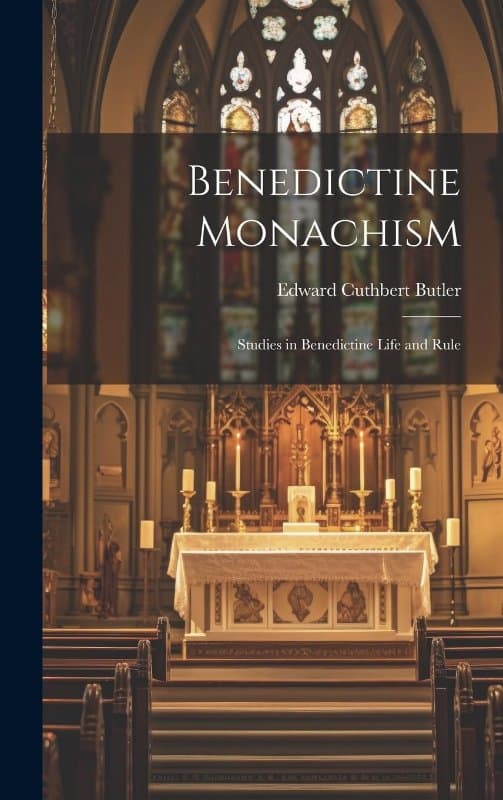
Benedictine Monachism: Studies in Benedictine Life and Rule
Cuthbert Butler
English
Book
Longmans, Green and Co.
1919
384 pages
11.1 MB
Introduction
The book is conceived as a broad intellectual and spiritual exposition of Benedictine monasticism. Butler opens from the conviction that the Rule of St Benedict has been one of the decisive forces in the formation of Western Europe, yet had not, in his view, received a sufficiently systematic treatment as a living theory of religious life. Rather than writing a simple commentary on the Rule chapter by chapter, he seeks to explain the inner logic of Benedictine life: its spirituality, discipline, social organization, institutional governance, and historical mission.
The study situates St Benedict within the crisis of late antique Italy, a period marked by political collapse, barbarian invasions, moral disorder, economic decline, and religious instability. Against this background, Benedict’s withdrawal from Rome, his solitude at Subiaco, and his foundation of Monte Cassino are interpreted not as escapism, but as the emergence of a constructive religious model capable of rebuilding spiritual and social life. Butler contrasts earlier forms of monasticism—especially the more individualistic eremitical ideals of Egypt and the communal forms of Pachomian cenobitism—with Benedict’s distinctive synthesis of moderation, order, obedience, community, prayer, and work.
The central concern of the book is the Benedictine way as a balanced form of Christian monastic existence. Butler explains Benedictine asceticism not as extreme mortification, but as disciplined conversion of life within a stable community. Prayer, contemplation, liturgy, silence, obedience, poverty, and humility are treated as integrated practices forming the monk’s spiritual character. The abbot, the vows, the monastic family, and the structures of government are examined as practical mechanisms through which the Rule becomes embodied in daily life.
The later sections broaden the analysis to Benedictine history and social contribution. Butler shows how Benedictine monasteries shaped European religious life, preserved learning, cultivated scholarship, restored agriculture, sustained education, and contributed to civilization. The work therefore presents Benedictine monachism as both contemplative and active: inwardly ordered toward God, outwardly fruitful for culture, learning, and society.
Copyright Notice
This material is provided solely for academic research, study, and religious practice purposes under Article 25 of Vietnam's Intellectual Property Law. Reproduction, distribution, or commercial use is strictly prohibited.
If you are the author, translator, publisher, or rights holder and believe this content has been posted without proper authorization, please contact us and we will promptly review and remove or restrict access.
Documents
Benedictine Monachism: Studies in Benedictine Life and Rule
11.1 MB
Keywords
Benedictine monasticismRule of St BenedictChristian asceticismMonastic spiritualityContemplative lifeMonastic governanceWestern monastic history.
Sách đọc nhiều nhất
The Buddha’s Ancient Path
Piyadassi Thera
Book·10.7 MB
229 pages1979223
The Questions of King Milinda, Part II
F. Max Müller (Editor)
Book·20.8 MB
427 pages1894208

A Taste of Freedom
Venerable Ajahn Chah / Phra Bodhinyana Thera
Book·1.2 MB
104 pages1980207
Buddhist Meditation: An Anthology of Texts from the Pāli Canon
Sarah Shaw (General Editors: Charles S. Prebish and Damien Keown)
Book·17.5 MB
253 pages2006204