
English
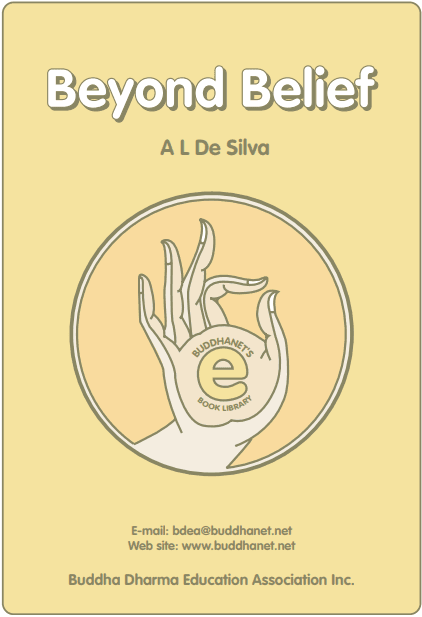
Beyond Belief: A Buddhist Critique of Fundamentalist Christianity
A. L. De Silva
English
Book
Free Gem Publications
1994
133 pages
945 KB
Introduction
The book is structured as a sustained Buddhist response to fundamentalist Christian claims, especially those directed toward Buddhists in missionary contexts. Its opening use of the Kalama Sutta establishes the methodological foundation of the work: religious claims should not be accepted merely because they are traditional, scriptural, authoritative, popular, or emotionally persuasive, but should be tested through observation, analysis, moral consequence, and practical benefit. On this basis, A. L. De Silva evaluates Christianity not as a general cultural tradition, but specifically in its fundamentalist and evangelistic form.
The early part of the book focuses on theistic arguments. It critiques attempts to prove God’s existence through biblical authority, cosmology, design, first cause reasoning, miracles, existential need, emotional testimony, and the claim that God cannot be disproved. The author argues that these arguments either depend on prior acceptance of Christian scripture, fail to distinguish the Christian God from other religious deities, or do not adequately address natural causation, suffering, and religious diversity. This leads into a more direct critique of the coherence of the Christian God, particularly the tension between divine omniscience and human free will, the persistence of evil and suffering, the question of why a perfect being would create an imperfect universe, and the problem of divine hiddenness.
A central comparative section contrasts the God of the Bible with the Buddha of the Buddhist scriptures. Here the book argues that the biblical image of God includes anger, jealousy, vengeance, war, punishment, sacrifice, and disease, while the Buddha is presented as calm, compassionate, peaceful, forgiving, rational, and morally consistent. The author uses this comparison to defend the Buddhist ideal as ethically superior to the fundamentalist Christian portrayal of divine authority. The later sections broaden the critique to the life of Jesus and the Bible, raising questions about prophecy, birth narratives, the resurrection, divine status, hell, miracles, inspiration, authorship, textual variation, and selective interpretation.
The final portion turns from critique to constructive Buddhist exposition. Buddhism is presented as a rational and practical alternative grounded in the Buddha, rebirth, suffering, the overcoming of suffering, and the Noble Eightfold Path. The book concludes with a series of direct responses to common evangelical objections against Buddhism, including questions about creation, non-violence, rebirth, population growth, Nirvana, kamma, Buddhist countries, social progress, and religious practice. Its overall purpose is apologetic, educational, and defensive: to equip Buddhists with arguments, deepen confidence in Buddhism, and encourage religious discussion based on critical inquiry rather than dogmatic conversion.
Copyright Notice
This material is provided solely for academic research, study, and religious practice purposes under Article 25 of Vietnam's Intellectual Property Law. Reproduction, distribution, or commercial use is strictly prohibited.
If you are the author, translator, publisher, or rights holder and believe this content has been posted without proper authorization, please contact us and we will promptly review and remove or restrict access.
Documents
Beyond Belief: A Buddhist Critique of Fundamentalist Christianity
945 KB
Keywords
Buddhist apologeticsFundamentalist ChristianityKalama SuttaGod critiqueBible criticismJesus and BuddhismNoble Eightfold Path.
Sách đọc nhiều nhất
The Buddha’s Ancient Path
Piyadassi Thera
Book·10.7 MB
229 pages1979223
The Questions of King Milinda, Part II
F. Max Müller (Editor)
Book·20.8 MB
427 pages1894208

A Taste of Freedom
Venerable Ajahn Chah / Phra Bodhinyana Thera
Book·1.2 MB
104 pages1980207
Buddhist Meditation: An Anthology of Texts from the Pāli Canon
Sarah Shaw (General Editors: Charles S. Prebish and Damien Keown)
Book·17.5 MB
253 pages2006204