English
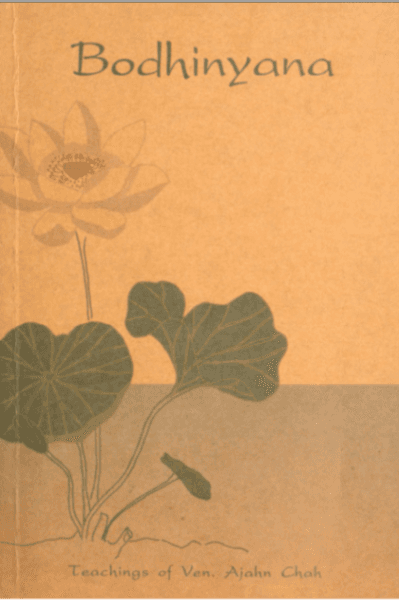
Bodhinyana: A Collection of Dhamma Talks
Ajahn Chah
English
Book
Abhayagiri Monastery
2000
134 pages
26.7 MB
Introduction
The book opens with the title page, identifying the work as Bodhinyana: A Collection of Dhamma Talks by Ajahn Chah (Phra Bodhinyana Thera) of Wat Pah Pong, Ubon Rajathani Province, Northeast Thailand. The copyright page states that commercial reproduction is prohibited, while reprinting for free distribution may be permitted with notification to Abhayagiri Monastery.
The Preface to the 2000 Edition explains that Bodhinyana was the first collection of Ajahn Chah’s talks translated and published by his Western students. The preface also notes the difficulty of translating Ajahn Chah’s oral Thai teachings into English, especially because Thai Buddhist terms often carry layered meanings derived from Pāli. For example, the Thai term related to Pāli ārammaṇa can mean sense object, mental impression, mood, or emotion, depending on context. The preface emphasizes that the translators attempted to preserve both the clarity and profundity of Ajahn Chah’s teaching.
The section Ajahn Chah provides a brief biographical introduction. Ajahn Chah was born in a rural village in Northeast Thailand, ordained as a novice in youth, and took full ordination at twenty. He studied basic Dhamma, discipline, and scriptures before training under meditation masters in the Forest Tradition. He wandered as an ascetic monk, living in forests, caves, and cremation grounds, and spent time with Ajahn Mun, one of the most respected Thai meditation masters of the twentieth century. Later, Ajahn Chah settled in a forest grove near his birthplace, which became Wat Pah Pong. His teaching attracted monks, nuns, and laypeople, including many Western students, leading to the establishment of Wat Pah Nanachat in 1975 as a training monastery for Westerners.
Fragments of a Teaching presents a foundational overview of Buddhist practice. Ajahn Chah begins by warning against Dhamma that is too vague, too abstract, or too scriptural to be practically useful. He defines Buddha as “the One-Who-Knows,” and Dhamma as the qualities of purity, radiance, and peace arising from morality, concentration, and wisdom. The chapter stresses that the path must be walked personally: teachers can point out the way, but each practitioner must cultivate morality, concentration, and wisdom for themselves. Through analogies such as medicine and travel, Ajahn Chah explains that intellectual knowledge alone cannot cure the disease of the mind; only practice can do so.
This chapter also explains the three levels of practitioners: ordinary Buddhist practitioners who take refuge and begin training; Noble Ones such as Stream-enterers, Once-returners, and Non-returners; and Arahants, who are free from attachment and clinging. Ajahn Chah then outlines the training in morality, concentration, and wisdom. Morality is defined as restraint and discipline of body and speech rooted in intention and mindfulness. Concentration is the training that makes the mind firm and peaceful. Wisdom arises when the trained mind investigates the Five Aggregates and sees impermanence, unsatisfactoriness, and not-self.
A Gift of Dhamma was delivered to Western monks, novices, and lay disciples at Wat Pah Nanachat in 1977, on the occasion of a visit from the parents of one of the monks. Ajahn Chah presents Dhamma as a gift greater than material things. He explains that modern societies may be materially prosperous but still lack inner peace because people remain confused by sense impressions. The chapter teaches that the mind is naturally pure, like clear rainwater, but becomes “colored” by mental impressions. Meditation is presented as the method for training the mind so that wisdom can arise. Ajahn Chah gives practical instructions on mindfulness of breathing, calming the mind, investigating the body, contemplating the four elements, and seeing the body-mind process as impermanent, unsatisfactory, and not-self.
Dhamma Nature develops the insight that Dhamma is not separate from nature. Ajahn Chah teaches that body and mind should be observed directly as natural processes. The practitioner learns by watching arising and passing away, instead of grasping concepts or becoming attached to moods. This chapter continues the Forest Tradition emphasis on direct seeing: reality is available in ordinary experience when the mind is steady, mindful, and free from compulsive reaction.
The Two Faces of Reality examines conventional truth and ultimate reality. Ajahn Chah often teaches that ordinary language, identity, possession, and social distinctions have practical use at the conventional level, but they should not be mistaken for ultimate truth. The practitioner must learn to live responsibly within convention while seeing that all conditioned things are unstable, changing, and empty of a permanent self.
The Training of the Heart focuses on inner discipline. In Ajahn Chah’s teaching, the “heart” and “mind” are not treated as separate in the ordinary Western sense; they refer to the center of experience, intention, feeling, and awareness. The chapter emphasizes that true Buddhist training is not merely outward observance but the transformation of one’s reactions, attachments, fears, desires, and views. Training the heart means developing patient endurance, mindfulness, restraint, and insight.
Living with the Cobra uses a powerful metaphor: defilements are like a cobra. One may live near a cobra, but only with constant caution and clear understanding. Likewise, the practitioner lives with sense contact, feelings, moods, and desires, but must not handle them carelessly. The teaching is not escapism; it is disciplined coexistence with the conditions of life through mindfulness and wisdom.
Reading the Natural Mind presents meditation as learning to read the mind directly. Rather than relying only on books or theories, practitioners must observe the movements of greed, hatred, delusion, fear, desire, boredom, and peace within their own experience. The natural mind becomes readable when mindfulness is continuous and when one stops identifying with every passing mental state.
Just Do It! is a practical exhortation to practice without overthinking. Ajahn Chah often discourages excessive speculation, argument, and dependence on conceptual study when these become obstacles to direct cultivation. The emphasis is on beginning where one is: keeping precepts, watching the mind, meditating regularly, and applying Dhamma in ordinary life.
Questions and Answers concludes the collection with practical responses to issues faced by practitioners. This section reflects Ajahn Chah’s flexible and situational teaching style. His answers are not merely theoretical; they arise from lived monastic training and direct meditative experience. The section helps readers understand how his teachings apply to actual problems in practice, including doubt, effort, meditation experience, attachment, and daily conduct.
Overall, Bodhinyana is a compact but significant work for the study of modern Theravāda practice and the Thai Forest Tradition. It is not a systematic philosophical treatise, but a practice-oriented manual grounded in oral instruction. Its core contribution is the translation of classical Buddhist training—morality, concentration, wisdom, mindfulness, non-attachment, and insight into the Three Characteristics—into direct, accessible language suitable for monastics and lay practitioners alike.
Copyright Notice
This material is provided solely for academic research, study, and religious practice purposes under Article 25 of Vietnam's Intellectual Property Law. Reproduction, distribution, or commercial use is strictly prohibited.
If you are the author, translator, publisher, or rights holder and believe this content has been posted without proper authorization, please contact us and we will promptly review and remove or restrict access.
Documents
Bodhinyana: A Collection of Dhamma Talks
26.7 MB
Keywords
Ajahn ChahBodhinyanaThai Forest TraditionDhamma PracticeMindfulness of Breathing.
Sách đọc nhiều nhất
The Buddha’s Ancient Path
Piyadassi Thera
Book·10.7 MB
229 pages1979223
The Questions of King Milinda, Part II
F. Max Müller (Editor)
Book·20.8 MB
427 pages1894208

A Taste of Freedom
Venerable Ajahn Chah / Phra Bodhinyana Thera
Book·1.2 MB
104 pages1980207
Buddhist Meditation: An Anthology of Texts from the Pāli Canon
Sarah Shaw (General Editors: Charles S. Prebish and Damien Keown)
Book·17.5 MB
253 pages2006204