
English
Buddha: A Story of Enlightenment
Deepak Chopra
English
Book
HarperCollins
2007
295 pages
1.2 MB
Introduction
The book opens with an Author’s Note, where Chopra explains his creative method. He acknowledges that the Buddha’s life has long been surrounded by legend, miracle, and devotional embellishment, but states that his aim is to portray the Buddha as “someone who is awake,” the basic meaning of the word Buddha. Chopra describes the book as a “sacred journey,” fictionalized externally but intended to be psychologically true to the seeker’s path. He divides the Buddha’s life into three phases: Siddhartha the prince, Gautama the monk, and Buddha the Compassionate One.
Part One: Siddhartha the Prince
Part One presents Siddhartha’s royal background and formative conditions. The narrative begins in the Kingdom of Sakya, 563 BCE, with King Suddhodana shown as a warrior king deeply attached to power, conquest, lineage, and political destiny. Queen Maya gives birth to Siddhartha in the forest, and the child is immediately surrounded by prophecy, grief, and expectation. Maya dies shortly after childbirth, and the young prince’s life is shaped by his father’s mixture of love, ambition, fear, and control.
A major dramatic element in this part is the prophecy concerning Siddhartha’s two possible destinies: he may become a universal monarch or awaken spiritually. Suddhodana, determined to prevent the second possibility, attempts to construct an artificial world for his son, shielding him from sickness, aging, death, and suffering. This part therefore dramatizes one of the central Buddhist themes: worldly power cannot protect the mind from existential truth. The palace becomes not merely a place of privilege but a carefully managed illusion.
The narrative also develops characters and tensions around Siddhartha, including Suddhodana, Maya, Prajapati, Devadatta, Yashodhara, Sujata, and others. Chopra gives these figures psychological complexity and uses them to present the young prince’s gradual confrontation with desire, violence, love, mortality, and dissatisfaction. The early chapters emphasize that Siddhartha’s renunciation does not arise from abstraction, but from a deep encounter with the limits of palace life, family expectation, sensual pleasure, and political destiny.
Part Two: Gautama the Monk
Part Two follows Siddhartha after renunciation, now identified as Gautama the Monk. This section presents the seeker’s journey away from royal identity and into spiritual discipline. Gautama encounters teachers, ascetics, hardship, hunger, fear, temptation, bodily suffering, and the limits of extreme willpower. The movement of this part is inward: Gautama must discover that neither royal pleasure nor severe self-mortification can bring final liberation.
This section corresponds to the classic Buddhist theme of rejecting both extremes: indulgence and self-torture. Chopra narrates Gautama’s struggle as psychological as much as religious. The seeker must face not only the external world but also his own mind: ambition, pride, memory, fear, desire, and the subtle ego hidden even in spiritual striving. Gautama gradually recognizes that liberation cannot be forced by domination of the body or heroic self-will.
The section prepares the transition to awakening by stripping Gautama of inherited identities. He is no longer protected by palace structures, no longer defined by family duty, and no longer sustained by the fantasy that ascetic extremity itself is wisdom. The monk’s journey becomes a process of exhaustion, surrender, and direct seeing.
Part Three: Buddha
Part Three presents Gautama’s awakening and emergence as Buddha. The chapters move from the brink of physical collapse to the decisive inner transformation associated with enlightenment. In this part, Chopra interprets awakening as a radical shift from illusion to clarity. The Buddha is no longer merely a seeker trying to solve suffering through effort; he becomes one who sees through the structure of self, desire, fear, and mental projection.
The narrative then turns to the early teaching career. Buddha encounters the five monks, teaches those who had once rejected him, and returns in some form to the world he left behind. The movement here is important: enlightenment is not treated as private escape, but as the beginning of compassionate teaching. The awakened one does not return as a prince or conqueror, but as one whose authority comes from insight.
The Epilogue reflects on the difficulty of telling the Buddha’s life as a story. Chopra argues that Siddhartha’s journey is not simply the tale of a romantic prince, suffering monk, or triumphant saint, but a universal spiritual journey from sleep to awakening. He interprets the root of suffering as illusion and presents the Buddha’s path as the dissolution of belief in a separate self and the world that sustains that self.
The Art of Non-Doing: A Practical Guide to Buddhism
After the fictional narrative, Chopra adds a reflective section titled “The Art of Non-Doing: A Practical Guide to Buddhism.” This section offers a popular introduction to Buddhist practice. Chopra explains that after enlightenment the Buddha becomes difficult to follow as a mere person, because his teaching points beyond personal identity. He outlines three ways of following the Buddha: the social way through the Sangha, the ethical way through compassion and non-judgment, and the mystical way through non-self and non-doing.
This section discusses non-doing not as passivity, but as openness beyond compulsive ego-driven activity. Chopra also explains desire, Nirvana, mindfulness, the silent gap between thoughts, and the gradual shift of allegiance from the separate self to a deeper state of awareness. He presents Buddhism as a “do-it-yourself project,” grounded in looking within, becoming clear, waking up, and moving beyond personal suffering.
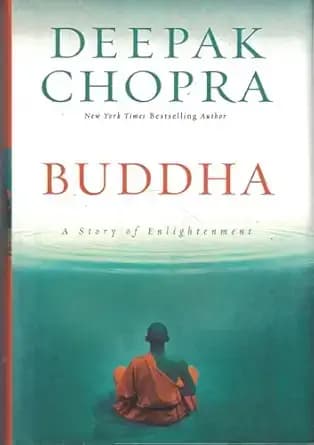
The book concludes with Acknowledgments, About the Author, Credits, Copyright, and About the Publisher. The cover image shows a seated monk-like figure before an expanse of water, visually reinforcing the themes of stillness, contemplation, depth, and awakening.
Overall, Buddha: A Story of Enlightenment is best classified as popular spiritual fiction based on the Buddha’s life. Its value lies not in historical-critical precision, but in its narrative accessibility and psychological rendering of Siddhartha’s transformation. For Buddhist studies, it may be useful as a modern literary reception of the Buddha story: a contemporary attempt to translate traditional Buddhist biography into a language of inner conflict, vulnerability, self-transcendence, compassion, and awakening.
Copyright Notice
This material is provided solely for academic research, study, and religious practice purposes under Article 25 of Vietnam's Intellectual Property Law. Reproduction, distribution, or commercial use is strictly prohibited.
If you are the author, translator, publisher, or rights holder and believe this content has been posted without proper authorization, please contact us and we will promptly review and remove or restrict access.
Documents
Buddha: A Story of Enlightenment
1.2 MB
Keywords
Siddhartha GautamaBuddhaEnlightenmentDeepak ChopraBuddhist Fiction.
Sách đọc nhiều nhất
The Buddha’s Ancient Path
Piyadassi Thera
Book·10.7 MB
229 pages1979223
The Questions of King Milinda, Part II
F. Max Müller (Editor)
Book·20.8 MB
427 pages1894208

A Taste of Freedom
Venerable Ajahn Chah / Phra Bodhinyana Thera
Book·1.2 MB
104 pages1980207
Buddhist Meditation: An Anthology of Texts from the Pāli Canon
Sarah Shaw (General Editors: Charles S. Prebish and Damien Keown)
Book·17.5 MB
253 pages2006204