English
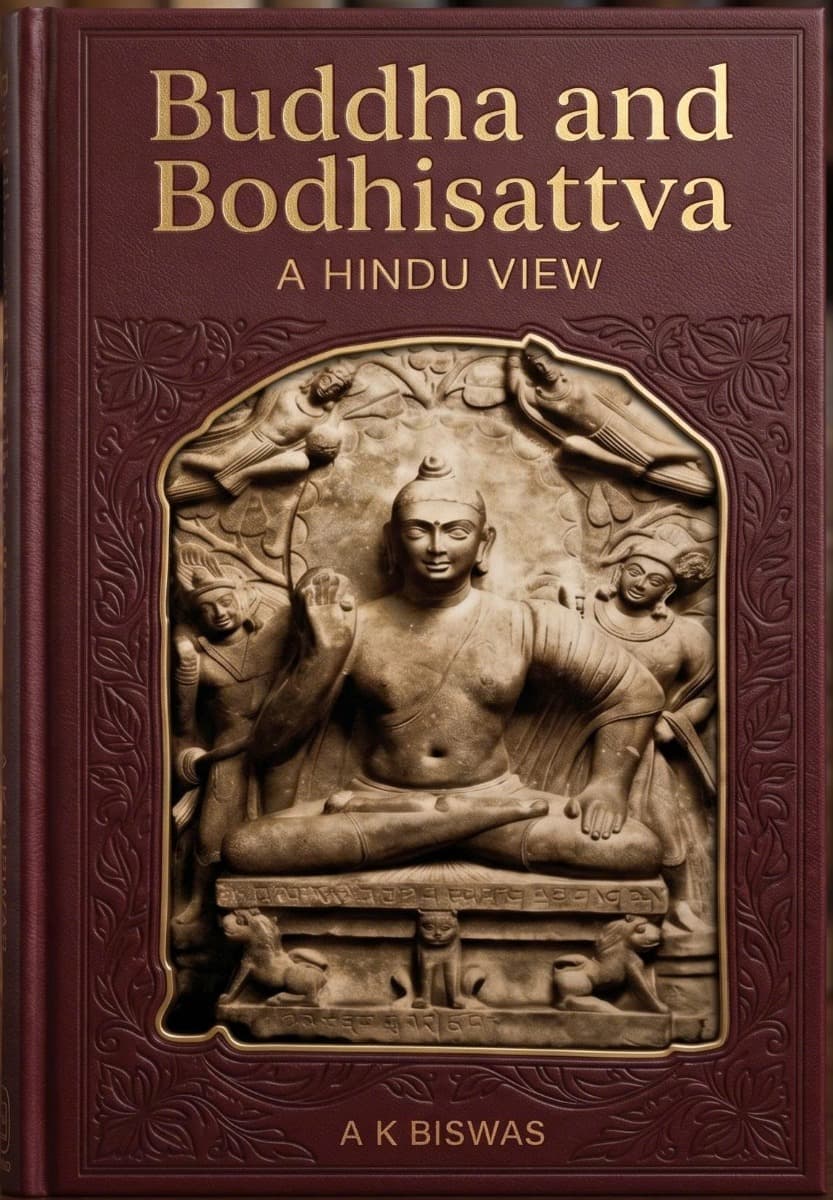
Buddha and Bodhisattva: A Hindu View
Arun Kumar Biswas
English
Book
Cosmo Publications, New Delhi
1987
265 pages
18.2 MB
Introduction
The book develops a synthetic interpretation of Buddha and Bodhisattva through historical narrative, doctrinal analysis, comparative religion, and Hindu philosophical reflection. Its opening premise is that Gautama Buddha should not be seen merely as the founder of a separate religious system, nor as an opponent of Hindu spirituality, but as one of the greatest spiritual figures produced by India. The author first establishes the life of Buddha in a compact historical framework: the Sakya background, birth of Siddhartha, renunciation, search for truth, enlightenment at Bodh Gayā, first sermon, formation of the Saṅgha, expansion of the teaching, and the Mahāparinirvāṇa. This biography is presented not only as sacred history but also as the foundation for understanding Buddha’s universal message.
The doctrinal core of the work centers on the Buddha’s teaching of suffering, causation, ethical discipline, meditation, non-attachment, self-effort, and liberation. Biswas gives special attention to the Four Noble Truths, the Noble Eightfold Path, the critique of ritualism, the rejection of mere metaphysical speculation, and the primacy of moral purification. From a Hindu viewpoint, he argues that Buddha’s silence on God, ātman, or ultimate metaphysical reality should not be simplistically interpreted as nihilism or atheism. Rather, the Buddha’s teaching is presented as practical, ethical, and liberative, oriented toward ending suffering rather than constructing speculative theology.
The later movement of the book turns to the Bodhisattva ideal and its long evolution. Drawing on Jātaka narratives and Buddhist legends, the author illustrates the Bodhisattva as one who cultivates generosity, compassion, sacrifice, patience, truthfulness, and universal concern for beings. The work also examines the transformation of the Bodhisattva concept from early narrative material into Mahāyāna religious philosophy, including the emergence of celestial Bodhisattvas and the expansive ideal of salvation for all beings. By integrating references to Hindu thinkers such as Vivekananda, Radhakrishnan, Aurobindo, and others, the book presents Buddha as a bridge between Buddhist and Hindu spiritual worlds. Its central contribution lies in arguing that Buddha’s message, when understood deeply, enriches rather than negates the Vedantic and broader Indian quest for truth, compassion, and liberation.
Copyright Notice
This material is provided solely for academic research, study, and religious practice purposes under Article 25 of Vietnam's Intellectual Property Law. Reproduction, distribution, or commercial use is strictly prohibited.
If you are the author, translator, publisher, or rights holder and believe this content has been posted without proper authorization, please contact us and we will promptly review and remove or restrict access.
Documents
Buddha and Bodhisattva: A Hindu View
18.2 MB
Sách đọc nhiều nhất
The Buddha’s Ancient Path
Piyadassi Thera
Book·10.7 MB
229 pages1979223
The Questions of King Milinda, Part II
F. Max Müller (Editor)
Book·20.8 MB
427 pages1894208

A Taste of Freedom
Venerable Ajahn Chah / Phra Bodhinyana Thera
Book·1.2 MB
104 pages1980207
Buddhist Meditation: An Anthology of Texts from the Pāli Canon
Sarah Shaw (General Editors: Charles S. Prebish and Damien Keown)
Book·17.5 MB
253 pages2006204