
English
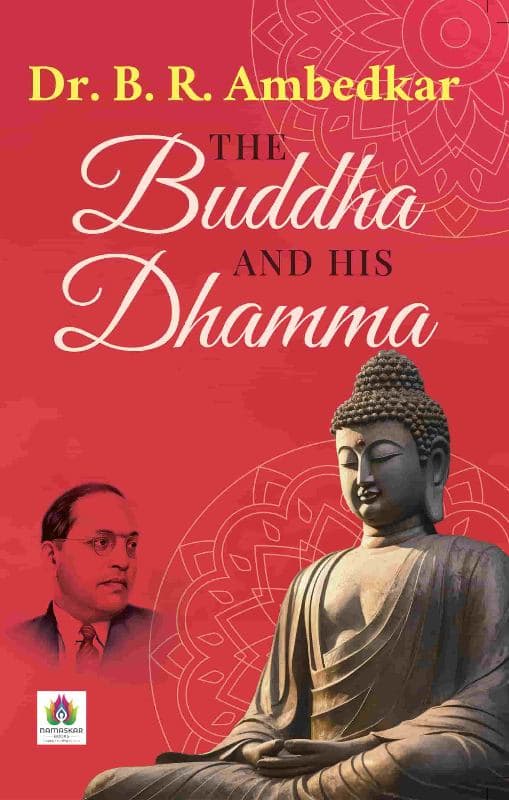
The Buddha and His Dhamma
Dr. Bhimrao Ramji Ambedkar
English
Book
People’s Education Society, Bombay
1957
492 pages
2.2 MB
Introduction
This work presents the life and teaching of the Buddha through Dr. B. R. Ambedkar’s distinctive rational, ethical, and social interpretation. Rather than treating Buddhism as a religion of metaphysical belief, ritual observance, or passive renunciation, Ambedkar redefines the Buddha’s Dhamma as a practical doctrine of human liberation grounded in reason, morality, compassion, and social responsibility. The narrative begins with Siddhartha Gautama’s historical and social background, emphasizing his early sensitivity to suffering, exploitation, violence, inequality, and the moral contradictions of the society into which he was born. His renunciation is therefore presented not merely as a personal spiritual withdrawal, but as a conscious search for a new path capable of addressing human suffering at both individual and collective levels.
The text gives sustained attention to the Buddha’s enlightenment, his rejection of speculative and ritualistic religion, and his formulation of Dhamma as a path concerned with right conduct, wisdom, welfare, and the reconstruction of society. Ambedkar highlights the Buddha’s opposition to blind faith, priestly authority, caste hierarchy, soul-theory, sacrificial religion, and social exclusion. At the same time, he portrays the Buddha as a teacher who placed human dignity, ethical effort, and social harmony at the center of spiritual life.
A major concern of the work is the social mission of Buddhism. The Buddha’s teaching activity is shown through his engagement with ascetics, rulers, householders, women, the poor, the marginalized, and those considered morally fallen by society. The Sangha is interpreted not only as a monastic institution but also as an ethical community intended to preserve, embody, and disseminate Dhamma. Ambedkar pays special attention to the Bhikkhu’s responsibility as a moral guide and social servant, and to the relationship between the monastic community and the laity.
The book also distinguishes sharply between “religion” and “Dhamma.” For Ambedkar, religion often depends on belief in God, soul, ritual, sacrifice, and supernatural authority, whereas Dhamma is a rational and moral order directed toward liberty, equality, fraternity, justice, and human welfare. In this sense, Buddha and His Dhamma is both a reconstruction of Buddhist doctrine and a program for social transformation. It presents Buddhism as a living path for moral cultivation, social emancipation, and the creation of a just human community.
Copyright Notice
This material is provided solely for academic research, study, and religious practice purposes under Article 25 of Vietnam's Intellectual Property Law. Reproduction, distribution, or commercial use is strictly prohibited.
If you are the author, translator, publisher, or rights holder and believe this content has been posted without proper authorization, please contact us and we will promptly review and remove or restrict access.
Documents
The Buddha and His Dhamma
2.2 MB
Keywords
BuddhismDhammasocial justiceequalitySangharational religionAmbedkarite Buddhism
Sách đọc nhiều nhất
The Buddha’s Ancient Path
Piyadassi Thera
Book·10.7 MB
229 pages1979223
The Questions of King Milinda, Part II
F. Max Müller (Editor)
Book·20.8 MB
427 pages1894208

A Taste of Freedom
Venerable Ajahn Chah / Phra Bodhinyana Thera
Book·1.2 MB
104 pages1980207
Buddhist Meditation: An Anthology of Texts from the Pāli Canon
Sarah Shaw (General Editors: Charles S. Prebish and Damien Keown)
Book·17.5 MB
253 pages2006204