English
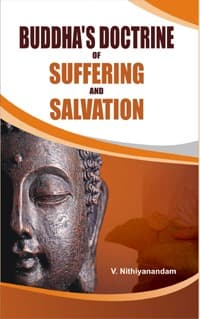
Buddha’s Doctrine of Suffering and Salvation (2 Vols)
Edited by V. Nithiyanandamtrin
English
Book
Global Vision Publishing House, Delhi
2002
282 pages
643.3 MB
Introduction
Vol.1 is organized around five major chapters. Chapter 1, “The Criterion of Suffering,” analyzes suffering through concepts such as human impulsion, obstruction of the will, evaluation of happiness and unhappiness, transitoriness, personality, sense organs, sense activity, perception, and the material organism. Chapter 2, “The World of Suffering,” explores the deceptive nature of pleasure, the satisfaction of will, scientific materialism, existence after death, and the metaphysical goal. Chapter 3, “The Subject of Suffering,” examines selfhood, personality, consciousness, spiritual substance, the hypothesis of soul and self, fear of death, belief in identity, and the Buddhist critique of personal essence. Chapter 4, “The Annihilation of Suffering,” discusses birth as an immediate condition of suffering and interprets grasping as a central expression of bondage. Chapter 5, “The Process of Rebirth and the Law of Karma,” studies thirst, saṅkhāra, becoming, the construction of craving, meditative contemplation, the chain of suffering, and the relationship between ignorance and conditioned existence.
Volume 2: The Path of Salvation continues the religio-philosophical analysis begun in Volume 1 by shifting from the causes of suffering to the practical and contemplative path of liberation. The volume is concerned with the Buddhist solution to dukkha: the removal of craving, ignorance, grasping, and the false identification with body, consciousness, sensation, perception, and personality. It presents liberation as freedom from willing, thirst, and attachment to the world of transient phenomena.
Vol. 2 contains four main chapters. Chapter 6, “The Liberation from Suffering,” examines the evil consequences of willing, the role of sensation and perception, liberty, the problem of freedom, physiological thirst, confrontation of sensation, the doctrine of deliverance, and the struggle for separation. Chapter 7, “The Path of Liberation from Suffering,” develops the practical path through themes such as thirst for the world, continual and deep meditation, the objects of craving considered singly and collectively, consciousness as cognitive faculty, right concentration, the four foundations of recollectedness, and the cultivation of concentration. Chapter 8, “The Steps of the Path,” presents the religious and ethical structure of Buddhist practice through homelessness, taking refuge in the Three Jewels, moral purity, concentration, and meditation. Chapter 9, “The Contemplative Visions: The Abyss Beyond Sensual Pleasures,” focuses on the consequences of transitoriness, the means of concentration, and the four holy states, showing how contemplative realization leads beyond attachment to sensual pleasure and toward final liberation.
Copyright Notice
This material is provided solely for academic research, study, and religious practice purposes under Article 25 of Vietnam's Intellectual Property Law. Reproduction, distribution, or commercial use is strictly prohibited.
If you are the author, translator, publisher, or rights holder and believe this content has been posted without proper authorization, please contact us and we will promptly review and remove or restrict access.
Documents (2 parts)
Vol. 1
232.0 MB
Vol. 2
411.4 MB
Keywords
Buddhist sufferingdukkhacravingdependent originationrebirthkarmafive aggregatesBuddhist salvationliberation from sufferingcravinganattāright concentrationmeditationEightfold Path.
Sách đọc nhiều nhất
The Buddha’s Ancient Path
Piyadassi Thera
Book·10.7 MB
229 pages1979223
The Questions of King Milinda, Part II
F. Max Müller (Editor)
Book·20.8 MB
427 pages1894208

A Taste of Freedom
Venerable Ajahn Chah / Phra Bodhinyana Thera
Book·1.2 MB
104 pages1980207
Buddhist Meditation: An Anthology of Texts from the Pāli Canon
Sarah Shaw (General Editors: Charles S. Prebish and Damien Keown)
Book·17.5 MB
253 pages2006204