
English
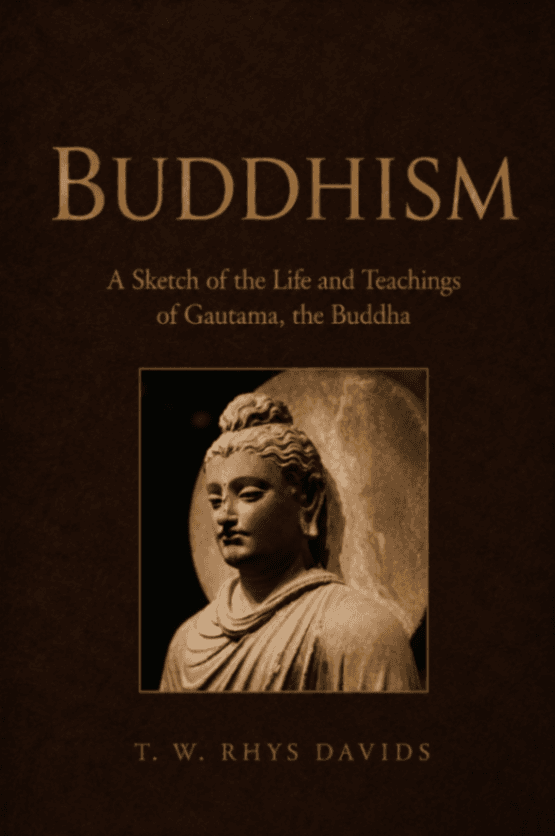
Buddhism: A Sketch of the Life and Teachings of Gautama, the Buddha
T. W. Rhys Davids, Ph.D., LL.D., F.B.A.
English
Book
Society for Promoting Christian Knowledge, London.
1912
277 pages
12.1 MB
Introduction
The book opens with a general introduction to Buddhism, beginning with statistical observations on the number and geographical distribution of Buddhists and comparing Buddhist influence with that of other major religious traditions. Rhys Davids is careful to note the limitations of such statistics, especially where Buddhist practice coexists with other religious or cultural traditions. He then defines the scope of the work: rather than attempting a complete history of all Buddhist developments, the book focuses chiefly on Buddhism as preserved in its earliest records, supplemented by a brief account of later transformations.
The next two chapters present the life of Gautama Buddha. The first part covers the social and religious background of the Aryans and the Sākiyas, Gautama’s birth, youth, marriage, the four visions, renunciation, study under Brahmanical teachers, austerities, abandonment of self-mortification, temptation, enlightenment, and the first sermon. The second part continues with the first lay disciples, the sending out of the sixty disciples, conversions, the return to Rājagṛha, the gift of Veḷuvana, the return to his family, the ordination of Rāhula, the gift of Jetavana, the ministry, Devadatta, the final days of the Buddha, and the relation between Buddhism and Brahmanism.
The doctrinal core of the work is found in the chapter on the essential teachings of Buddhism. It discusses the Piṭakas as the oldest authority, ultimate facts, the skandhas, the Buddhist denial of an eternal soul, transmigration, karma, the Four Noble Truths, the Four Paths, the Ten Fetters, and Nirvāṇa. The following chapter turns to Buddhist morality, treating the fruit of the Noble Path, Buddhist beatitudes, scriptural verses, parables, lay duties from the Dhammika Sutta, the Ten Sins, and the Sigālovāda Sutta. The chapter on the Order of Mendicants examines the foundation of the monastic community, admission into the Order, rules concerning food, residence, clothing, poverty, obedience, daily life, and jhāna. Later chapters address the growth of Buddha legends, including miraculous narratives and symbolic interpretations; Tibetan Buddhism, including Mañjuśrī, Avalokiteśvara, Vajrapāṇi, Dhyāni Buddhas, Ādi-Buddha, Tantra, prayer wheels, and flags; and finally the spread of Buddhism through councils, Aśoka’s missions, Sri Lanka, the writing down of the Piṭakas, Buddhaghosa, Central Asia, China, Korea, Japan, and Tibet.
Copyright Notice
This material is provided solely for academic research, study, and religious practice purposes under Article 25 of Vietnam's Intellectual Property Law. Reproduction, distribution, or commercial use is strictly prohibited.
If you are the author, translator, publisher, or rights holder and believe this content has been posted without proper authorization, please contact us and we will promptly review and remove or restrict access.
Documents
Buddhism: A Sketch of the Life and Teachings of Gautama, the Buddha
12.1 MB
Keywords
Gautama BuddhaEarly BuddhismPāli CanonFour Noble TruthsBuddhist moralityBuddhist monasticismSpread of Buddhism.
Sách đọc nhiều nhất
The Buddha’s Ancient Path
Piyadassi Thera
Book·10.7 MB
229 pages1979223
The Questions of King Milinda, Part II
F. Max Müller (Editor)
Book·20.8 MB
427 pages1894208

A Taste of Freedom
Venerable Ajahn Chah / Phra Bodhinyana Thera
Book·1.2 MB
104 pages1980207
Buddhist Meditation: An Anthology of Texts from the Pāli Canon
Sarah Shaw (General Editors: Charles S. Prebish and Damien Keown)
Book·17.5 MB
253 pages2006204