English
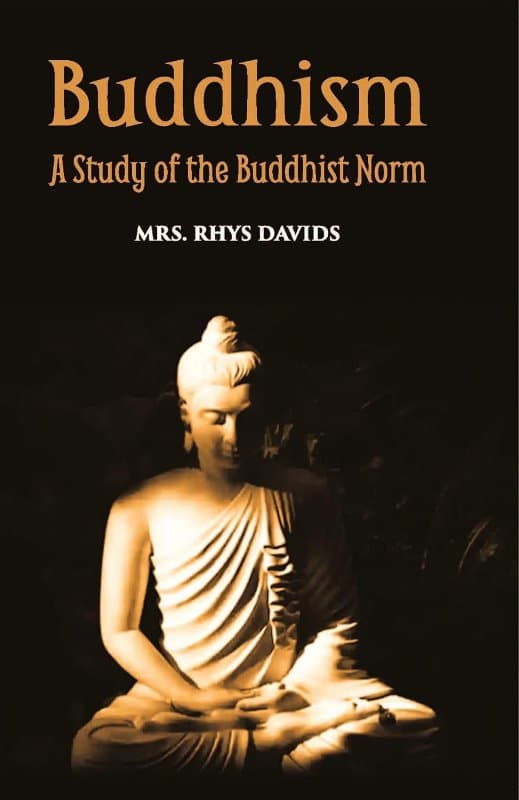
Buddhism: A Study of the Buddhist Norm
Mrs. Rhys Davids
English
Book
Williams & Norgate, London; Henry Holt & Co., New York.
260 pages
12.4 MB
Introduction
This work presents Buddhism through the central idea of Dhamma understood as the Buddhist “Norm”: a principle of truth, rightness, law, moral order, doctrine, and ideal conduct. Rather than offering a conventional narrative of the Buddha’s life or a general history of Buddhist expansion, Mrs. Rhys Davids focuses on the philosophical and ethical structure underlying early Buddhism as preserved in the Pāli Canon and developed in the Theravāda tradition. The book approaches Buddhism as a disciplined way of understanding reality, human experience, moral responsibility, and the path toward an ideal life.
A major concern of the work is the Pāli tradition, especially the authority and preservation of the Three Piṭakas. The author emphasizes the importance of Pāli literature as the earliest available textual foundation for Buddhist doctrine, preserved in Southern Buddhist countries such as Ceylon, Siam, and Burma. This textual tradition is not treated merely as scripture, but as the basis of a long intellectual and ethical culture. Through the Pāli Canon, Buddhism is presented as a historical, philosophical, and practical system whose core teachings can be studied through language, doctrine, analysis, and moral application.
The book gives special attention to the meaning of Dhamma and its relation to Abhidhamma. Dhamma is explained as the normative foundation of Buddhism: the law by which life should be understood and conducted. Abhidhamma, by contrast, represents the analytical and classificatory dimension of Buddhist thought, seeking to define experience, mind, moral states, causation, and reality in systematic terms. This distinction allows the author to show Buddhism not as a religion dependent on dogma, but as a reflective and analytical tradition grounded in ethical discipline and philosophical inquiry.
The central doctrinal themes of the work include the theory of no-soul, the law of causation, moral law, and the Buddhist ideal. The doctrine of no-soul is interpreted as a challenge to permanent-self theories and as a way to understand human life as a dynamic process rather than as an enduring metaphysical entity. Causation is presented as a fundamental principle governing existence, moral consequence, and spiritual development. Moral law is explained through responsibility, action, and the ethical formation of character. The Buddhist ideal is therefore not abstract speculation, but a practical goal realized through right understanding, self-discipline, moral cultivation, and liberation-oriented practice.
Overall, Buddhism: A Study of the Buddhist Norm portrays Buddhism as a coherent ethical-philosophical tradition centered on Dhamma. Its value lies in showing how early Buddhist thought provides a distinctive framework for understanding life, conduct, causality, and spiritual aspiration. The book is especially useful for readers interested in Pāli Buddhism, Theravāda philosophy, Buddhist ethics, Abhidhamma analysis, and the normative meaning of Dhamma as the guiding principle of Buddhist life.
Copyright Notice
This material is provided solely for academic research, study, and religious practice purposes under Article 25 of Vietnam's Intellectual Property Law. Reproduction, distribution, or commercial use is strictly prohibited.
If you are the author, translator, publisher, or rights holder and believe this content has been posted without proper authorization, please contact us and we will promptly review and remove or restrict access.
Documents
Buddhism: A Study of the Buddhist Norm
12.4 MB
Keywords
BuddhismDhammaPāli CanonAbhidhammano-soulcausationmoral law.
Sách cùng tác giả

Sách đọc nhiều nhất
The Buddha’s Ancient Path
Piyadassi Thera
Book·10.7 MB
229 pages1979223
The Questions of King Milinda, Part II
F. Max Müller (Editor)
Book·20.8 MB
427 pages1894208

A Taste of Freedom
Venerable Ajahn Chah / Phra Bodhinyana Thera
Book·1.2 MB
104 pages1980207
Buddhist Meditation: An Anthology of Texts from the Pāli Canon
Sarah Shaw (General Editors: Charles S. Prebish and Damien Keown)
Book·17.5 MB
253 pages2006204