
English
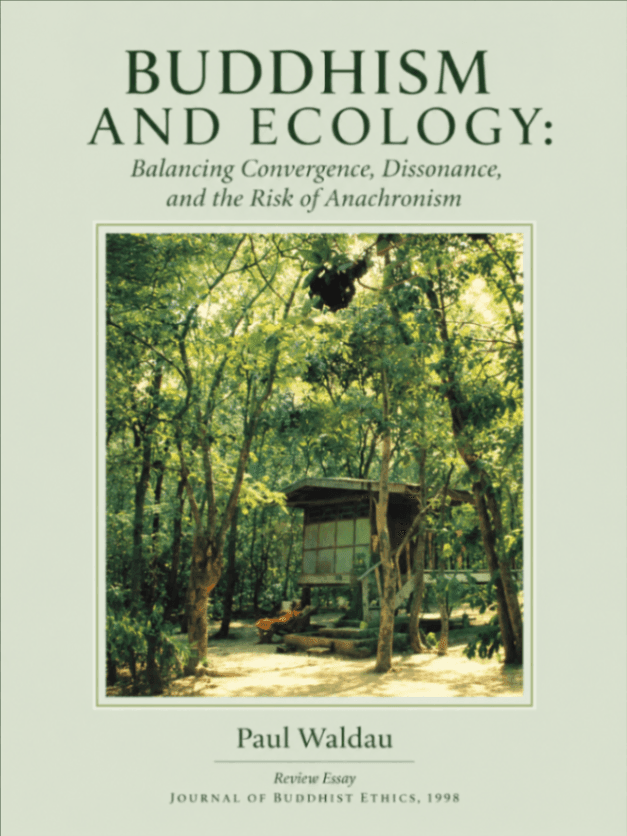
Buddhism and Ecology: Balancing Convergence, Dissonance, and the Risk of Anachronism
Paul Waldau (Reviewer)
English
Journal
Journal of Buddhist Ethics, Volume 5, pp. 374-383
1998
10 pages
108 KB
Introduction
The review begins by locating the edited volume within the Harvard conference series on religion and ecology and assessing its geographical, doctrinal, and methodological scope. It then examines the risks involved in interpreting traditional Buddhist teachings through modern environmental categories, particularly the dangers of anachronism, revisionism, and conceptual oversimplification. Subsequent sections discuss the distinction between Buddhist metaphysical interdependence and scientifically verifiable ecological relationships, the role of Buddhist ethics and the First Precept, institutional and monastic environmental practices, Thai Buddhist environmental activism, Japanese animal-release rituals, and Buddhist representations of nonhuman animals. The concluding section evaluates the collection’s academic and pedagogical value, identifying it as a major but not definitive contribution to the study of Buddhism and ecology.
Copyright Notice
This material is provided solely for academic research, study, and religious practice purposes under Article 25 of Vietnam's Intellectual Property Law. Reproduction, distribution, or commercial use is strictly prohibited.
If you are the author, translator, publisher, or rights holder and believe this content has been posted without proper authorization, please contact us and we will promptly review and remove or restrict access.
Documents
Buddhism and Ecology: Balancing Convergence, Dissonance, and the Risk of Anachronism
108 KB
Keywords
Buddhism and ecologyenvironmental ethicsinterdependenceBuddhist ethicsnonhuman animalsecological hermeneuticsanachronism
Sách đọc nhiều nhất
The Buddha’s Ancient Path
Piyadassi Thera
Book·10.7 MB
229 pages1979223
The Questions of King Milinda, Part II
F. Max Müller (Editor)
Book·20.8 MB
427 pages1894208

A Taste of Freedom
Venerable Ajahn Chah / Phra Bodhinyana Thera
Book·1.2 MB
104 pages1980207
Buddhist Meditation: An Anthology of Texts from the Pāli Canon
Sarah Shaw (General Editors: Charles S. Prebish and Damien Keown)
Book·17.5 MB
253 pages2006204