
English
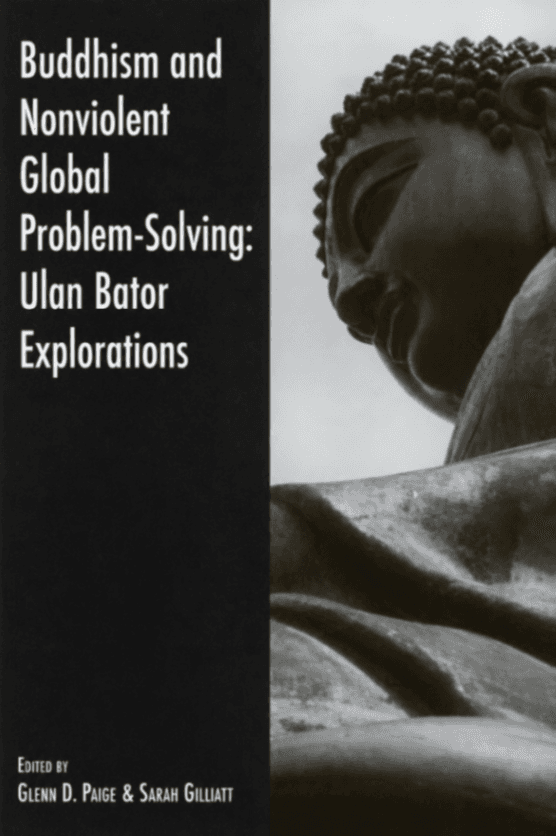
Buddhism and Nonviolent Global Problem-Solving
Glenn D. Paige and Sarah Gilliatt
English
Book
Center for Global Nonviolence, Honolulu, Hawai‘i
2001
180 pages
549 KB
Introduction
The book opens with the background of the Ulan Bator seminar and an opening address that moves from the critique of violence and militarism toward a vision of peaceful cooperation symbolized by the “playful exchange of flowers.” The first major group of essays presents broad perspectives on Buddhism, leadership, scholarship, and action: Sulak Sivaraksa calls for socially engaged Buddhist responses to global crises; Kinhide Mushakoji frames contemporary problems as a crisis of civilization and human values; Johan Galtung proposes a multidimensional peace framework involving military, economic, cultural, and political power; and A. T. Ariyaratne presents the Sri Lankan Sarvodaya movement as a concrete model of Buddhist-inspired nonviolent problem-solving. The second part addresses specific global issues: Thich Minh Chau proposes five principles for a new global moral order; Yoichi Kawada examines karma as a framework for understanding collective responsibility; Yoichi Shikano discusses disarmament from a Mahāyāna Buddhist standpoint; Medagoda Sumanatissa analyzes economic justice through Buddhist egalitarian values; Sulak Sivaraksa reflects on tolerance and diversity of religion and belief; Leslie E. Sponsel and Poranee Natadecha-Sponsel develop the idea of nonviolent ecology; and Baoxu Zhao presents Buddhism as a socially engaged tradition capable of supporting human cooperation. The conclusion synthesizes the seminar’s discussions around disarmament, economic justice, human rights, ecological protection, and global cooperation, affirming nonviolence as both the ethical foundation and the strategic method for Buddhist global problem-solving.
Copyright Notice
This material is provided solely for academic research, study, and religious practice purposes under Article 25 of Vietnam's Intellectual Property Law. Reproduction, distribution, or commercial use is strictly prohibited.
If you are the author, translator, publisher, or rights holder and believe this content has been posted without proper authorization, please contact us and we will promptly review and remove or restrict access.
Documents
Buddhism and Nonviolent Global Problem-Solving
549 KB
Keywords
Buddhism and peacenonviolenceglobal problem-solvingengaged Buddhismdisarmamenteconomic justicenonviolent ecology.
Sách đọc nhiều nhất
The Buddha’s Ancient Path
Piyadassi Thera
Book·10.7 MB
229 pages1979223
The Questions of King Milinda, Part II
F. Max Müller (Editor)
Book·20.8 MB
427 pages1894208

A Taste of Freedom
Venerable Ajahn Chah / Phra Bodhinyana Thera
Book·1.2 MB
104 pages1980207
Buddhist Meditation: An Anthology of Texts from the Pāli Canon
Sarah Shaw (General Editors: Charles S. Prebish and Damien Keown)
Book·17.5 MB
253 pages2006204