
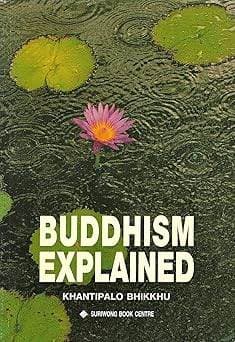
English
Buddhism Explained: An Introduction to the Teachings of Lord Buddha
Bhikkhu Khantipalo
English
Book
The Corporate Body of the Buddha Educational Foundation
201 pages
342.4 MB
Introduction
The book opens with introductory materials explaining the purpose of the volume and the importance of Dhammadāna, the “gift of Truth,” as the highest form of giving. The preface emphasizes that Buddhism is not merely a set of beliefs, but a way of understanding mind and body through direct practice. The author frames Dhamma as something to be discovered in oneself rather than accepted blindly.
Part I: What do Buddhists Believe? presents the doctrinal foundation of Buddhism. It begins with the meaning of Dhamma, the Triple Gem, and the role of faith joined with wisdom. It then offers a narrative account of the life of Gotama Buddha, from birth, renunciation, meditation, awakening, first sermon, teaching career, and final Nirvana. The discussion of refuge in the Buddha and Dhamma introduces the Buddha not as a god, but as the supreme teacher who rediscovered the path to liberation. The doctrinal core of this part explains dukkha, kamma, rebirth, realms of existence, the three roots of evil, the inversions, the three marks of existence, merit-making, perfections, and the Middle Path. The focus is to show that Buddhist belief is not dogmatic, but grounded in experience, ethical causality, and the practical transformation of the mind.
Part II: What do Buddhists Practise? explains the practical dimension of Buddhism. It presents the Saṅgha as the living community that preserves and transmits the Dhamma, while clarifying the relationship between monks, nuns, and lay followers. The section then develops the threefold training of virtue, collectedness, and wisdom. It discusses monastic discipline, lay precepts, giving, renunciation, meditation, mindfulness, divine abidings, patience, energy, and the dangers of mind-training. This part highlights that practice is the operational core of Buddhism: belief must mature into moral discipline, mental cultivation, and direct insight.
Part III: What do Buddhists Realize? turns to the goal of Buddhist practice. It explains supermundane wisdom, the limitation of words, relative and ultimate truth, skilful means, truthfulness, the movement from worldling to noble disciple, and Nirvana. Nirvana is presented not as annihilation, union with God, or a metaphysical abstraction, but as the supreme peace realized through the ending of craving, ignorance, and the causes of dukkha.
The appendices and supporting materials provide additional context on Buddhism in Siam, the Three Refuges and Five Precepts, Buddhist scriptures, glossary, further reading, and index. The footnote section also responds to common misunderstandings, making the book useful as both an introductory guide and a corrective manual for misconceptions about Buddhism.
Copyright Notice
This material is provided solely for academic research, study, and religious practice purposes under Article 25 of Vietnam's Intellectual Property Law. Reproduction, distribution, or commercial use is strictly prohibited.
If you are the author, translator, publisher, or rights holder and believe this content has been posted without proper authorization, please contact us and we will promptly review and remove or restrict access.
Documents
Buddhism Explained: An Introduction to the Teachings of Lord Buddha
342.4 MB
Keywords
BuddhismBhikkhu KhantipaloTriple GemDhammaBuddhist practicekammaNirvana.
Sách đọc nhiều nhất
The Buddha’s Ancient Path
Piyadassi Thera
Book·10.7 MB
229 pages1979223
The Questions of King Milinda, Part II
F. Max Müller (Editor)
Book·20.8 MB
427 pages1894208

A Taste of Freedom
Venerable Ajahn Chah / Phra Bodhinyana Thera
Book·1.2 MB
104 pages1980207
Buddhist Meditation: An Anthology of Texts from the Pāli Canon
Sarah Shaw (General Editors: Charles S. Prebish and Damien Keown)
Book·17.5 MB
253 pages2006204