English
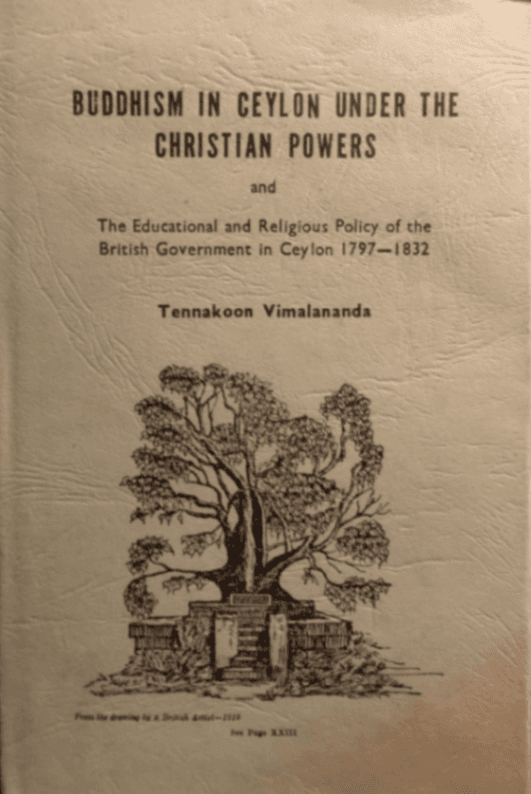
Buddhism in Ceylon under the Christian Powers
Tennakoon Vimalananda
English
Book
M. D. Gunasena & Co. Ltd.; Colombo, Kandy, Galle & Negombo.
1963
190 pages
56.9 MB
Introduction
The book opens by placing Buddhism in Ceylon within the larger history of the Saṅgha, Buddhist missionary activity, the role of Aśoka, the coming of Mahinda, and the establishment of Buddhism as a major cultural and religious force in the island. It then turns to the colonial period, examining how Christian powers attempted to reshape religious life through education, administration, church patronage, missionary activity, and government policy. The core documentary section presents official correspondence and reports concerning religious establishments, schools, Christianity in the maritime provinces, public education, missionary proposals, the appointment of native preachers, relations with Kandy, the condition of schools, Protestant and Catholic institutions, Wesleyan missions, Bible translation, government schools, and the spread of Christian education. Through these materials, the book demonstrates how religious policy and educational policy became strategic instruments of colonial governance, while Buddhist institutions continued to represent the older moral and cultural order of Ceylon.
Copyright Notice
This material is provided solely for academic research, study, and religious practice purposes under Article 25 of Vietnam's Intellectual Property Law. Reproduction, distribution, or commercial use is strictly prohibited.
If you are the author, translator, publisher, or rights holder and believe this content has been posted without proper authorization, please contact us and we will promptly review and remove or restrict access.
Documents
Buddhism in Ceylon under the Christian Powers
56.9 MB
Keywords
Buddhism in CeylonChristian PowersBritish CeylonColonial EducationMissionary PolicySaṅghaTennakoon Vimalananda.
Sách cùng tác giả
Sách đọc nhiều nhất
The Buddha’s Ancient Path
Piyadassi Thera
Book·10.7 MB
229 pages1979223
The Questions of King Milinda, Part II
F. Max Müller (Editor)
Book·20.8 MB
427 pages1894208

A Taste of Freedom
Venerable Ajahn Chah / Phra Bodhinyana Thera
Book·1.2 MB
104 pages1980207
Buddhist Meditation: An Anthology of Texts from the Pāli Canon
Sarah Shaw (General Editors: Charles S. Prebish and Damien Keown)
Book·17.5 MB
253 pages2006204