English
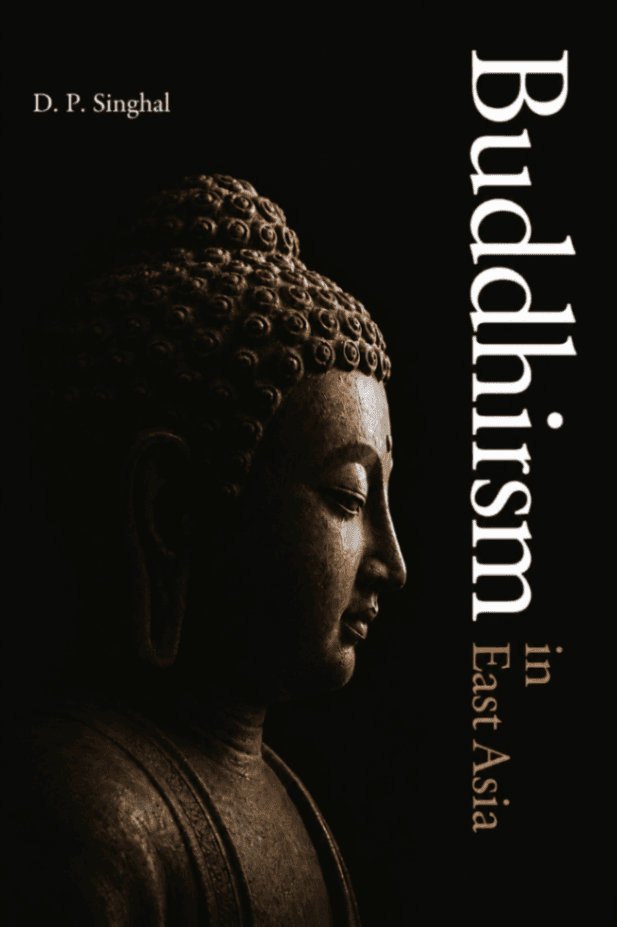
Buddhism in East Asia
D. P. Singhal
English
Book
Books & Books, New Delhi
1984
211 pages
44.1 MB
Introduction
The book is organized into an Introduction and three main chapters. The Introduction presents the basic historical and doctrinal framework of Buddhism, including the life of Gautama Buddha, the Four Noble Truths, the Eightfold Path, the Saṅgha, Buddhist ethics, nirvāṇa, and the later development of Buddhist schools such as Hīnayāna, Mahāyāna, and Tantric Buddhism. Chapter One, “Central Asia,” examines the transmission of Buddhism through the major overland routes linking India with Afghanistan, Khotan, Kashgar, Turfan, Tibet, and other Central Asian regions, with attention to archaeological discoveries, monasteries, manuscripts, art, and the role of trade networks. Chapter Two, “China,” studies the contacts between India and China, the development of Buddhist routes, the arrival of Buddhist monks and texts, translation activity, and the gradual interaction between Buddhism and Chinese cultural traditions. Chapter Three, “Korea and Japan,” follows the further eastward expansion of Buddhism, analyzing how Buddhist institutions, rituals, art, and thought were received and adapted in Korean and Japanese contexts.
Copyright Notice
This material is provided solely for academic research, study, and religious practice purposes under Article 25 of Vietnam's Intellectual Property Law. Reproduction, distribution, or commercial use is strictly prohibited.
If you are the author, translator, publisher, or rights holder and believe this content has been posted without proper authorization, please contact us and we will promptly review and remove or restrict access.
Documents
Buddhism in East Asia
44.1 MB
Keywords
East Asian BuddhismCentral AsiaChinese BuddhismKorean BuddhismJapanese BuddhismBuddhist transmissionBuddhist art.zz
Sách đọc nhiều nhất
The Buddha’s Ancient Path
Piyadassi Thera
Book·10.7 MB
229 pages1979223
The Questions of King Milinda, Part II
F. Max Müller (Editor)
Book·20.8 MB
427 pages1894208

A Taste of Freedom
Venerable Ajahn Chah / Phra Bodhinyana Thera
Book·1.2 MB
104 pages1980207
Buddhist Meditation: An Anthology of Texts from the Pāli Canon
Sarah Shaw (General Editors: Charles S. Prebish and Damien Keown)
Book·17.5 MB
253 pages2006204