English
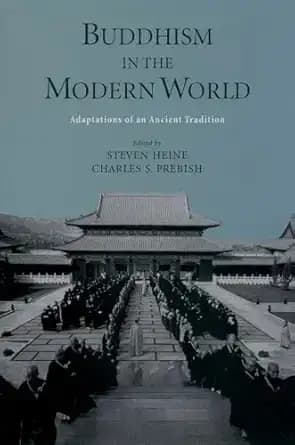
Buddhism in the Modern World: Adaptations of an Ancient Tradition
Steven Heine and Charles S. Prebish
English
Book
Oxford University Press
2001
298 pages
3.0 MB
Introduction
The volume opens with “Introduction: Traditions and Transformations in Modern Buddhism” by Steven Heine and Charles S. Prebish. The introduction frames the central issue of the book: Buddhism has always had to balance preservation of traditional ideals with adaptation to changing social and cultural conditions. The editors identify modernization as a broad process involving scientism, rationalism, secularization, technology, psychotherapy, Marxism, Christian competition, colonialism, nationalism, Westernization, gender issues, social discrimination, medical ethics, environmental concerns, and global cultural exchange. They argue that modern Buddhism should be studied through specific cases of transformation rather than through a simplistic contrast between “pure tradition” and “modern corruption.”
Chapter 1: Aniconism Versus Iconism in Thai Buddhism — Donald K. Swearer
This chapter studies contemporary Thai debates over Buddha images, relics, icons, and amulets. Swearer examines a long-standing Buddhist tension: whether material signs of the Buddha are merely reminders of the Buddha or somehow make the Buddha present. The chapter analyzes image consecration rituals, relic veneration, amulet commerce, and modern critiques by Thai reformers such as Phra Prayudh, Buddhadāsa Bhikkhu, and the Santi Asok movement. Its central insight is that the modern Thai cult of images and amulets is not simply a survival of “primitive” religion; it reflects both ancient devotional patterns and modern commercial, social, and political anxieties.
Chapter 2: The Modernization of Sinhalese Buddhism as Reflected in the Dambulla Cave Temples — Nathan Katz
This chapter examines the Dambulla cave temples in Sri Lanka as a case study in the modernization of Sinhalese Buddhism. Katz traces the temples through multiple historical phases: mythic consecration, meditation cave use, medieval pilgrimage, and modern nationalist reinterpretation. The chapter shows how sacred Buddhist sites can acquire new meanings under colonial and postcolonial conditions. Dambulla is not treated merely as a religious monument, but as a site where memory, kingship, pilgrimage, nationalism, and Buddhist identity are continually reconstructed.
Chapter 3: Varying the Vinaya: Creative Responses to Modernity — Charles S. Prebish
Prebish studies modern adaptations of the Vinaya, especially in Buddhist communities outside Asia. The chapter focuses on how monastic rules concerning clothing, food, work, training, hierarchy, and teaching have been creatively reinterpreted in new social settings. Rather than seeing these changes as simple decline, Prebish argues that modern Buddhist communities often adapt the Vinaya while trying to preserve its wisdom, rigor, and original intent. This chapter is important for research on Western Buddhism, monastic reform, and the tension between discipline and cultural translation.
Chapter 4: Master Hongyi Looks Back: A Modern Man Becomes a Monk in Twentieth-Century China — Raoul Birnbaum
Birnbaum examines the life of Li Shutong, later known as Master Hongyi, a modern Chinese intellectual, artist, and cultural figure who became a Buddhist monk. The chapter explores why a modern, talented, cosmopolitan man would renounce worldly life and enter the monastic path. It uses autobiographical material and reminiscences from those close to him to understand Hongyi’s transition. The chapter also examines Chinese reactions to Hongyi, ranging from shock to admiration, thereby showing how monastic renunciation was reinterpreted in modern Chinese cultural life.
Chapter 5: Transitions in the Practice and Defense of Chinese Pure Land Buddhism — Charles B. Jones
This chapter studies modern transformations in Chinese Pure Land Buddhism. Jones contrasts conservative defense of traditional Pure Land practice, especially associated with Yinguang, with reformist reinterpretations by modern masters such as Taixu and Yinshun, who emphasized the idea of “building a Pure Land on Earth.” The chapter shows how Pure Land Buddhism responded to modern rationalism, social reform, and new forms of Buddhist activism. It is especially useful for understanding the movement from devotional rebirth-oriented practice toward socially engaged and this-worldly Buddhist reform.
Chapter 6: Won Buddhism: The Historical Context of Sot’aesan’s Reformation of Buddhism for the Modern World — Bongkil Chung
Chung presents Won Buddhism, founded by Sot’aesan in Korea, as a modern Buddhist reform movement. The chapter places Won Buddhism in the context of Korean indigenous religions and modern religious reform. It analyzes how Sot’aesan sought to renovate Buddhism for modern society through a synthesis of Confucian ethical concerns and Mahāyāna Buddhist metaphysics. The chapter highlights Won Buddhism as a modern attempt to make Buddhist practice relevant to everyday life, social responsibility, and the realization of the Buddha land in the modern world.
Chapter 7: Abbreviation or Aberration: The Role of the Shushōgi in Modern Sōtō Zen Buddhism — Steven Heine
Heine analyzes the modern Sōtō Zen text Shushōgi, a condensed selection from Dōgen’s Shōbōgenzō. The chapter asks whether the Shushōgi is a legitimate abbreviation of Dōgen’s teaching or a distortion of it. Heine places the text in the context of modern Japanese Buddhism, including anti-Buddhist pressure, lay movements, Christian influence, institutional restructuring, and the effort to create a universal Buddhist self-identity. The chapter is important because it shows how modern institutions can reshape a founder’s writings into a more accessible and ritualized scripture for priests and lay followers.
Chapter 8: “By Imperial Edict and Shogunal Decree”: Politics and the Issue of the Ordination Platform in Modern Lay Nichiren Buddhism — Jacqueline I. Stone
Stone examines modern interpretations of Nichiren Buddhism, especially among lay followers. The chapter considers how Nichiren’s teachings on the earthly Buddha land, Japan’s place in the Buddhist cosmos, and the ordination platform were reinterpreted in relation to nationalism, socialism, postwar peace movements, and modern pluralism. The key issue is how a tradition with strong exclusive truth claims negotiates the modern world’s demand for tolerance, democracy, and religious plurality.
Chapter 9: The Making of the Western Lama — Daniel Cozort
Cozort studies the formation of Western lamas in Tibetan Buddhist organizations, especially the Foundation for the Preservation of the Mahayana Tradition and the New Kadampa Tradition. The chapter compares Western training programs with traditional Tibetan monastic curricula and examines how the role of lama changes in Western contexts. The lama may become not only a religious teacher and object of devotion, but also a therapist, life coach, discussion leader, and spiritual counselor. This chapter is valuable for research on the globalization of Tibetan Buddhism and the transformation of religious authority.
Chapter 10: “Liberate the Mahabodhi Temple!” Socially Engaged Buddhism, Dalit-Style — Tara N. Doyle
The final chapter examines the Mahabodhi Temple at Bodh Gaya as a contested religious and political site. Doyle discusses Buddhist and Hindu claims over the temple, Dalit Buddhist activism, and socially engaged Buddhism in the Indian context. The chapter shows that the modern transformation of Bodh Gaya is not merely devotional, but also legal, economic, political, narrative, and identity-based. It is especially important for studying Ambedkarite/Dalit Buddhism, Buddhist revival in India, sacred site politics, and Buddhist social activism.
The book concludes with an Index, making it useful for academic research and course use. Overall, Buddhism in the Modern World is a high-value scholarly resource for understanding Buddhist modernism across traditions. Its strength lies in showing that modern Buddhism is not one single movement but a field of diverse adaptations: reformist, conservative, nationalist, devotional, institutional, textual, social, and transnational.
Copyright Notice
This material is provided solely for academic research, study, and religious practice purposes under Article 25 of Vietnam's Intellectual Property Law. Reproduction, distribution, or commercial use is strictly prohibited.
If you are the author, translator, publisher, or rights holder and believe this content has been posted without proper authorization, please contact us and we will promptly review and remove or restrict access.
Documents
Buddhism in the Modern World: Adaptations of an Ancient Tradition
3.0 MB
Keywords
Buddhist ModernismModern BuddhismAdaptationAsian BuddhismSocially Engaged Buddhism.
Sách đọc nhiều nhất
The Buddha’s Ancient Path
Piyadassi Thera
Book·10.7 MB
229 pages1979223
The Questions of King Milinda, Part II
F. Max Müller (Editor)
Book·20.8 MB
427 pages1894208

A Taste of Freedom
Venerable Ajahn Chah / Phra Bodhinyana Thera
Book·1.2 MB
104 pages1980207
Buddhist Meditation: An Anthology of Texts from the Pāli Canon
Sarah Shaw (General Editors: Charles S. Prebish and Damien Keown)
Book·17.5 MB
253 pages2006204