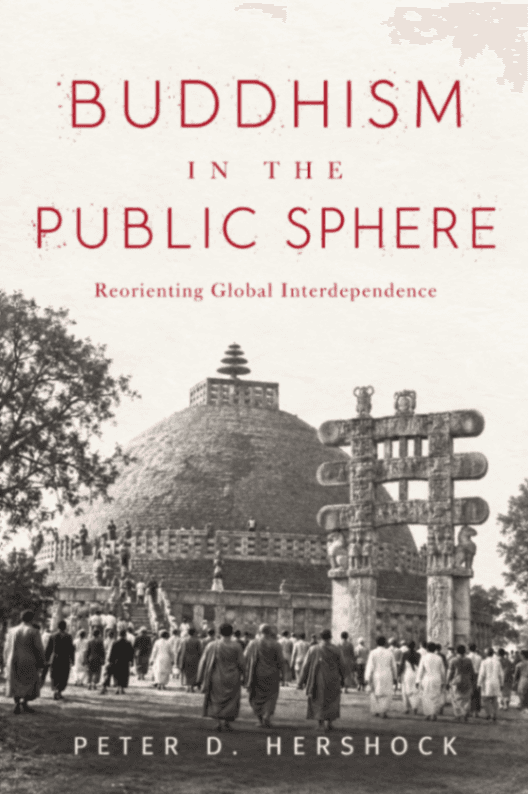
Buddhism in the Public Sphere: Reorienting Global Interdependence
Introduction
The book develops this argument across a wide range of contemporary issues. It examines environmental ethics, health and healthcare, global trade and development, technology and mass media, governance, religion and politics, international relations, terrorism, and education. Hershock consistently shifts attention away from isolated agents, fixed identities, and purely individual rights toward patterns of relationship, mutual contribution, situational responsibility, and the qualitative direction of interdependence. In the environmental discussion, for example, liberation is framed not merely as conservation but as transforming relational patterns so that ecological systems become more contributory and mutually sustaining. In the chapters on trade and technology, the author critiques consumerism, commodification, control-oriented technologies, and the erosion of relational quality.
Three ideas are especially important. First, dependent origination (pratītya-samutpāda) reframes reality in relational rather than substantial terms. Second, karma is treated not merely as a doctrine of personal moral causation but as a way of understanding how patterns of values, intentions, and actions condition present and future possibilities. Third, emptiness (śūnyatā) undermines rigid assumptions about fixed identities and independent existence. Together, these principles support a form of “engaged Buddhism” capable of entering public debates without reducing Buddhist practice to ideology or policy prescription.
The central thesis is that Buddhist practice can function publicly not by imposing religious doctrine, but by helping societies revise entrenched patterns of values, intentions, actions, and institutions. The book therefore presents Buddhism as a critical and constructive resource for cultivating diversity, equity, cooperation, appreciative interdependence, and forms of public good appropriate to a globally interconnected world.
Main Headings:
Liberating Environments
Health and Healing: Relating the Personal and the Public
Trade, Development, and the Possibility of Post-Market Economics
Technology, Media, and the Colonization of Consciousness
Governance Cultures and Countercultures: Religion, Politics, and Public Good
Diversity as Commons: International Relations beyond Competition and Cooperation
From Vulnerability to Virtuosity: Responding to the Realities of Global Terrorism
Educating for Virtuosity
Copyright Notice
This material is provided solely for academic research, study, and religious practice purposes under Article 25 of Vietnam's Intellectual Property Law. Reproduction, distribution, or commercial use is strictly prohibited.
If you are the author, translator, publisher, or rights holder and believe this content has been posted without proper authorization, please contact us and we will promptly review and remove or restrict access.
Documents
Buddhism in the Public Sphere: Reorienting Global Interdependence
85.0 MB
Keywords
Sách cùng tác giả
Sách đọc nhiều nhất
The Buddha’s Ancient Path
Piyadassi Thera
The Questions of King Milinda, Part II
F. Max Müller (Editor)

A Taste of Freedom
Venerable Ajahn Chah / Phra Bodhinyana Thera
Buddhist Meditation: An Anthology of Texts from the Pāli Canon
Sarah Shaw (General Editors: Charles S. Prebish and Damien Keown)