
English
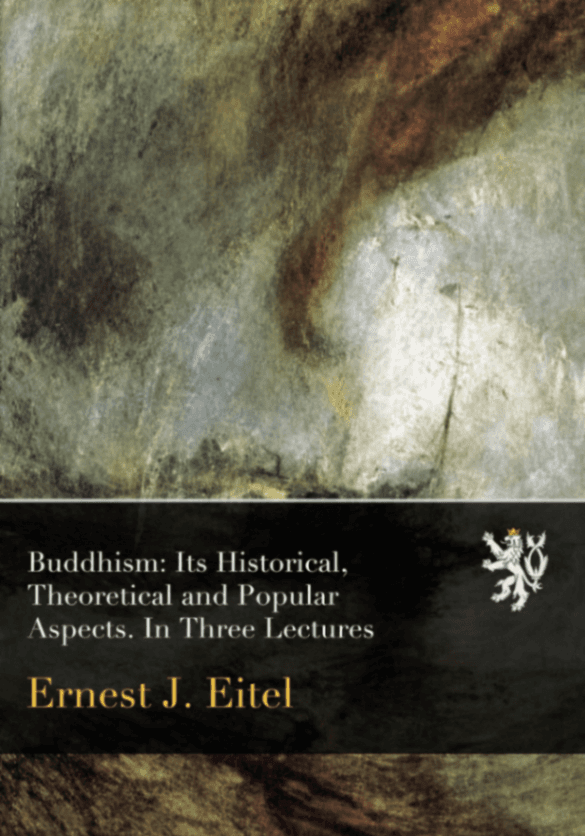
Buddhism: Its Historical, Theoretical and Popular Aspects
Ernest J. Eitel, Ph.D.
English
Book
Trübner & Co., London
1884
166 pages
7.4 MB
Introduction
The work is organized into three major lectures. Lecture I, “Buddhism, an Event in History,” examines the magnitude and importance of Buddhism, its historical and legendary origins, the life of Śākyamuni Gautama Buddha, the formation of the Buddhist canon and Church, Buddhist missions, the division between Southern and Northern Buddhism, the introduction and expansion of Buddhism in China, Tibet, and other regions, and the historical value of Buddhism. Lecture II, “Buddhism, a Theoretical System,” analyzes Buddhist doctrine through its dogmatic development, summary teachings, theory of the physical world, metempsychosis, ethics, philosophy, and Nirvāṇa, presenting Buddhism as an intellectual and metaphysical structure. Lecture III, “Buddhism, a Popular Religion,” explores Buddhism as lived and practiced by communities, discussing its truths and defects, popular forms in Southern and Northern traditions, objects of worship, devotional figures, monastic interiors, polytheistic and monotheistic tendencies, Buddhist notions of atonement, and the author’s concluding evaluation of Buddhism as both a philosophical and religious system.
Copyright Notice
This material is provided solely for academic research, study, and religious practice purposes under Article 25 of Vietnam's Intellectual Property Law. Reproduction, distribution, or commercial use is strictly prohibited.
If you are the author, translator, publisher, or rights holder and believe this content has been posted without proper authorization, please contact us and we will promptly review and remove or restrict access.
Documents
Buddhism: Its Historical, Theoretical and Popular Aspects
7.4 MB
Keywords
Buddhist historyBuddhist doctrinePopular BuddhismŚākyamuni GautamaNirvāṇaNorthern BuddhismSouthern Buddhism.
Sách đọc nhiều nhất
The Buddha’s Ancient Path
Piyadassi Thera
Book·10.7 MB
229 pages1979223
The Questions of King Milinda, Part II
F. Max Müller (Editor)
Book·20.8 MB
427 pages1894208

A Taste of Freedom
Venerable Ajahn Chah / Phra Bodhinyana Thera
Book·1.2 MB
104 pages1980207
Buddhist Meditation: An Anthology of Texts from the Pāli Canon
Sarah Shaw (General Editors: Charles S. Prebish and Damien Keown)
Book·17.5 MB
253 pages2006204