English
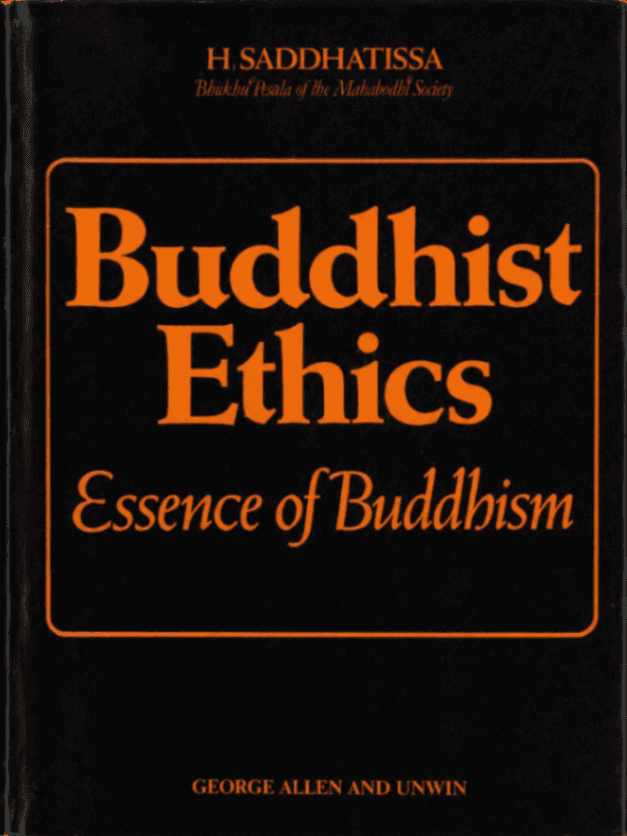
Buddhist Ethics: Essence of Buddhism
H. Saddhatissa, M.A., Ph.D.
English
Book
George Allen & Unwin Ltd, London.
1970
104 pages
222.6 MB
Introduction
Buddhist Ethics: Essence of Buddhism presents a comprehensive study of Buddhist moral thought as an essential dimension of the Buddhist path. The book does not treat ethics merely as a set of social rules or abstract moral principles, but places morality within the broader framework of Buddhist doctrine, practice, and liberation. Beginning with a discussion of the meaning and scope of ethics, the author situates Buddhist ethical thought against the background of Indian religious and philosophical developments in the sixth century BCE, while also engaging comparative perspectives from Western moral philosophy. The work then moves into the doctrinal foundations of Buddhist ethics by examining the enlightenment of the Buddhas, the life and teaching of Gotama Buddha, dependent origination, the doctrine of non-self, the three characteristics of existence, and the significance of the Buddha as a guide to moral and spiritual transformation. A central concern of the book is the Three Refuges—Buddha, Dhamma, and Saṅgha—which are presented not only as acts of devotion but as the structural basis for Buddhist ethical commitment. Within this framework, the author explains the role of sīla, samādhi, and paññā, the Noble Eightfold Path, and the importance of the Vinaya, Sutta, and Abhidhamma Piṭakas in shaping Buddhist moral understanding. The discussion of the Five Precepts, Eight Precepts, and Ten Precepts shows how Buddhist morality functions as a practical discipline for purifying conduct, training the mind, and supporting progress toward wisdom. The book also gives substantial attention to the ethical life of lay Buddhists, including duties toward parents, children, spouses, friends, teachers, pupils, servants, workers, and society at large. By extending Buddhist ethics into family, livelihood, social responsibility, and the relation between the individual and the state, Saddhatissa demonstrates that Buddhist morality is both personal and social. The final part of the work turns toward the ultimate goal of Buddhist practice, explaining Nibbāna as the culmination of moral discipline, mental cultivation, and insight. In this way, the book offers both an introduction to Buddhist ethical principles and a systematic account of how morality, meditation, wisdom, and liberation are integrated within the Buddhist path.
Copyright Notice
This material is provided solely for academic research, study, and religious practice purposes under Article 25 of Vietnam's Intellectual Property Law. Reproduction, distribution, or commercial use is strictly prohibited.
If you are the author, translator, publisher, or rights holder and believe this content has been posted without proper authorization, please contact us and we will promptly review and remove or restrict access.
Documents
Buddhist Ethics: Essence of Buddhism
222.6 MB
Keywords
Buddhist ethicsSīlaFive PreceptsThree RefugesNibbānaBuddhist moralityLay Buddhist practice.
Sách đọc nhiều nhất
The Buddha’s Ancient Path
Piyadassi Thera
Book·10.7 MB
229 pages1979223
The Questions of King Milinda, Part II
F. Max Müller (Editor)
Book·20.8 MB
427 pages1894208

A Taste of Freedom
Venerable Ajahn Chah / Phra Bodhinyana Thera
Book·1.2 MB
104 pages1980207
Buddhist Meditation: An Anthology of Texts from the Pāli Canon
Sarah Shaw (General Editors: Charles S. Prebish and Damien Keown)
Book·17.5 MB
253 pages2006204