English
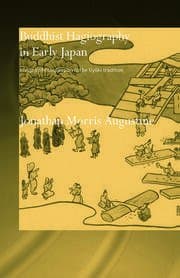
Buddhist Hagiography in Early Japan: Images of Compassion in the Gyōki Tradition
Jonathan Morris Augustine
English
Book
Routledge Curzon, London and New York.
2005
182 pages
1.6 MB
Introduction
The book opens with an Introduction: The Bodhisattva Gyōki in the Broader Hagiographic Context. Augustine situates Gyōki within comparative studies of hagiography, explaining that Buddhist hagiographies, like Christian saints’ lives, combine historical memory, devotion, miracle, moral exemplarity, and institutional agenda. The introduction emphasizes that Japan did not possess a formal canonization process like medieval Christianity; nevertheless, emperors, monks, ascetics, and compassionate figures could be venerated as bodhisattvas. Gyōki is introduced as a particularly complex case: he was initially condemned as a renegade monk under the Nara court’s monastic regulations, yet later became revered as a bodhisattva because of his bridges, dikes, irrigation canals, orphanages, roadside shelters, and temples.
The introduction also explains the book’s methodological frame. Augustine is not merely reconstructing the historical Gyōki; he is studying the changing images of Gyōki across time. The introduction includes sections on The subject matter of Buddhist hagiography, Popular veneration, Primary sources, and Organization. The author also highlights the importance of fuse, derived from Sanskrit dāna, as Buddhist giving or charity. In Gyōki’s case, roadside shelters were called fuseya, “houses where one performed acts of fuse,” making the study directly relevant to Buddhist charitable practice and the social expression of compassion.
Chapter 1: The Received Biography of Gyōki
This chapter analyzes how the standard modern biography of Gyōki was constructed from multiple layers of historical and legendary materials. Augustine identifies key elements: Gyōki’s Korean ancestral background, ordination, ambiguous monastic status, mountain asceticism, violation of court regulations, charitable projects, involvement in the Vairocana Buddha project, and eventual promotion to the highest monastic office. The chapter discusses Western scholarship, ancestral lineage, ordination, education, asceticism, the imperial edict against Gyōki, construction projects, and his final relationship with the Vairocana project. It shows that what appears today as Gyōki’s “received biography” is not a simple historical record but the result of centuries of textual accumulation and reinterpretation.
Chapter 2: The Bodhisattva Tradition and the Hagiographer’s Craft
This chapter examines how Gyōki came to be understood as a bodhisattva within Japanese Buddhist tradition. Augustine discusses the bodhisattva tradition in Japan, Gyōki’s place in hagiographic studies, his chronology from 668 to 749, the earliest texts about him, medieval hagiography, and the reliability of the Gyōki nenpu. The chapter is important because it explains how hagiographers transformed charitable labor, social welfare, preaching, and miraculous charisma into evidence of bodhisattva status. It also clarifies the difference between early records and later medieval biographies.
Chapter 3: Gyōki and the Sōniryō: Violations of Early Monastic Regulations in Japan
This chapter studies Gyōki’s relationship to the Sōniryō, the laws governing monks and nuns in early Japan. Augustine first explains the establishment of the Sōniryō, then discusses its interpretation, punishments, the monastic power structure, and how some monks avoided punishment. Gyōki’s activities were problematic because official monks were expected to remain within temple institutions and serve the state through ritual, whereas Gyōki moved among the people, preached, organized followers, and conducted construction projects. The chapter shows that Gyōki’s career reveals the limitations of Nara state control over the Buddhist monastic community.
Chapter 4: Gyōki and the Politics of the Nara Court
This chapter places Gyōki within the political environment of the Nara period and the ritsuryō state. Augustine discusses the rise of Gyōki’s charitable activities, the court’s movement from condemnation to toleration, Emperor Shōmu’s wanderings, Gyōki’s projects, and the Vairocana Buddha project. The chapter shows that Gyōki’s career coincided with political instability, rebellions, epidemics, poverty, and heavy burdens placed on peasants and laborers. His projects can therefore be read as both religious compassion and a practical response to social distress. The Vairocana project becomes a key issue because Gyōki, once regarded as suspicious by the court, was later incorporated into an imperial Buddhist project.
Chapter 5: Gyōki’s Charitable Projects
This chapter is central for research on Buddhist charity and social welfare. Augustine examines the possible influences behind Gyōki’s charitable activities, the Buddhist concept of the field of merit, charitable works before Gyōki, and charitable projects after Gyōki. Gyōki is associated with temples, bridges, dikes, ponds, irrigation canals, orphanages, and roadside shelters. The chapter argues that although Gyōki’s activities were exceptional in scale, he was not entirely without precedent; continental Buddhist models, Hossō mentors, Buddhist commentaries, and earlier construction projects may have influenced his work. The chapter also situates his activities within a broader Buddhist economy of merit, compassion, and public benefit.
Chapter 6: Gyōki and Further Developments in Buddhist Hagiography
This chapter traces the later development of Gyōki biographies. Augustine discusses Gyōki’s ancestry, fragmented accounts in the Nihon ryōiki, the proliferation of hagiography, the longest biography, the monk Chikō who condemned Gyōki, and the rediscovery of Gyōki’s grave. The chapter explains how Gyōki’s image expanded after his death: he became a miracle worker, living bodhisattva, incarnation of Mañjuśrī, Pure Land figure, poet, compassionate builder, and object of local veneration. This chapter demonstrates how hagiography preserved memory while also reshaping it according to later religious, institutional, and social needs.
The Conclusion returns to the implications of Gyōki’s bodhisattva title and proposes new directions for research. Augustine argues that Gyōki’s case challenges overly simple descriptions of early Japanese Buddhism as merely state-controlled. His life and posthumous image show a more dynamic religious field: official Buddhism, unauthorized monks, local communities, charitable labor, court politics, miracle tales, and bodhisattva devotion all interacted in complex ways. Gyōki’s hagiographic transformation reveals how compassion could become a historical force, a religious ideal, and a literary image.
The book ends with an Appendix, Glossary of Japanese terms, Notes, Bibliography, and Index. These supporting sections make the volume useful for advanced research on Nara Buddhism, Japanese hagiography, Buddhist social welfare, monastic regulation, and the bodhisattva ideal.
Copyright Notice
This material is provided solely for academic research, study, and religious practice purposes under Article 25 of Vietnam's Intellectual Property Law. Reproduction, distribution, or commercial use is strictly prohibited.
If you are the author, translator, publisher, or rights holder and believe this content has been posted without proper authorization, please contact us and we will promptly review and remove or restrict access.
Documents
Buddhist Hagiography in Early Japan Images of Compassion in the Gyōki Tradition
1.6 MB
Keywords
GyōkiBuddhist HagiographyNara BuddhismBuddhist CharityBodhisattva Tradition.
Sách đọc nhiều nhất
The Buddha’s Ancient Path
Piyadassi Thera
Book·10.7 MB
229 pages1979223
The Questions of King Milinda, Part II
F. Max Müller (Editor)
Book·20.8 MB
427 pages1894208

A Taste of Freedom
Venerable Ajahn Chah / Phra Bodhinyana Thera
Book·1.2 MB
104 pages1980207
Buddhist Meditation: An Anthology of Texts from the Pāli Canon
Sarah Shaw (General Editors: Charles S. Prebish and Damien Keown)
Book·17.5 MB
253 pages2006204