English
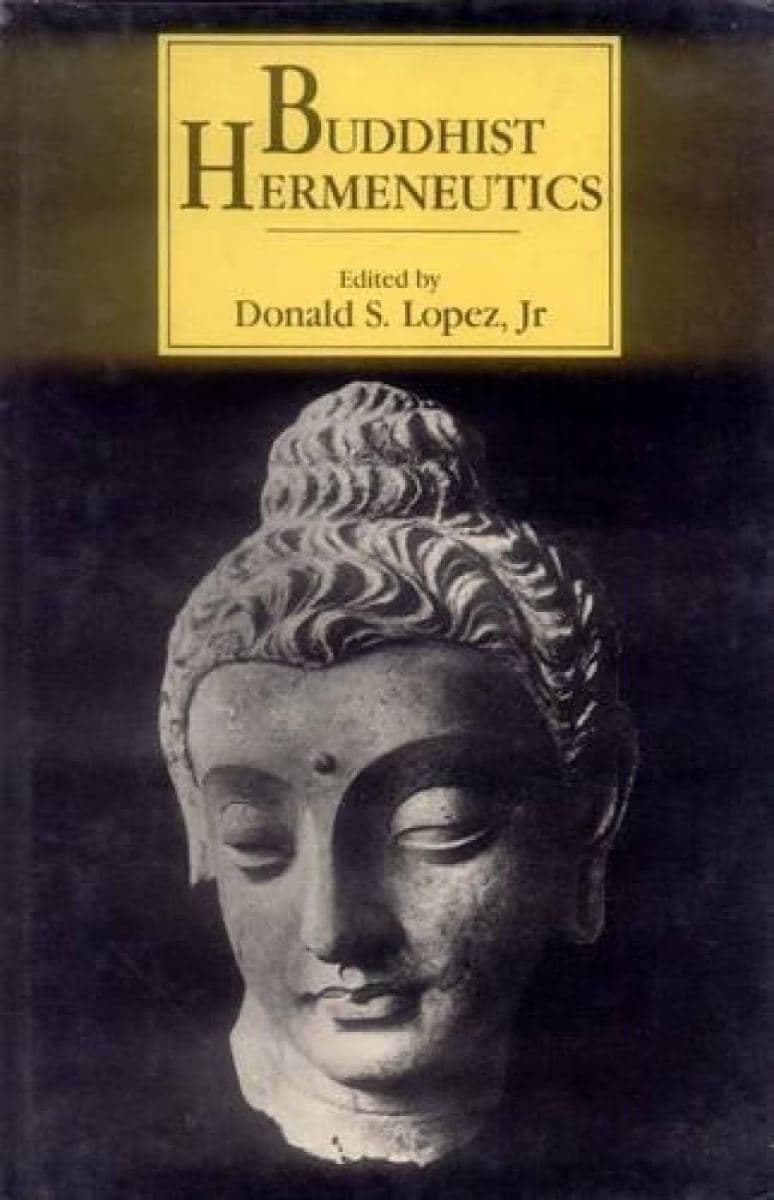
Buddhist Hermeneutics
Donald S. Lopez, Jr.
English
Book
University of Hawai‘i Press
1986
293 pages
18.4 MB
Introduction
The introduction frames Buddhist hermeneutics around a central question: after the Buddha’s death, where does authority reside and how should his teaching be interpreted? Lopez explains that Buddhism developed a vast canon and many doctrinal systems, making interpretation necessary for reconciling different teachings. Key interpretive principles include relying on the teaching rather than the teacher, the meaning rather than the letter, definitive meaning rather than provisional meaning, and wisdom rather than ordinary consciousness.
The chapters proceed through major Buddhist traditions and interpretive frameworks: Étienne Lamotte discusses textual assessment in Buddhism; George D. Bond treats the gradual path as a hermeneutical approach; Lopez examines Mahāyāna sūtras; Michael M. Broido studies tantric interpretation; Robert A. F. Thurman discusses Vajra hermeneutics; Matthew Kapstein analyzes Mi-pham; David W. Chappell, Peter N. Gregory, and Robert E. Buswell explore Chinese, Hua-yen, and Korean Ch’an hermeneutics; Thomas P. Kasulis presents Kūkai’s theory of interpretation; and Roger Tashi Corless concludes with Shinran’s “proofs” of true Buddhism.
Copyright Notice
This material is provided solely for academic research, study, and religious practice purposes under Article 25 of Vietnam's Intellectual Property Law. Reproduction, distribution, or commercial use is strictly prohibited.
If you are the author, translator, publisher, or rights holder and believe this content has been posted without proper authorization, please contact us and we will promptly review and remove or restrict access.
Documents
Buddhist Hermeneutics
18.4 MB
Keywords
Buddhist hermeneuticsDonald S. Lopez Jr.Scriptural interpretationUpāyaDefinitive meaningProvisional meaningMahāyāna sūtrasVajrayānaHua-yenCh’an Buddhism.
Sách cùng tác giả
Sách đọc nhiều nhất
The Buddha’s Ancient Path
Piyadassi Thera
Book·10.7 MB
229 pages1979223
The Questions of King Milinda, Part II
F. Max Müller (Editor)
Book·20.8 MB
427 pages1894208

A Taste of Freedom
Venerable Ajahn Chah / Phra Bodhinyana Thera
Book·1.2 MB
104 pages1980207
Buddhist Meditation: An Anthology of Texts from the Pāli Canon
Sarah Shaw (General Editors: Charles S. Prebish and Damien Keown)
Book·17.5 MB
253 pages2006204