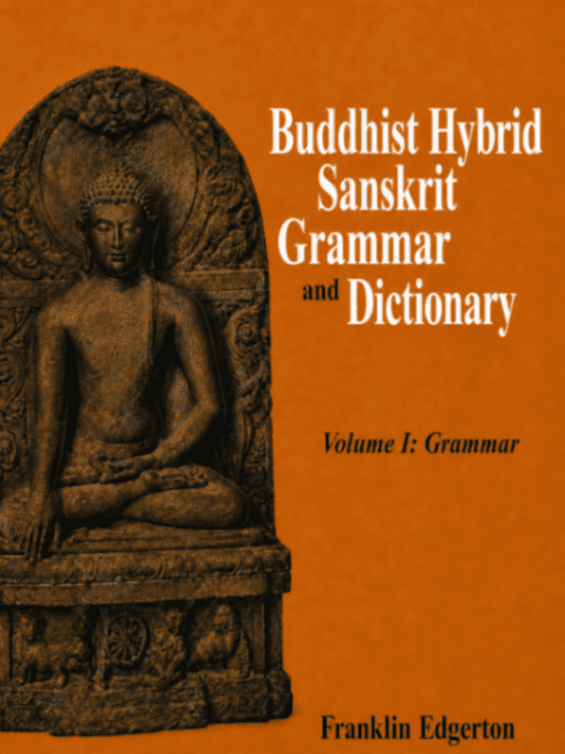
Buddhist Hybrid Sanskrit Grammar and Dictionary, Volume 1: Grammar
Introduction
The central premise of the volume is that Buddhist Hybrid Sanskrit must be studied as a historically conditioned linguistic system rather than judged exclusively according to Classical Sanskrit norms. Edgerton notes that Buddhist Sanskrit texts display different degrees of Sanskritization: some remain relatively close to Middle Indo-Aryan linguistic structures, while others exhibit much stronger Classical Sanskrit influence. The resulting language is therefore “hybrid” not because it represents random grammatical corruption, but because its texts preserve overlapping strata of Middle Indo-Aryan and Sanskrit linguistic development.
Edgerton’s method is fundamentally philological and comparative. He evaluates manuscript variants, parallel passages, metrically conditioned forms, textual traditions, and evidence from related Indo-Aryan languages before determining the grammatical status of a form. He also explains that the Grammar and Dictionary were conceived as complementary works: the Grammar analyzes recurrent linguistic patterns, while the Dictionary records lexical forms and meanings, with extensive cross-reference between the two. The bibliography and abbreviations further demonstrate the breadth of textual sources used, encompassing major Buddhist Sanskrit works and comparative Sanskrit, Pāli, and Prākrit scholarship.
Table of Contents
Preface
Bibliography and Abbreviations
Introduction
Phonology, Consonants
Phonology, Vowels
Sandhi
Number
Gender
Case
a-stems
Feminines in ā
i- and u-stems
Feminines in ī and ū
ṛ-stems
Consonant Stems
Participles, Including Gerundives
Feminines
-ka
-vant and -mant
Personal Pronouns
Generic Pronouns
Noun Suffixes
Suffixes of Secondary Derivation
Compounds
Person and Number
Personal Endings
Summary Classification of Non-Sanskritic Presents
Present
Optative
Imperative
Future and Conditional
Aorist, or Preterite
Perfect
Participles, Including Gerundives
Gerund
Infinitive
Voice
Stems in -aya: Causative and Denominative
Intensive
Desiderative
Periphrastic Addenda to the Verb
Syntax of Verb Forms
Synopsis of Verb Forms
Copyright Notice
This material is provided solely for academic research, study, and religious practice purposes under Article 25 of Vietnam's Intellectual Property Law. Reproduction, distribution, or commercial use is strictly prohibited.
If you are the author, translator, publisher, or rights holder and believe this content has been posted without proper authorization, please contact us and we will promptly review and remove or restrict access.
Documents
Buddhist Hybrid Sanskrit Grammar and Dictionary, Volume 1: Grammar
42.8 MB
Series: Buddhist Hybrid Sanskrit Grammar and Dictionary
Select a volume to see details or navigate between parts.
Buddhist Hybrid Sanskrit Grammar and Dictionary, Volume 1: Grammar
Keywords
Sách đọc nhiều nhất
The Buddha’s Ancient Path
Piyadassi Thera
The Questions of King Milinda, Part II
F. Max Müller (Editor)
A Taste of Freedom
Venerable Ajahn Chah / Phra Bodhinyana Thera
Buddhist Meditation: An Anthology of Texts from the Pāli Canon
Sarah Shaw (General Editors: Charles S. Prebish and Damien Keown)