
English
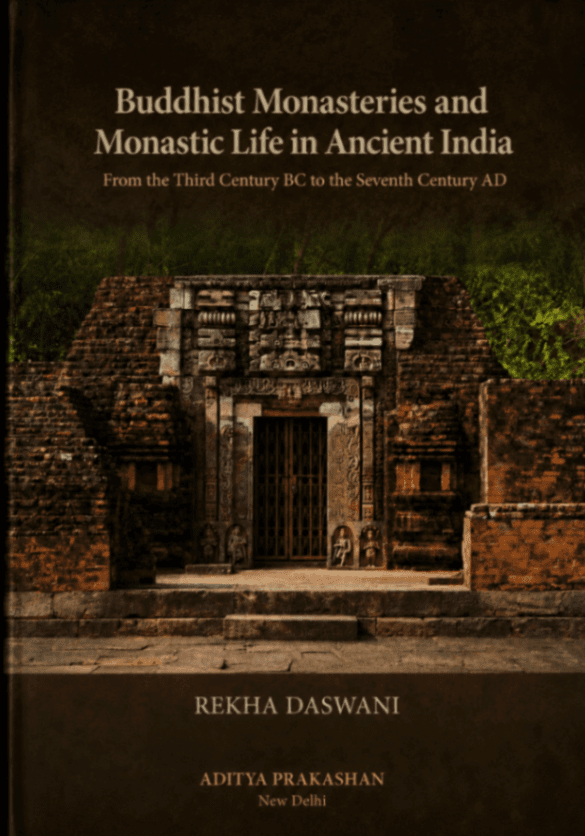
Buddhist Monasteries and Monastic Life in Ancient India: From the 3rd Century BC to the 7th Century AD
Rekha Daswani
English
Book
Aditya Prakashan, New Delhi
2006
170 pages
15.6 MB
Introduction
The work begins by distinguishing asceticism as an individual spiritual discipline from monasticism as its organized social expression. It situates Buddhist monasticism within the broader Śramaṇa movement and explores the possible pre-Vedic and pre-Aryan origins of wandering mendicancy in India. The study then follows the institutionalization of the Buddhist community, showing how shared beliefs, discipline, ordination, and communal residence created a stable religious order.
The subsequent analysis focuses on sectarian development, internal monastic life, education, social relations, merit-making, royal patronage, and architecture. The book demonstrates that Buddhist monasteries were not isolated centres of renunciation alone; they became influential institutions of religion, scholarship, social exchange, economic support, and cultural transmission. Through literary, epigraphic, archaeological, and travel-account evidence, the study presents Buddhist monasticism as a dynamic institution continuously adapting to changing historical conditions.
Copyright Notice
This material is provided solely for academic research, study, and religious practice purposes under Article 25 of Vietnam's Intellectual Property Law. Reproduction, distribution, or commercial use is strictly prohibited.
If you are the author, translator, publisher, or rights holder and believe this content has been posted without proper authorization, please contact us and we will promptly review and remove or restrict access.
Documents
Buddhist Monasteries and Monastic Life in Ancient India: From the 3rd Century BC to the 7th Century AD
15.6 MB
Keywords
Buddhist monasticismVinayaBuddhist educationmonastic architectureancient Indiaepigraphic evidence.
Sách đọc nhiều nhất
The Buddha’s Ancient Path
Piyadassi Thera
Book·10.7 MB
229 pages1979223
The Questions of King Milinda, Part II
F. Max Müller (Editor)
Book·20.8 MB
427 pages1894208

A Taste of Freedom
Venerable Ajahn Chah / Phra Bodhinyana Thera
Book·1.2 MB
104 pages1980207
Buddhist Meditation: An Anthology of Texts from the Pāli Canon
Sarah Shaw (General Editors: Charles S. Prebish and Damien Keown)
Book·17.5 MB
253 pages2006204