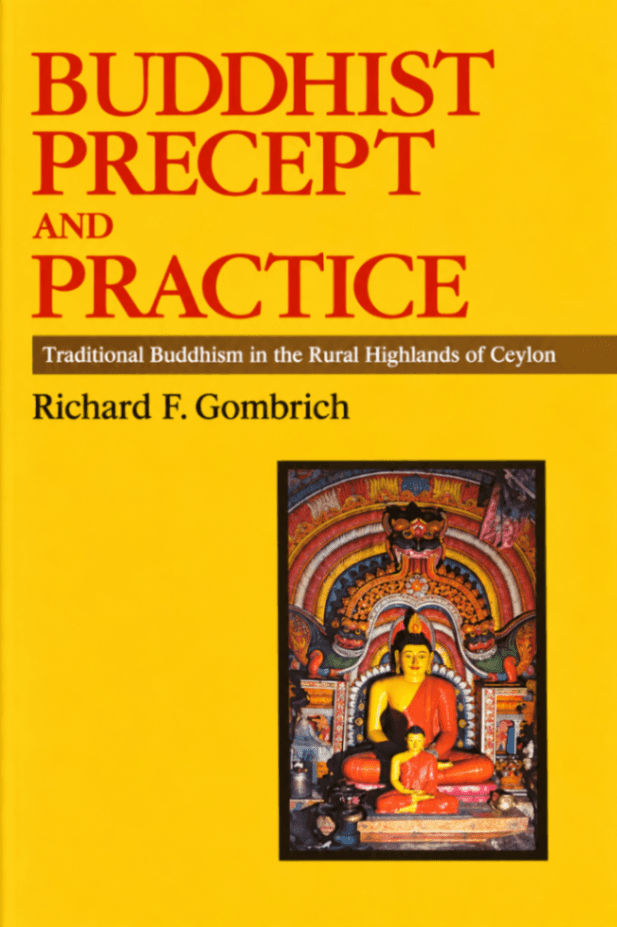
Buddhist Precept and Practice: Traditional Buddhism in the Rural Highlands of Ceylon
Introduction
Buddhist Precept and Practice is a foundational study of lived Theravāda Buddhism that seeks to understand Sinhalese Buddhist religion from within the relationship between canonical teaching and actual social practice. Based primarily on fieldwork in villages of the Kandyan highlands, supplemented by Pāli textual study and the historical literature of Sri Lanka, Richard F. Gombrich investigates how Buddhist doctrines are interpreted, transmitted, and embodied in everyday life. The work challenges the methodological assumption that departures from a textual norm should automatically be classified as degeneration or syncretism. Instead, it asks how Buddhists themselves organize seemingly diverse beliefs concerning the Buddha, gods, karma, merit, morality, intention, monasticism, and nirvāṇa within a coherent religious worldview. This approach makes the book particularly significant for the anthropology of Buddhism, Theravāda studies, Buddhist ethics, and the study of the relationship between normative doctrine and lived religion.
The book begins with an extensive methodological introduction discussing religious change, the reasons for selecting Ceylon as the field of study, the island’s historical, geographical, and economic background, and the author’s fieldwork methodology. Gombrich distinguishes between what religious adherents say they believe, how they behave, and the conceptual systems through which they understand their world. He argues for an empirical study of religion that takes seriously both doctrinal traditions and the interpretations of actual practitioners.
A central issue is whether Sinhalese Buddhism should be characterized as orthodox or syncretistic. Gombrich questions earlier interpretations that describe village Buddhism as a corrupt mixture of Buddhism, Hinduism, and animism. His analysis suggests that the presence of gods and other supernatural beings in Sinhalese religious life does not necessarily contradict Buddhist doctrine. Such beings may be acknowledged within a Buddhist cosmological hierarchy without occupying the soteriological position of the Buddha or undermining the central Buddhist teachings concerning karma, rebirth, and nirvāṇa.
The study then examines the basic vocabulary of Buddhism, showing how doctrinal concepts are understood by ordinary Buddhists rather than assuming that canonical definitions automatically correspond to popular understanding. Gombrich pays particular attention to the Buddha: his traditional biography, his status after parinirvāṇa, and the question of whether Sinhalese Buddhists understand him as a human teacher, transcendent being, or object of devotional worship.
Another substantial section reconstructs the Buddhist universe as perceived from a Sinhalese village, covering causation, cosmology, supernatural beings, gods, spirits, and attempts to influence non-human beings. This material demonstrates how canonical cosmology interacts with ritual, local tradition, and everyday religious experience.
The later chapters turn increasingly toward Buddhist ethics. “Total Responsibility in Theory and Practice” investigates karma and personal moral responsibility, while “The Ethics of Intention” examines the fundamental Buddhist principle that the moral quality of an action depends significantly upon cetanā—intention. This analysis connects doctrinal ethics with concrete Sinhalese attitudes toward merit, morality, ritual, and social conduct.
Gombrich also examines the monastic ideal and the historical condition of Buddhism, asking how the ideal of renunciation functions within actual social institutions. The chapter on caste in the monastery explores the interaction between Buddhist universalism and the historically embedded caste organization of the Sri Lankan Saṅgha. The concluding discussion returns to the larger problem of continuity and transformation: how a religious tradition can remain recognizably Theravāda Buddhist while continually adapting to historical, social, and cultural circumstances.
Copyright Notice
This material is provided solely for academic research, study, and religious practice purposes under Article 25 of Vietnam's Intellectual Property Law. Reproduction, distribution, or commercial use is strictly prohibited.
If you are the author, translator, publisher, or rights holder and believe this content has been posted without proper authorization, please contact us and we will promptly review and remove or restrict access.
Documents
Buddhist Precept and Practice: Traditional Buddhism in the Rural Highlands of Ceylon
129.9 MB
Keywords
Sách cùng tác giả
Sách đọc nhiều nhất
The Buddha’s Ancient Path
Piyadassi Thera
The Questions of King Milinda, Part II
F. Max Müller (Editor)

A Taste of Freedom
Venerable Ajahn Chah / Phra Bodhinyana Thera
Buddhist Meditation: An Anthology of Texts from the Pāli Canon
Sarah Shaw (General Editors: Charles S. Prebish and Damien Keown)