
English
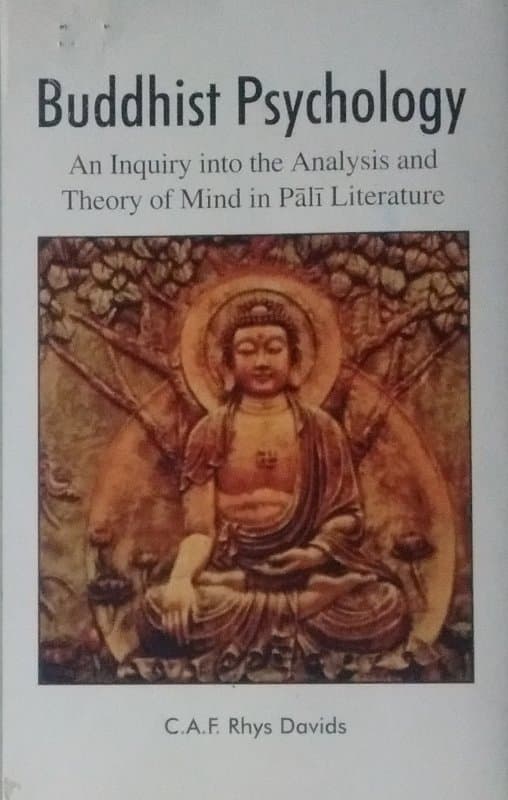
Buddhist Psychology: An Inquiry into the Analysis and Theory of Mind in Pali Literature
Mrs. C. A. F. Rhys Davids, M.A.
English
Book
G. Bell and Sons Ltd., London.
1914
228 pages
4.1 MB
Introduction
Buddhist Psychology investigates the Buddhist understanding of mind as preserved in Pāli literature, with special attention to Early Buddhism and the Theravāda tradition. The work is built on the premise that Buddhism cannot be adequately understood only as a moral reform, a religious movement, or a doctrine of salvation. It must also be studied as a sophisticated analysis of mental life. Rhys Davids emphasizes that Buddhist philosophy and religious practice rest upon a psychological foundation: the observation, classification, and ethical evaluation of consciousness and its associated mental states.
The book begins by drawing attention to the difference between Western and Buddhist “habits of thought.” Western philosophical traditions often approach mind through categories such as substance, essence, unity, and universality. Buddhist thought, by contrast, tends to analyze experience as a stream of conditioned events, processes, and mental factors. This difference is crucial for understanding Buddhist psychology. The Buddhist thinker is less concerned with defining a permanent soul or metaphysical substance than with examining how consciousness arises, changes, functions, and ceases under specific conditions.
A central focus of the work is the psychology of the Nikāyas. Rhys Davids examines key Pāli terms for mind and consciousness, especially citta, mano, and viññāṇa, showing how these terms overlap yet carry different emphases in Buddhist analysis. Mind is presented not as an enduring entity, but as a series of conditioned mental events. Consciousness arises in dependence upon causes, such as sense-organ, sense-object, and appropriate conditions. This view supports the broader Buddhist doctrines of impermanence, non-self, moral responsibility, and rebirth without requiring a permanent soul.
The study also gives careful attention to feeling and ideation, showing how Buddhist literature analyzes experience into affective, cognitive, and volitional dimensions. Mental states are not treated as ethically neutral facts only; they are also evaluated as wholesome, unwholesome, or morally consequential. This ethical dimension is essential to Buddhist psychology, because the training of mind is inseparable from the path of liberation.
The later sections trace the development of psychological analysis in the Abhidhamma Piṭaka, the Milinda, and medieval Buddhist thought. These materials show how early insights into consciousness, mental factors, causation, and ethical quality were gradually systematized. The book therefore serves as a concise historical introduction to Buddhist theories of mind and a corrective to histories of psychology that overlook the analytical achievements of Indian Buddhist thought.
Copyright Notice
This material is provided solely for academic research, study, and religious practice purposes under Article 25 of Vietnam's Intellectual Property Law. Reproduction, distribution, or commercial use is strictly prohibited.
If you are the author, translator, publisher, or rights holder and believe this content has been posted without proper authorization, please contact us and we will promptly review and remove or restrict access.
Documents
Buddhist Psychology: An Inquiry into the Analysis and Theory of Mind in Pali Literature
4.1 MB
Keywords
Buddhist psychologyPāli literatureconsciousnesscittaAbhidhammaTheravādatheory of mind
Sách đọc nhiều nhất
The Buddha’s Ancient Path
Piyadassi Thera
Book·10.7 MB
229 pages1979223
The Questions of King Milinda, Part II
F. Max Müller (Editor)
Book·20.8 MB
427 pages1894208

A Taste of Freedom
Venerable Ajahn Chah / Phra Bodhinyana Thera
Book·1.2 MB
104 pages1980207
Buddhist Meditation: An Anthology of Texts from the Pāli Canon
Sarah Shaw (General Editors: Charles S. Prebish and Damien Keown)
Book·17.5 MB
253 pages2006204