
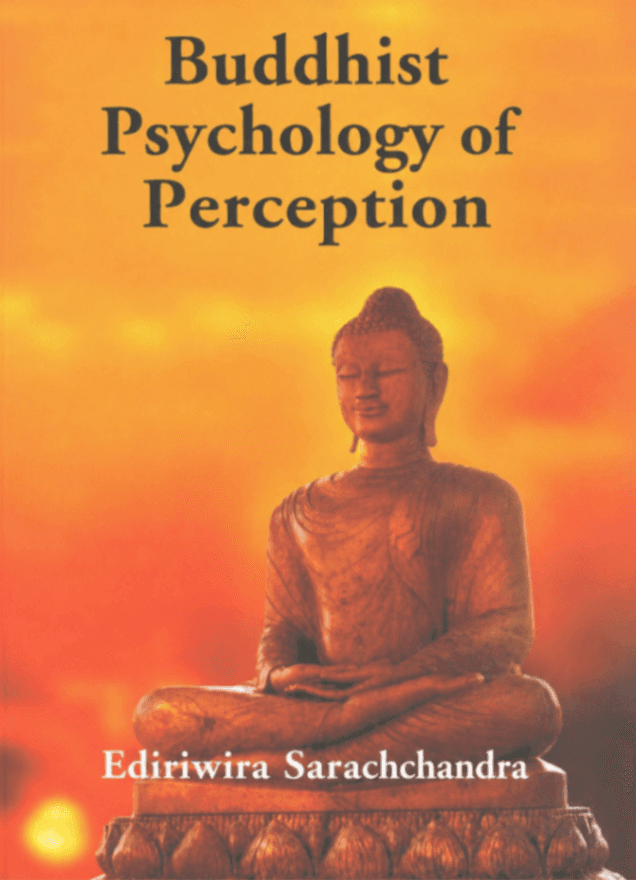
Buddhist Psychology of Perception
Introduction
The study seeks to interpret Buddhist theories of mind in terms intelligible to readers familiar with Western philosophy while avoiding the imposition of alien conceptual categories. He notes that psychological reflection in Buddhism arose largely as a by-product of broader philosophical and soteriological inquiry rather than as an autonomous science. Nevertheless, the Abhidhamma developed an increasingly precise analysis of cognition and mental processes that, in his view, deserves comparison with both Indian and Western theories of perception.
Methodologically, the work moves historically from the Nikāyas to the Pāli Abhidhamma and later scholastic developments. Sarachchandra pays close attention to changes in the meanings of technical terms and repeatedly distinguishes early canonical usage from later commentarial interpretation. This historical-philological approach is particularly important in his discussions of viññāṇa, saññā, phassa, samannāhāra, javana, and bhavaṅga, where later systematic meanings should not automatically be projected backward into the earliest texts.
Table of Contents
Bibliography and List of Abbreviations
Introductory Note
Part One: Theories of Perception in the Nikāyas
Theories of Perception in the Nikāyas
Part Two: Perception in the Abhidhamma
Perception in the Abhidhamma
The Physiology of Sense-Perception
Developments in the Twelfth Century
The Presentative Continuum
Ideational Process and Dreams
Part Three: The Theory of Bhavaṅga
Bhavaṅga: The Origin and Meaning of the Term
Bhavaṅga in Birth and Death
Bhavaṅga and Ālaya Vijñāna
Philosophical Basis of the Buddhist Theory of Perception
Index of Pāli and Sanskrit Words
General Index
Copyright Notice
This material is provided solely for academic research, study, and religious practice purposes under Article 25 of Vietnam's Intellectual Property Law. Reproduction, distribution, or commercial use is strictly prohibited.
If you are the author, translator, publisher, or rights holder and believe this content has been posted without proper authorization, please contact us and we will promptly review and remove or restrict access.
Documents
Buddhist Psychology of Perception
48.1 MB
Sách đọc nhiều nhất
The Buddha’s Ancient Path
Piyadassi Thera
The Questions of King Milinda, Part II
F. Max Müller (Editor)

A Taste of Freedom
Venerable Ajahn Chah / Phra Bodhinyana Thera
Buddhist Meditation: An Anthology of Texts from the Pāli Canon
Sarah Shaw (General Editors: Charles S. Prebish and Damien Keown)