English
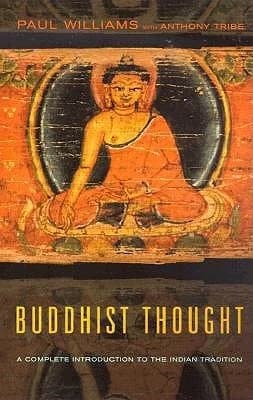
Buddhist Thought: A Complete Introduction to the Indian Tradition
Paul Williams (with Anthony Tribe)
English
Book
Routledge. London and New York.
2000
336 pages
1.2 MB
Introduction
The opening chapter, “The Doctrinal Position of the Buddha in Context,” situates Buddhism within the wider religious and philosophical world of ancient India. Williams explains the intellectual environment of Brahmanism, the Upaniṣadic search for liberation, renunciant movements, karma theory, rebirth, and the soteriological concerns that shaped the emergence of Buddhism. The Buddha is presented not merely as a religious founder, but as a renunciant teacher responding critically to Brahmanical doctrines of ātman, sacrifice, and metaphysical speculation.
The chapter also explores Buddhism as a path of liberation centered on transforming the mind through insight. Williams repeatedly stresses that Buddhism prioritizes practice and direct realization over mere belief. He characterizes Buddhism as a “soteriology” concerned with liberation from suffering (duḥkha) through wisdom and mental transformation.
The second chapter, “Mainstream Buddhism: the Basic Thought of the Buddha,” presents the doctrinal foundations of early Buddhism. Major themes include the Four Noble Truths, non-self (anātman/anattā), dependent origination (pratītyasamutpāda), karma, cosmology, meditation theory, and the rise of Abhidharma analysis. Williams carefully explains how early Buddhism analyzes human experience into conditioned processes rather than permanent entities. This section is particularly useful for understanding the philosophical foundations that later Buddhist schools inherited and transformed.
The third chapter studies the nature and origins of Mahāyāna Buddhism. Williams addresses one of the most debated questions in Buddhist Studies: how Mahāyāna emerged historically. Rather than presenting Mahāyāna as a completely separate religion, he shows it as a complex movement developing within mainstream Buddhist communities. Themes such as the Bodhisattva ideal, new sūtra literature, devotionalism, and expanding cosmological imagination are analyzed in relation to earlier Buddhist traditions.
The fourth chapter surveys major Mainstream Buddhist schools, including the Sarvāstivāda/Vaibhāṣika, Sautrāntika, Theravāda, Pudgalavāda, and Mahāsāṃghika traditions. Williams explains their distinctive doctrinal positions concerning ontology, temporality, personhood, and epistemology. This chapter is especially valuable because it introduces readers to the diversity of early Buddhist scholastic traditions beyond Theravāda.
The fifth chapter, “Mahayana Philosophy,” is one of the intellectual centers of the book. It systematically examines:
Prajñāpāramitā thought
Madhyamaka philosophy
Yogācāra philosophy
Tathāgatagarbha (Buddha-nature) doctrine
Williams explains Nāgārjuna’s Madhyamaka as a radical critique of intrinsic existence (svabhāva), while Yogācāra is presented as a sophisticated phenomenological and epistemological system analyzing consciousness and cognition. The Tathāgatagarbha section examines the doctrinal tensions between emptiness (śūnyatā) and Buddha-nature thought within Indian Mahāyāna.
The sixth chapter focuses on the Buddha in Mahāyāna Buddhism, including the doctrine of the Buddha’s multiple bodies (trikāya), bodhisattva practice, Buddhahood, and devotional cults. This section demonstrates how Mahāyāna expanded the conception of Buddhahood from a historical teacher into a cosmic and transcendent principle active throughout innumerable worlds.
The seventh and final chapter, written primarily by Anthony Tribe, provides a substantial introduction to Indian Vajrayāna/Tantric Buddhism. This is one of the strongest features of the book. The chapter explains tantric texts, initiation, deity yoga, mandalas, empowerment, antinomian practices, ritual symbolism, sexual imagery, and the social role of tantric practitioners. Rather than sensationalizing Tantra, Tribe carefully situates tantric Buddhism within broader Indian religious history and Buddhist soteriology.
The book concludes with an extensive bibliography of primary and secondary sources, making it especially useful for graduate students and researchers seeking further study pathways. Overall, Buddhist Thought succeeds as both an introductory textbook and a serious scholarly synthesis of Indian Buddhist philosophy and religious thought.
Copyright Notice
This material is provided solely for academic research, study, and religious practice purposes under Article 25 of Vietnam's Intellectual Property Law. Reproduction, distribution, or commercial use is strictly prohibited.
If you are the author, translator, publisher, or rights holder and believe this content has been posted without proper authorization, please contact us and we will promptly review and remove or restrict access.
Documents
Buddhist Thought A Complete Introduction to the Indian Tradition
1.2 MB
Keywords
Indian BuddhismBuddhist PhilosophyMahāyānaMadhyamakaVajrayāna.
Sách đọc nhiều nhất
The Buddha’s Ancient Path
Piyadassi Thera
Book·10.7 MB
229 pages1979223
The Questions of King Milinda, Part II
F. Max Müller (Editor)
Book·20.8 MB
427 pages1894208

A Taste of Freedom
Venerable Ajahn Chah / Phra Bodhinyana Thera
Book·1.2 MB
104 pages1980207
Buddhist Meditation: An Anthology of Texts from the Pāli Canon
Sarah Shaw (General Editors: Charles S. Prebish and Damien Keown)
Book·17.5 MB
253 pages2006204