
English
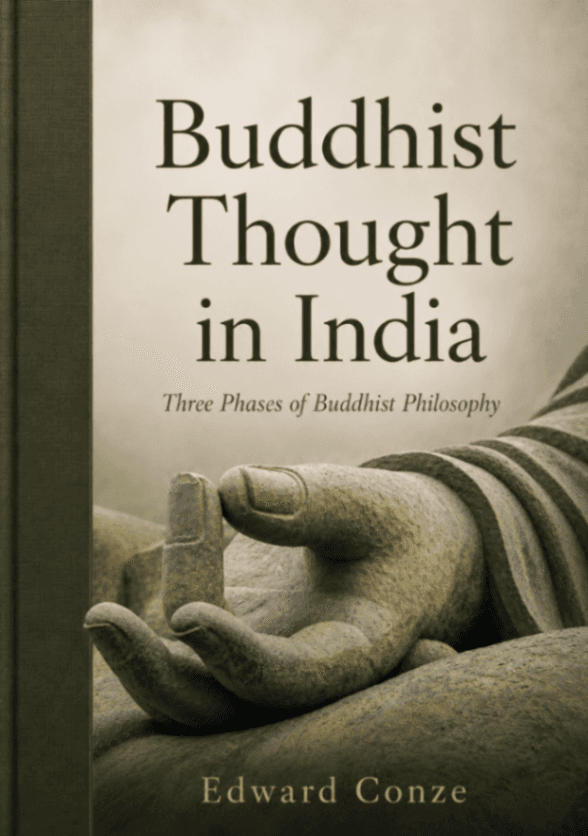
Buddhist Thought in India: Three Phases of Buddhist Philosophy
Edward Conze
English
Book
George Allen & Unwin
1962
298 pages
9.5 MB
Introduction
This work presents Indian Buddhist philosophy as a living spiritual method rather than as a merely speculative system of ideas. Conze’s central premise is that Buddhist thought arises from the experiences, disciplines, and insights of Buddhist yogins; therefore, its doctrines must be understood in relation to meditation, spiritual maturity, and the quest for liberation. The book begins by clarifying the tacit assumptions behind Buddhist philosophy, especially the authority of yogic experience, the hierarchy of reality, the role of spiritual insight, and the distinction between ordinary sensory knowledge and liberating wisdom. This framework is essential because many Buddhist doctrines—impermanence, non-self, emptiness, Nirvāṇa, and the analysis of dharmas—are not treated as abstract theories, but as instruments for transforming perception and loosening attachment to conditioned existence.
A major concern of the book is the development of Buddhist thought through three phases. In Archaic Buddhism, Conze examines the common doctrinal foundation shared by early Buddhist traditions: the three marks of conditioned existence, the four perverted views, the cultivation of faith, mindfulness, concentration, and wisdom, the final approach to Nirvāṇa, the social emotions, and the early analysis of experience into dharmas, skandhas, sense-fields, and elements. These teachings establish the basic Buddhist diagnosis of ordinary existence as impermanent, painful, and without self, while also showing the practical path toward emancipation.
The second phase focuses on the Sthavira traditions and their scholastic developments. Here the book studies debates over the self, momentariness, causality, conditioned co-production, the Unconditioned, and the map of the path. Conze gives particular attention to Abhidharma analysis, showing how Buddhist thinkers refined earlier teachings into technical classifications of conditioned and unconditioned dharmas, mental processes, material phenomena, and stages of realization.
The third phase turns to the Mahāyāna, which Conze interprets as both continuous with and transformative of earlier Buddhism. The Mahāyāna reorients Buddhist thought through the doctrine of emptiness, the six perfections, the expanded role of compassion, the Bodhisattva ideal, and a new understanding of Buddhahood and the Absolute. The chapters on Madhyamaka and Yogācāra present two major philosophical articulations of Mahāyāna thought: one emphasizing dialectical emptiness and the critique of conceptual fixation, the other emphasizing consciousness, representation, and the structure of experience. The final discussion of Buddhist logic and Tantra shows how Indian Buddhist philosophy continued to diversify while remaining oriented toward liberation. Overall, the book offers a dense but coherent map of Buddhist philosophy as a path of contemplative insight, doctrinal analysis, and spiritual emancipation.
Copyright Notice
This material is provided solely for academic research, study, and religious practice purposes under Article 25 of Vietnam's Intellectual Property Law. Reproduction, distribution, or commercial use is strictly prohibited.
If you are the author, translator, publisher, or rights holder and believe this content has been posted without proper authorization, please contact us and we will promptly review and remove or restrict access.
Documents
Buddhist Thought in India: Three Phases of Buddhist Philosophy
9.5 MB
Keywords
Buddhist philosophyIndian BuddhismArchaic BuddhismSthaviraMahāyānaMadhyamakaYogācāra
Sách cùng tác giả


Sách đọc nhiều nhất
The Buddha’s Ancient Path
Piyadassi Thera
Book·10.7 MB
229 pages1979223
The Questions of King Milinda, Part II
F. Max Müller (Editor)
Book·20.8 MB
427 pages1894208

A Taste of Freedom
Venerable Ajahn Chah / Phra Bodhinyana Thera
Book·1.2 MB
104 pages1980207
Buddhist Meditation: An Anthology of Texts from the Pāli Canon
Sarah Shaw (General Editors: Charles S. Prebish and Damien Keown)
Book·17.5 MB
253 pages2006204