English
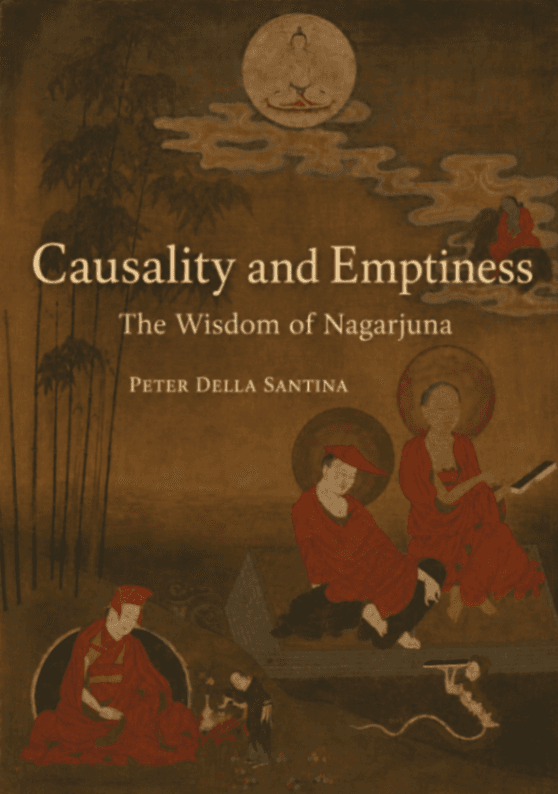
Causality and Emptiness: The Wisdom of Nagarjuna
Peter Della Santina
English
Book
Buddhist Research Society
2002
189 pages
5.7 MB
Introduction
This book presents Nāgārjuna’s wisdom through four interconnected texts that move from practical instruction to philosophical depth. The Good Hearted Letter offers a concise manual of Buddhist practice, covering faith in the Buddha, Dharma and Saṅgha, generosity, morality, patience, vigilance, renunciation, impermanence, suffering, and the cultivation of the path. The Heart of Interdependent Origination explains dependent arising as the structural principle of Buddhist thought, clarifying how phenomena arise through causes and conditions rather than through a permanent self or independent essence. Reasoning: The Sixty Stanzas develops Nāgārjuna’s Madhyamaka method, using reasoning to free the mind from extreme views and mistaken assumptions about reality. Emptiness: The Seventy Stanzas further applies the philosophy of emptiness to key Buddhist doctrines, showing that emptiness does not deny causality but makes causality intelligible by rejecting inherent existence. Together, these four works show the strategic continuity between ethical practice, dependent origination, the two truths, and liberation, making the book a systematic introduction to Nāgārjuna’s role as one of the central architects of Mahāyāna Buddhist philosophy.
Copyright Notice
This material is provided solely for academic research, study, and religious practice purposes under Article 25 of Vietnam's Intellectual Property Law. Reproduction, distribution, or commercial use is strictly prohibited.
If you are the author, translator, publisher, or rights holder and believe this content has been posted without proper authorization, please contact us and we will promptly review and remove or restrict access.
Documents
Causality and Emptiness: The Wisdom of Nagarjuna
5.7 MB
Keywords
NāgārjunaMadhyamakaEmptinessDependent OriginationTwo TruthsBuddhist PhilosophyPeter Della Santina
Sách cùng tác giả
Sách đọc nhiều nhất
The Buddha’s Ancient Path
Piyadassi Thera
Book·10.7 MB
229 pages1979223
The Questions of King Milinda, Part II
F. Max Müller (Editor)
Book·20.8 MB
427 pages1894208

A Taste of Freedom
Venerable Ajahn Chah / Phra Bodhinyana Thera
Book·1.2 MB
104 pages1980207
Buddhist Meditation: An Anthology of Texts from the Pāli Canon
Sarah Shaw (General Editors: Charles S. Prebish and Damien Keown)
Book·17.5 MB
253 pages2006204