English
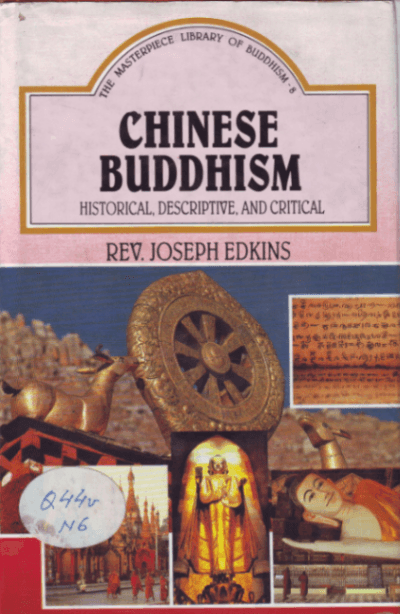
Chinese Buddhism: Historical, Descriptive, and Critical
Joseph Edkins
English
Book
Aryan Books International
1998
453 pages
25.8 MB
Introduction
Introduction — Explains why Buddhism deserves examination and introduces earlier European research on Buddhist texts and Sanskrit manuscripts.
Chapter I. Life of Shakyamuni till His Appearance at Benares as a Teacher — Covers previous lives, chronology, birth, early life, renunciation, enlightenment, and first preaching.
Chapter II. Life of Buddha from His Appearance as a Teacher at Benares to the Conversion of Rahula — Presents the Four Truths, early disciples, monastic beginnings, and conversion narratives.
Chapter III. From the Commencement of Rahula’s Religious Life till the Near Approach of the Nirvana — Discusses monastic rules, teaching activity, miracles, protectors of Buddhism, and late ministry.
Chapter IV. Last Discourses and Death of Buddha — Describes final teachings, journey to Kuśinagara, death, cremation, relics, and pagodas.
Chapter V. The Patriarchs of the Northern Buddhists — Presents the succession of patriarchs from Kāśyapa and Ānanda to later figures, including Bodhidharma.
Chapter VI. Sketch of the History of Buddhism in China — Surveys the arrival, translation, imperial support, decline, revival, and controversies of Buddhism in China.
Chapter VII. The Schools of Chinese Buddhism — Describes major Chinese Buddhist schools, including contemplative, esoteric, Pure Land, and scholastic traditions.
Chapter VIII. On Chi-k’ai and the T’ien-t’ai School of Buddhism — Introduces Chi-k’ai, T’ien-t’ai doctrine, meditation, discipline, and institutional organization.
Chapter IX. The Buddhist Moral System — Discusses virtues, prohibitions, compassion, karma, transmigration, heaven, hell, judgment, and Nirvāṇa.
Chapter X. The Buddhist Calendar — Presents Buddhist festivals, birth observances, seasonal rites, and calendar reforms.
Chapter XI. Relation of Buddhism to the Older Hindoo Mythology — Explores Buddhist adaptation of Brahmanical gods, devas, yakṣas, nāgas, and mythological categories.
Chapter XII. The Buddhist Universe — Explains Buddhist cosmology, kalpas, worlds, heavens, hells, and cosmic cycles.
Chapter XIII. The Extended Universe of the Northern Buddhists — Discusses Mahāyāna cosmology, bodhisattvas, expanded worlds, and celestial Buddhas.
Chapter XIV. Buddhist Images and Image-Worship — Describes temples, halls, icons, Buddhas, bodhisattvas, arhats, guardians, and image devotion.
Chapter XV. Monasteries at P’u-to — Studies monastic life and Buddhist institutions at P’u-to, especially connected with Kwan-yin.
Chapter XVI. Buddhist Processions, Associations, Pilgrimages, and Ceremonies for the Dead — Covers lay associations, ancestral rites, village processions, and rituals for deceased souls.
Chapter XVII. Buddhist Literature — Surveys Chinese Buddhist libraries, sūtras, translations, Mahāyāna texts, catalogues, and translation history.
Chapter XVIII. The Leng-yen-king—First Chapter — Introduces and analyzes the opening chapter of the Śūraṅgama Sūtra.
Chapter XIX. The Ekashloka Shastra — Provides translation, analysis, and notes on the Ekashloka Shastra.
Chapter XX. Effect of Buddhism on the Philosophy of the Sung Dynasty — Examines Buddhist influence on Neo-Confucian philosophical development.
Chapter XXI. Feng-shui, or the Wind and Water Superstition of the Chinese — Discusses geomancy, cosmology, Buddhist influence, and Chinese popular belief.
Chapter XXII. Buddhist Phraseology in Relation to Christian Teaching — Compares Buddhist terms with Christian doctrinal vocabulary and missionary translation issues.
Chapter XXIII. Notice of the Wu-wei-kiau, a Reformed Buddhist Sect — Presents a reformed Buddhist movement, its founder, history, and doctrines.
Chapter XXIV. Buddhism and Tauism in Their Popular Aspects — Compares Buddhist and Taoist ritual, popular deities, prayers, death rites, and religious syncretism.
Chapter XXV. On the Use of Sanskrit by the Chinese Buddhists — Discusses Sanskrit transliteration, translation practices, pronunciation, and Buddhist linguistic transmission.
Chapter XXVI. Books and Papers That May Be Consulted for the Study of Chinese Buddhism — Lists reference works and sources for further study.
Copyright Notice
This material is provided solely for academic research, study, and religious practice purposes under Article 25 of Vietnam's Intellectual Property Law. Reproduction, distribution, or commercial use is strictly prohibited.
If you are the author, translator, publisher, or rights holder and believe this content has been posted without proper authorization, please contact us and we will promptly review and remove or restrict access.
Documents
Chinese Buddhism: Historical, Descriptive, and Critical
25.8 MB
Keywords
Chinese BuddhismBuddhist historyMahāyāna BuddhismBuddhist schoolsBuddhist literatureBuddhist ritualsSanskrit translation.
Sách đọc nhiều nhất
The Buddha’s Ancient Path
Piyadassi Thera
Book·10.7 MB
229 pages1979223
The Questions of King Milinda, Part II
F. Max Müller (Editor)
Book·20.8 MB
427 pages1894208

A Taste of Freedom
Venerable Ajahn Chah / Phra Bodhinyana Thera
Book·1.2 MB
104 pages1980207
Buddhist Meditation: An Anthology of Texts from the Pāli Canon
Sarah Shaw (General Editors: Charles S. Prebish and Damien Keown)
Book·17.5 MB
253 pages2006204