
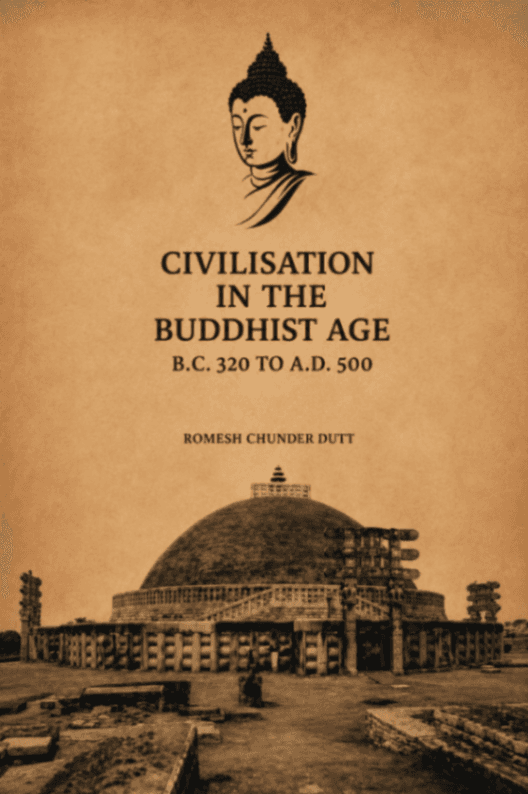
English
Civilisation in the Buddhist Age: B.C. 320 to A.D. 500
Romesh C. Dutt, C.I.E.
English
Book
Rare Reprints, Delhi.
1987
204 pages
38.5 MB
Introduction
The book is arranged as “Book IV: Buddhist Period, B.C. 320 to A.D. 500” and consists of eighteen chapters. It begins with Buddhist sacred literature, explaining the place of the Three Piṭakas and the early textual foundations of Buddhism. It then presents the life of Gautama Buddha, his doctrines, and his moral precepts, followed by chapters on the history of Buddhism and the history of Jainism. The middle chapters move into political and dynastic history, discussing Chandragupta and Aśoka the Great, language and alphabet, the kings of Magadha, Kashmir and Gujarat, and the Gupta kings. The book then turns to foreign testimony through Fa-Hian’s account of India, followed by chapters on Buddhist architecture and sculpture, caste, social life, administration, laws, and astronomy and learning. Taken together, these chapters present the Buddhist age as an integrated civilizational period in which religious ideals, imperial power, literary culture, social institutions, and intellectual traditions interacted to shape ancient Indian society.
Copyright Notice
This material is provided solely for academic research, study, and religious practice purposes under Article 25 of Vietnam's Intellectual Property Law. Reproduction, distribution, or commercial use is strictly prohibited.
If you are the author, translator, publisher, or rights holder and believe this content has been posted without proper authorization, please contact us and we will promptly review and remove or restrict access.
Documents
Civilisation in the Buddhist Age: B.C. 320 to A.D. 500
38.5 MB
Sách đọc nhiều nhất
The Buddha’s Ancient Path
Piyadassi Thera
Book·10.7 MB
229 pages1979223
The Questions of King Milinda, Part II
F. Max Müller (Editor)
Book·20.8 MB
427 pages1894208

A Taste of Freedom
Venerable Ajahn Chah / Phra Bodhinyana Thera
Book·1.2 MB
104 pages1980207
Buddhist Meditation: An Anthology of Texts from the Pāli Canon
Sarah Shaw (General Editors: Charles S. Prebish and Damien Keown)
Book·17.5 MB
253 pages2006204