
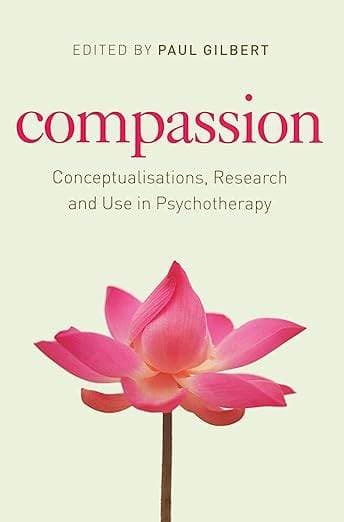
English
Compassion: Conceptualisations, Research and Use in Psychotherapy
Paul Gilbert (Editor)
English
Book
Routledge, London and New York
2005
387 pages
1.7 MB
Introduction
Chapter 1: Introduction and outline (Paul Gilbert): Provides an overview of the psychology of compassion, explores the integration of Eastern Buddhist philosophy with Western science, and outlines the two-part structure of the book.
Chapter 2: Compassion and cruelty: A biopsychosocial approach (Paul Gilbert): Analyzes compassion in contrast to cruelty from evolutionary, biological, and social-ecological perspectives, examining threat-defense and safety systems within the mind.
Chapter 3: A conceptual framework for integrating research related to the physiology of compassion and the wisdom of Buddhist teachings (Sheila Wang): Establishes a model linking Buddhist views of the mind with neuroscience, emphasizing interdependence and multi-level physiological regulation.
Chapter 4: An attachment-theoretical approach to compassion and altruism (Omri Gillath, Phillip R. Shaver and Mario Mikulincer): Evaluates research data on how early attachment relationships create the developmental context for compassion and altruistic behavior in later life.
Chapter 5: The psychology of compassion and prosocial behaviour (Hans-Werner Bierhoff): Examines the connections between helping behavior, prosocial behavior, and altruism through the principles of conditioning, observational learning, and personality.
Chapter 6: Compassion and forgiveness: Implications for psychotherapy (Everett L. Worthington, Jr, Lynn E. O'Connor, Jack W. Berry, Connie Sharp, Rebecca Murray and Eunice Yi): Explores the reciprocal relationship between compassion, forgiveness, guilt, and their roles in healing interpersonal relationships.
Chapter 7: A social-cognitive model of validation (Robert L. Leahy): Presents a social-cognitive model of emotional validation in psychotherapy, particularly for patients who lacked parental validation during childhood.
Chapter 8: The Buddhist use of compassionate imagery in mind healing (Ringu Tulku Rinpoche and Kenneth Mullen): Offers insights into using the visualization of compassionate archetypes (Buddhist deities) to heal the mind and internalize positive qualities.
Chapter 9: Mindfulness, compassion for self, and compassion for others: Implications for understanding the psychopathology and treatment of depression (Nicholas B. Allen and Wendy E.J. Knight): Discusses the application of mindfulness and compassion training in clinical treatment and relapse prevention for depressed patients.
Chapter 10: Focused therapies and compassionate mind training for shame and self-attacking (Paul Gilbert and Chris Irons): Analyzes the mechanisms of self-criticism and self-attack, and describes Compassionate Mind Training (CMT) techniques to foster self-acceptance.
Chapter 11: The perfect nurturer: A model to develop a compassionate mind within the context of cognitive therapy (Deborah A. Lee): Illustrates the use of the "perfect nurturer" imagery in cognitive therapy for patients suffering from severe trauma or PTSD.
Chapter 12: Compassionate imagery in the treatment of early memories in Axis I anxiety disorders (Ann Hackmann): Uses clinical case studies to outline methods of working with compassionate imagery to restructure early memories in patients with anxiety disorders.
Chapter 13: The expression of compassion in group cognitive therapy (Tony Bates): Analyzes the processes and healing potential of compassion as it is expressed among members within a group cognitive therapy context.
Copyright Notice
This material is provided solely for academic research, study, and religious practice purposes under Article 25 of Vietnam's Intellectual Property Law. Reproduction, distribution, or commercial use is strictly prohibited.
If you are the author, translator, publisher, or rights holder and believe this content has been posted without proper authorization, please contact us and we will promptly review and remove or restrict access.
Documents
Compassion: Conceptualisations, Research and Use in Psychotherapy
1.7 MB
Keywords
CompassionPsychotherapyBiopsychosocialCognitive-behavioural therapyMindfulnessAttachment theoryEvolution
Sách đọc nhiều nhất
The Buddha’s Ancient Path
Piyadassi Thera
Book·10.7 MB
229 pages1979223
The Questions of King Milinda, Part II
F. Max Müller (Editor)
Book·20.8 MB
427 pages1894208

A Taste of Freedom
Venerable Ajahn Chah / Phra Bodhinyana Thera
Book·1.2 MB
104 pages1980207
Buddhist Meditation: An Anthology of Texts from the Pāli Canon
Sarah Shaw (General Editors: Charles S. Prebish and Damien Keown)
Book·17.5 MB
253 pages2006204