
English
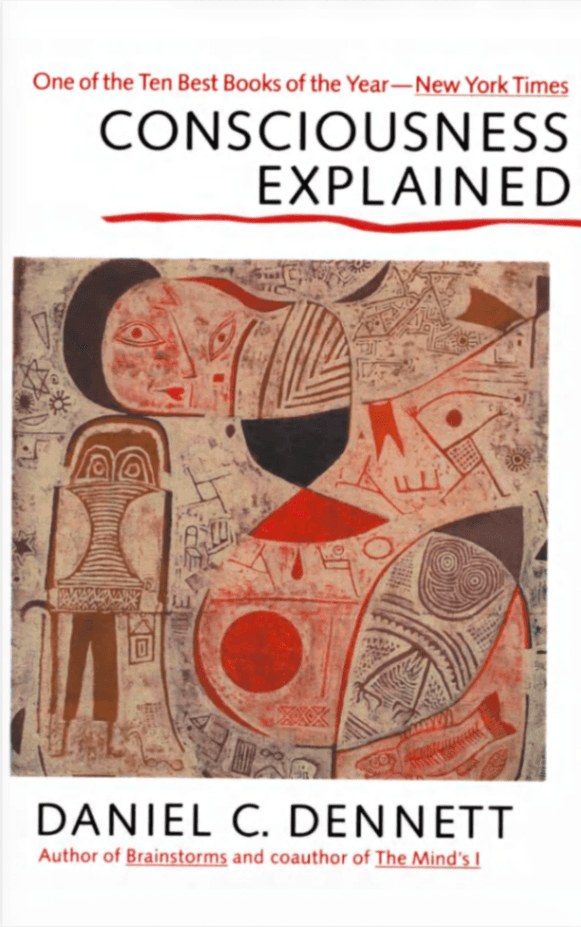
Consciousness Explained
Daniel C. Dennett
English
Book
Back Bay Books, Little, Brown and Company, New York, Boston, and London
1991
526 pages
10.0 MB
Introduction
The book comprises fourteen chapters arranged into three major parts. The opening chapter uses hallucination and the “brain in a vat” thought experiment to introduce the problem of how the brain constructs apparently coherent experience. Part I examines the principal conceptual and methodological problems involved in explaining consciousness, critiques dualism, surveys the contents of phenomenal experience, and introduces heterophenomenology as a scientific method for studying subjective reports. Part II develops an empirical theory of mind through the Multiple Drafts Model, analyses the brain’s representation of time, traces the biological and cultural evolution of consciousness, investigates the formative role of language, and outlines the architecture of the human mind as a distributed “Joycean machine.” Part III addresses the major philosophical problems of consciousness, including mental imagery, perceptual reporting, blindsight, visual completion, qualia, the construction and plurality of selves, conscious robots, animal experience, and the question of whether a functional explanation genuinely explains consciousness or merely explains it away.
Copyright Notice
This material is provided solely for academic research, study, and religious practice purposes under Article 25 of Vietnam's Intellectual Property Law. Reproduction, distribution, or commercial use is strictly prohibited.
If you are the author, translator, publisher, or rights holder and believe this content has been posted without proper authorization, please contact us and we will promptly review and remove or restrict access.
Documents
Consciousness Explained
10.0 MB
Keywords
ConsciousnessPhilosophy of MindMultiple Drafts ModelHeterophenomenologyCognitive ScienceQualiaPersonal Identity
Sách đọc nhiều nhất
The Buddha’s Ancient Path
Piyadassi Thera
Book·10.7 MB
229 pages1979223
The Questions of King Milinda, Part II
F. Max Müller (Editor)
Book·20.8 MB
427 pages1894208

A Taste of Freedom
Venerable Ajahn Chah / Phra Bodhinyana Thera
Book·1.2 MB
104 pages1980207
Buddhist Meditation: An Anthology of Texts from the Pāli Canon
Sarah Shaw (General Editors: Charles S. Prebish and Damien Keown)
Book·17.5 MB
253 pages2006204