
English
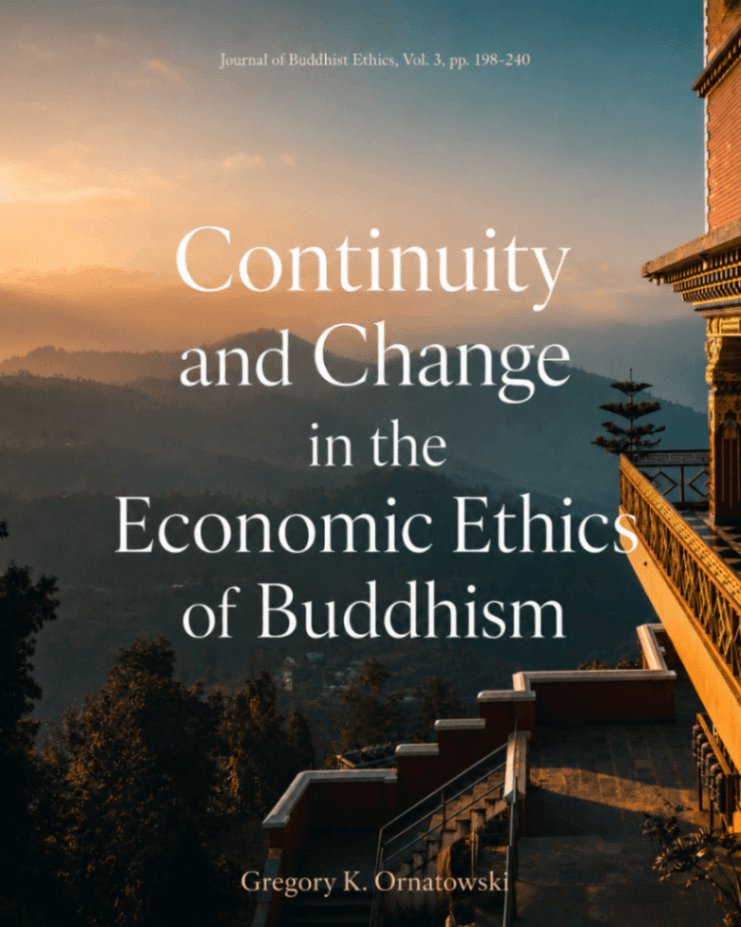
Continuity and Change in the Economic Ethics of Buddhism: Evidence From the History of Buddhism in India, China and Japan
Gregory K. Ornatowski
English
Book
Journal of Buddhist Ethics, Vol.3, pp. 198-240
1996
43 pages
267 KB
Introduction
This article presents Buddhist economic ethics as a historically dynamic field shaped by doctrine, monastic regulation, lay practice, political patronage, and regional adaptation. It begins with early Theravāda Buddhism, where the Four Noble Truths, karma, non-self, dependent origination, right livelihood, and nonattachment define the ethical framework for wealth and economic life. In this context, laypeople are encouraged to earn wealth honestly, avoid harmful occupations, practice disciplined consumption, support family and society, and give generously to the Saṅgha; monks, by contrast, are expected to live with minimal possessions and avoid economic accumulation. The article then turns to Mahāyāna Buddhism in India and China, showing how changes in the understanding of nirvāṇa, saṃsāra, compassion, and the bodhisattva ideal created broader space for social and economic activity, especially in monasteries. In medieval China, Buddhist institutions developed extensive commercial operations, including loans, grain lending, land rental, pawnshops, and “inexhaustible treasuries,” while Chan Buddhism revalued manual labor as part of religious discipline. The final major section analyzes Japanese Buddhism, where Buddhist economic ethics absorbed Confucian and Shinto influences, supported social harmony, loyalty, productive labor, and temple-state cooperation, while temples accumulated land, wealth, and institutional power. Taken together, the article shows both continuity and transformation: continuity in the Buddhist ideal of nonattachment and generosity, and change in the concrete economic practices of Buddhist communities across historical and cultural contexts.
Copyright Notice
This material is provided solely for academic research, study, and religious practice purposes under Article 25 of Vietnam's Intellectual Property Law. Reproduction, distribution, or commercial use is strictly prohibited.
If you are the author, translator, publisher, or rights holder and believe this content has been posted without proper authorization, please contact us and we will promptly review and remove or restrict access.
Documents
Continuity and Change in the Economic Ethics of Buddhism: Evidence From the History of Buddhism in India, China and Japan
267 KB
Keywords
Buddhist Economic EthicsDānaWealth and NonattachmentMonastic EconomyBuddhism and CapitalismTheravāda and MahāyānaIndiaChina and Japan
Sách đọc nhiều nhất

The Buddha’s Ancient Path
Piyadassi Thera
Book·10.7 MB
229 pages1979223
The Questions of King Milinda, Part II
F. Max Müller (Editor)
Book·20.8 MB
427 pages1894208

A Taste of Freedom
Venerable Ajahn Chah / Phra Bodhinyana Thera
Book·1.2 MB
104 pages1980207
Buddhist Meditation: An Anthology of Texts from the Pāli Canon
Sarah Shaw (General Editors: Charles S. Prebish and Damien Keown)
Book·17.5 MB
253 pages2006204