
English
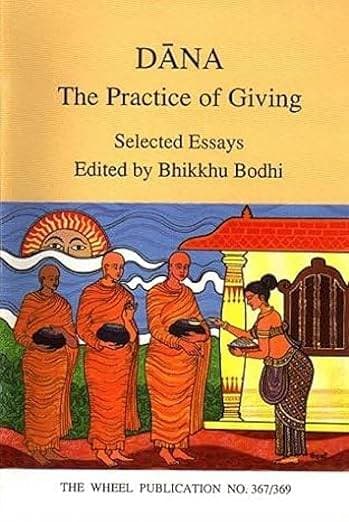
Dāna: The Practice of Giving — Selected Essays
Bhikkhu Bodhi
English
Book
Buddhist Publication Society, Sri Lanka.
1997
76 pages
500 KB
Introduction
The book opens with an Introduction by Bhikkhu Bodhi. He presents giving as one of the most basic human virtues and, within Buddhism, as the “foundation and seed” of spiritual development. In the Pāli suttas, the Buddha often begins his graduated instruction with dānakathā, or talk on giving, before moving to morality, kamma, renunciation, and finally the Four Noble Truths. Bhikkhu Bodhi explains that giving does not directly produce liberating insight by itself, but it supports the entire path by softening attachment and preparing the mind for deeper training. He also connects dāna with puññakiriyavatthu — the bases of meritorious action, saṅgahavatthu — the means of benefiting others, and the pāramīs — the perfections cultivated by Bodhisattas.
The Practice of Giving, by Susan Elbaum Jootla, explains dāna as an essential preliminary step in Buddhist practice. The essay analyzes three key factors that determine the merit of giving: the donor’s volition, the purity of the recipient, and the nature of the gift. Jootla emphasizes that the donor’s intention before, during, and after the act is crucial. Giving with wisdom, faith, respect, and aspiration toward Nibbāna is superior to giving out of social pressure, reputation-seeking, fear, or expectation of reward. The essay also discusses dhammadāna, the gift of Dhamma, as the highest gift, and concludes by presenting giving as a means to weaken craving and support liberation.
Giving in the Pāli Canon, by Lily de Silva, surveys dāna through canonical references. The essay shows that giving is the first of the three bases of merit and the first of the ten perfections. Lily de Silva explains that dāna functions as an antidote to greed, egoism, and possessiveness. The essay discusses the qualities of the donor, the types of gifts, proper recipients, motivations for giving, the manner of giving, and the fruits of generosity. It draws on texts such as the Aṅguttara Nikāya, Saṃyutta Nikāya, Dhammapada, Suttanipāta, Majjhima Nikāya, and Vinaya materials. A key insight is the distinction between dāna as the practical act of giving and cāga as the inward disposition of generosity.
Giving from the Heart, by M. O’C. Walshe, reflects on the spirit of giving and the relationship between lay Buddhists and the Saṅgha. The essay addresses the idea of the Saṅgha as an “unequalled field of merit,” explaining that this status depends on the Saṅgha’s proper conduct and fidelity to the Vinaya. Walshe stresses the symbiotic relationship between monastics and lay followers: the Saṅgha offers the gift of Dhamma, while the laity supports the Saṅgha materially. The essay also clarifies possible misunderstandings about giving to monks and nuns by emphasizing that the true value of such giving is tied to Dhamma practice, discipline, and spiritual integrity.
Generosity: The Inward Dimension, by Nina van Gorkom, focuses on generosity as an internal mental quality. The essay likely emphasizes that the value of giving is not limited to the external object transferred, but lies in the wholesome mental states that arise through the act. In the Abhidhamma-oriented perspective associated with van Gorkom, generosity is significant because it weakens clinging and cultivates wholesome consciousness. Thus, dāna becomes an inward training in non-attachment, mindfulness, and purification of intention.
The Perfection of Giving, by Ācariya Dhammapāla, presents the traditional Theravāda account of dāna-pāramī, extracted from his Treatise on the Pāramīs in the commentary to the Cariyāpiṭaka. This section places giving within the Bodhisatta path. Ordinary giving creates merit and supports ethical life, but the perfection of giving requires radical renunciation. The Bodhisatta gives not only material goods but, in the highest narratives, even limbs, children, spouse, and life itself for the sake of omniscience and Buddhahood. This section connects dāna with the long cultivation of the pāramīs across many lifetimes.
The book ends with About the Contributors, identifying the modern essayists and traditional source material. As a whole, the volume is structured as a practical and doctrinal guide rather than a purely academic monograph. Its value lies in combining Pāli canonical evidence, Theravāda ethical interpretation, practical Buddhist reflection, and classical commentary on the Bodhisatta ideal.
Copyright Notice
This material is provided solely for academic research, study, and religious practice purposes under Article 25 of Vietnam's Intellectual Property Law. Reproduction, distribution, or commercial use is strictly prohibited.
If you are the author, translator, publisher, or rights holder and believe this content has been posted without proper authorization, please contact us and we will promptly review and remove or restrict access.
Documents
Dāna: The Practice of Giving
500 KB
Keywords
DānaBuddhist GivingTheravāda EthicsDāna-pāramī
Sách cùng tác giả
In the Buddha’s Words: An Anthology of Discourses from the Pāli Canon
Bhikkhu Bodhi
Book·1.9 MB
517 pages200564
The Buddha’s Teachings on Social and Communal Harmony: An Anthology of Discourses from the Pāli Canon
Bhikkhu Bodhi
Book·1.5 MB
244 pages201686
Transcendental Dependent Arising: A Translation and Exposition of the Upanisa Sutta
Bhikkhu Bodhi
Book·771 KB
68 pages198058
Facing the Future: Four Essays on Buddhism and Society
Bhikkhu Bodhi
Book·473 KB
89 pages200099
Sách đọc nhiều nhất
The Buddha’s Ancient Path
Piyadassi Thera
Book·10.7 MB
229 pages1979223
The Questions of King Milinda, Part II
F. Max Müller (Editor)
Book·20.8 MB
427 pages1894208

A Taste of Freedom
Venerable Ajahn Chah / Phra Bodhinyana Thera
Book·1.2 MB
104 pages1980207
Buddhist Meditation: An Anthology of Texts from the Pāli Canon
Sarah Shaw (General Editors: Charles S. Prebish and Damien Keown)
Book·17.5 MB
253 pages2006204