English
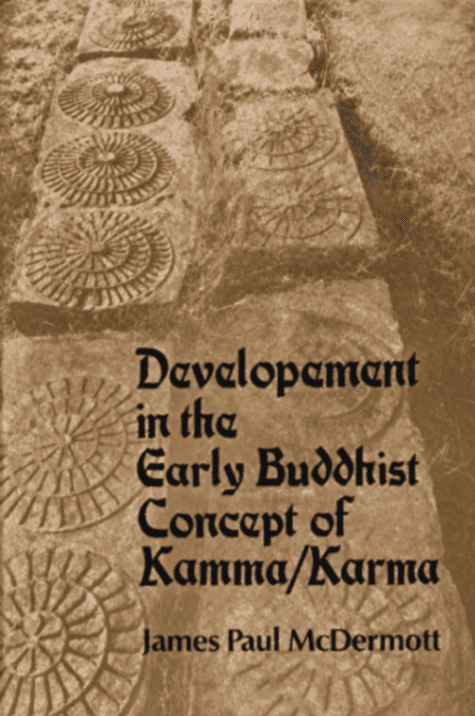
Development in the Early Buddhist Concept of Kamma/Karma
James Paul McDermott
English
Book
Munshiram Manoharlal Publishers Pvt. Ltd., New Delhi
2003
183 pages
303.2 MB
Introduction
The book opens with a Preface, Acknowledgements, Abbreviations, and an Introduction that situates kamma/karma as a central Buddhist doctrine and explains the study’s historical-critical method, scope, and textual focus. Chapter I, “Kamma in the Vinaya and the Sutta Piṭaka,” analyzes the earliest canonical formulation of kamma, including rebirth, the five or six realms of existence, the relation between kamma and anattā, dependent origination, social status, caste, wealth, health, environment, free will, punishment, merit, transfer of merit, and early popular developments. Chapter II, “Kamma in the Abhidhamma Piṭaka,” studies six Abhidhamma works and the Kathāvatthu, showing how kamma becomes more technically classified through categories such as wholesome, unwholesome, indeterminate, old and new kamma, result, condition, and doctrinal debate. Chapter III, “Kamma in the Milindapañha,” examines how the dialogue between King Milinda and Nāgasena treats questions of moral continuity, rebirth without a permanent self, merit, responsibility, and karmic result. Chapter IV, “Karma in the Abhidharmakośa,” turns to Vasubandhu and the Sarvāstivāda-Abhidharma tradition, where karma is analyzed through a more systematic concern with intention, bodily and verbal action, informative and non-informative acts, causal force, and the mechanism of retribution. Chapter V, “Conclusion,” synthesizes the book’s central finding that the Buddhist doctrine of karma developed along two major lines: popular folk-religious expansion and scholastic refinement toward precise doctrinal definition, followed by a selected bibliography and index.
Copyright Notice
This material is provided solely for academic research, study, and religious practice purposes under Article 25 of Vietnam's Intellectual Property Law. Reproduction, distribution, or commercial use is strictly prohibited.
If you are the author, translator, publisher, or rights holder and believe this content has been posted without proper authorization, please contact us and we will promptly review and remove or restrict access.
Documents
Development in the Early Buddhist Concept of Kamma/Karma
303.2 MB
Keywords
KammaKarmaRebirthAbhidhammaMilindapañhaAbhidharmakośaBuddhist Ethics.
Sách đọc nhiều nhất
The Buddha’s Ancient Path
Piyadassi Thera
Book·10.7 MB
229 pages1979223
The Questions of King Milinda, Part II
F. Max Müller (Editor)
Book·20.8 MB
427 pages1894208

A Taste of Freedom
Venerable Ajahn Chah / Phra Bodhinyana Thera
Book·1.2 MB
104 pages1980207
Buddhist Meditation: An Anthology of Texts from the Pāli Canon
Sarah Shaw (General Editors: Charles S. Prebish and Damien Keown)
Book·17.5 MB
253 pages2006204