English
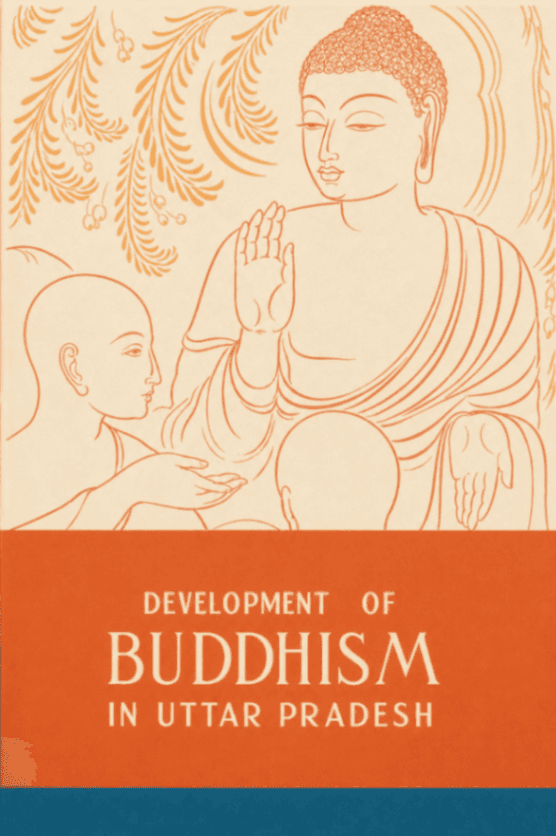
Development of Buddhism in Uttar Pradesh
Nalinaksha Dutt and Krishna Datta Bajpai
English
Book
Publication Bureau, Government of Uttar Pradesh, Lucknow.
1956
406 pages
76.0 MB
Introduction
The book is arranged into eighteen chapters. It begins with “Ancient Countries in Uttar Pradesh,” identifying the major political and cultural regions connected with early Buddhism, including Kāśī, Kosala, Vatsa, Pañcāla, Sūrasena, the Śākyas, Mallas, and related territories. The second chapter analyzes the religious and social conditions of northern India before the Buddha, including Vedic ritualism, non-Brahmanical cults, social organization, economic life, guilds, and intellectual movements. The following chapters discuss the early life of Gautama Buddha, his missionary activities, his interaction with Brahmanas of Kosala, and his relationship with kings such as Pasenadi and Udena. The middle chapters study the training of lay devotees, the gradual discipline of monks, practices conducive to nirvāṇa, and philosophical issues such as causation, karma, anattā, tathāgata-existence after death, and nibbāna. Later chapters examine the monastic system, Upagupta and Aśoka, Sarvāstivādins and Saṃmitiyas, Chinese pilgrims’ accounts of Buddhism in Uttar Pradesh, major Buddhist centres and monuments, Buddhist art, Buddhist architecture, and Aśoka’s edicts.
Copyright Notice
This material is provided solely for academic research, study, and religious practice purposes under Article 25 of Vietnam's Intellectual Property Law. Reproduction, distribution, or commercial use is strictly prohibited.
If you are the author, translator, publisher, or rights holder and believe this content has been posted without proper authorization, please contact us and we will promptly review and remove or restrict access.
Documents
Development of Buddhism in Uttar Pradesh
76.0 MB
Keywords
Uttar PradeshBuddhist historySarnathKosalaBuddhist monasticismAśokaBuddhist art and architecture.
Sách đọc nhiều nhất
The Buddha’s Ancient Path
Piyadassi Thera
Book·10.7 MB
229 pages1979223
The Questions of King Milinda, Part II
F. Max Müller (Editor)
Book·20.8 MB
427 pages1894208

A Taste of Freedom
Venerable Ajahn Chah / Phra Bodhinyana Thera
Book·1.2 MB
104 pages1980207
Buddhist Meditation: An Anthology of Texts from the Pāli Canon
Sarah Shaw (General Editors: Charles S. Prebish and Damien Keown)
Book·17.5 MB
253 pages2006204