English
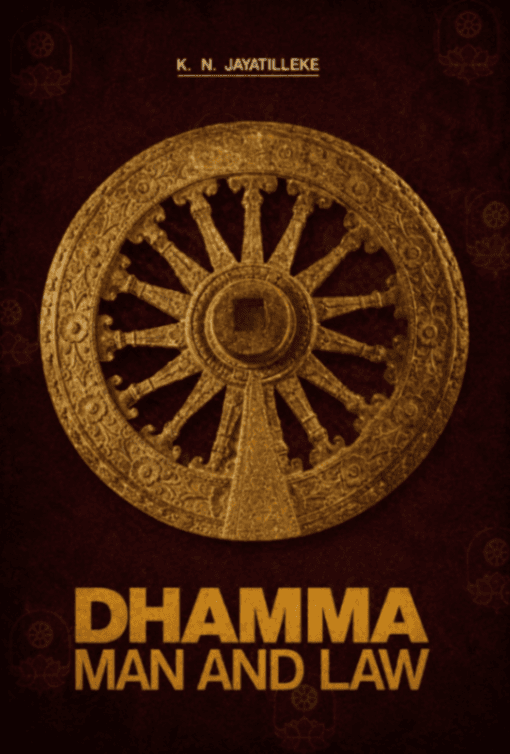
Dhamma, Man and Law
K. N. Jayatilleke
English
Book
Buddhist Cultural Centre, Dehiwela, Sri Lanka
2000
119 pages
12.9 MB
Introduction
The book opens by explaining the origins of Buddhism and the relevance of Buddhist epistemology for law, especially the role of critical inquiry, impartial judgment, and rational faith in legal reasoning. It then examines the Buddhist theory of reality and its implications for law, showing that legal systems must be understood against a wider philosophical view of human nature, causality, moral responsibility, and social order. The third chapter focuses on Buddhist ethics, arguing that law must serve moral and practical ends such as welfare, restraint of harmful conduct, and the cultivation of justice rather than merely enforcing formal rules. The fourth chapter studies the Buddhist conception of society, law, and human rights, including the relationship between the Saṅgha, the state, rulers, citizens, and moral obligations within a just social framework. The final chapter addresses Buddhism and international law, discussing Buddhist principles relevant to peace, war, inter-state conduct, universal welfare, and the possibility of a righteous international order grounded in Dhamma rather than domination.
Copyright Notice
This material is provided solely for academic research, study, and religious practice purposes under Article 25 of Vietnam's Intellectual Property Law. Reproduction, distribution, or commercial use is strictly prohibited.
If you are the author, translator, publisher, or rights holder and believe this content has been posted without proper authorization, please contact us and we will promptly review and remove or restrict access.
Documents
Dhamma, Man and Law
12.9 MB
Keywords
Buddhist jurisprudenceDhamma and lawVinayaBuddhist ethicshuman rightsinternational lawBuddhist social philosophy.
Sách cùng tác giả
Sách đọc nhiều nhất
The Buddha’s Ancient Path
Piyadassi Thera
Book·10.7 MB
229 pages1979223
The Questions of King Milinda, Part II
F. Max Müller (Editor)
Book·20.8 MB
427 pages1894208

A Taste of Freedom
Venerable Ajahn Chah / Phra Bodhinyana Thera
Book·1.2 MB
104 pages1980207
Buddhist Meditation: An Anthology of Texts from the Pāli Canon
Sarah Shaw (General Editors: Charles S. Prebish and Damien Keown)
Book·17.5 MB
253 pages2006204