
English
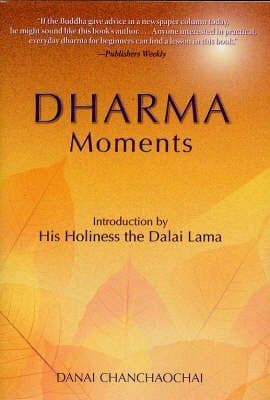
Dharma Moments
Danai Chanchaochai
English
Book
Nicholas Brealey Publishing,
2006
249 pages
910 KB
Introduction
The book opens with an Introduction by His Holiness the Dalai Lama. The Dalai Lama emphasizes that although the Buddha taught more than 2,500 years ago, his teachings remain relevant because all human beings seek happiness and wish to avoid suffering. He highlights that Buddhist practice is not only meditation, but also the cultivation of love, compassion, generosity, patience, and non-harming in daily life. He presents Dharma Moments as a useful work because it makes Buddhist teachings accessible and practically applicable to modern readers.
The Foreword by Prapai Kraisornkovit, editor of Real.Time at the Bangkok Post, explains that the book developed from Danai Chanchaochai’s weekly column “Dharma Moments,” which began in August 2002. The foreword describes the book as a guide to everyday social karma, showing how small acts, common courtesies, moral habits, and daily choices shape both individual character and social life.
Part I: Dharma Teachings
The first section, Dharma Teachings, introduces key Buddhist principles in simple, contemporary language.
“The Great Awakening” begins with the famous image of the Buddha as “awake.” The chapter explains mindfulness as genuine wakefulness: being aware of the present moment, overcoming denial, letting go of the past, not being trapped by anxiety about the future, and living according to the Middle Path. It presents Buddhist teaching as a practical discipline for cultivating perspective, non-attachment, and present-moment awareness.
“It’s All in the Mind” reflects on the Buddhist teaching that the mind is the master. Using the example of mathematician John Nash and the film A Beautiful Mind, the chapter emphasizes the need to tame, guard, and train the mind. It shows that peace of mind cannot be given from outside; it must be cultivated through inner discipline, awareness, and ethical thought.
“Life’s Simple Beauties” uses the image of rice and curry to explain the harmony of body and mind. The chapter argues that mindfulness gives even simple daily tasks a deeper purpose. It also warns against unnecessary desires, symbolized by “desserts,” and encourages contentment, balance, and restraint.
“Idle Curiosity” distinguishes genuine inquiry from idle mental wandering. The chapter warns that trivial curiosity can lead to gossip, distraction, and mental clutter. It connects this theme to Buddhist teachings on impermanence, selflessness, suffering, equanimity, and the need to see things as they truly are.
“A Universal Message” presents Buddhism as a teaching that can benefit people across cultures. Through the story of a British couple practicing Vipassanā meditation, the chapter illustrates how Buddhist practice can help people cope with grief, death, family relationships, and emotional suffering.
“Righteous Roots” explains sīla, or morality, as the foundation of Buddhist practice. The chapter discusses the five precepts: not killing, not stealing, avoiding sexual misconduct, refraining from false speech, and avoiding intoxicants. It also presents Buddhist ethics as practical, universal, and rooted in intention, consequences for oneself, and consequences for others.
Other chapters in this section, including “The Big Picture,” “A Freed Mind,” “Blind Faith,” “Theory into Practice,” and “Elusive Search,” further develop themes of insight meditation, calm-abiding, practical Dharma, self-knowledge, non-attachment, and the difference between genuine spiritual practice and mere theoretical understanding.
Part II: Dharma in the Workplace
The second section, Dharma in the Workplace, applies Buddhist principles to professional life, corporate culture, communication, leadership, and interpersonal conduct.
“Shallow Society” critiques superficiality, image-consciousness, and the tendency to measure human value through appearance or status. It encourages deeper ethical reflection beneath social surfaces.
“Millionaires Seldom Smile” examines wealth, ambition, and happiness. It suggests that financial success without inner peace does not guarantee contentment. The chapter aligns with Buddhist critiques of craving and attachment.
“Dharma at Work” directly addresses the application of Buddhist values in the workplace. It encourages mindfulness, responsibility, patience, respect, and ethical action in professional environments.
“Dealing with the Dragons at Work” discusses difficult colleagues and workplace conflict. The Buddhist response is not avoidance or aggression, but mindful engagement, restraint, and compassion.
“Maximum Benefits” considers how one can act for mutual benefit rather than narrow personal gain. This chapter is relevant to Buddhist ideas of generosity, interdependence, and wholesome action.
“The Best Policy” and “Telling It as It Is” emphasize honesty, right speech, transparency, and moral courage. These chapters connect Buddhist ethics with communication integrity and professional trust.
“Personality Counts” examines how character expresses itself in social and workplace conduct. Buddhist practice is presented as a way to refine habits, attitudes, and interpersonal presence.
“The Medium Is the Message” reflects on communication style and ethical delivery. It suggests that how one communicates may be as important as the content of communication.
“Older Workers Should Be Valued,” “Agreeing to Disagree,” and “True Colors” extend the workplace discussion to respect for age, difference of opinion, authenticity, and ethical culture. Together, this section makes the book especially useful for readers interested in Buddhist ethics in business, management, leadership, and organizational life.
Part III: Dharma Moments in Daily Life
The third section, Dharma Moments in Daily Life, turns to ordinary experiences and personal challenges.
“The Road to Nowhere” reflects on direction, purpose, and the danger of living without awareness.
“Beyond Sight and Sound” encourages readers to move beyond superficial perception and cultivate deeper understanding.
“Nothing Is What It Seems” develops the Buddhist insight that appearances are unstable and often deceptive.
“Animal Virtues” draws ethical lessons from the natural world and highlights qualities such as loyalty, patience, simplicity, and non-harming.
“The Sound of Silence” presents silence not as emptiness but as a space for reflection, calm, and inner awareness.
“A Powerful Force for Change” discusses transformation through inner discipline and moral intention.
“Lazy Excuses” and “The Perils of Procrastination” address avoidance, delay, and lack of discipline. These chapters frame diligence as both a practical and spiritual virtue.
“Lessons in Humility” explores humility as a necessary antidote to ego, pride, and self-importance.
“It’s Never Too Late,” “Changing Times,” and “Defeating Depression” show how Dharma can help people face aging, change, sadness, and discouragement.
“Wherever I Go, There I Am Not,” “Special Relativity,” “Empty Words,” “A Life of Non-stop Surprises,” and “The Infinite Dimensions of the Human Brain” conclude the book by reflecting on identity, perception, language, change, and the vast potential of the human mind.
Overall, Dharma Moments is not a technical Buddhist treatise, but a practical guide to living with greater awareness, kindness, balance, and ethical responsibility. Its value lies in translating Buddhist principles into the language of modern life: workplace pressure, social interaction, family concerns, emotional difficulty, personal growth, and moral decision-making. For research on contemporary applied Buddhism, Buddhist ethics in business, and Dharma in daily life, the book is a useful example of how Buddhist teaching is adapted for a modern lay readership.
Copyright Notice
This material is provided solely for academic research, study, and religious practice purposes under Article 25 of Vietnam's Intellectual Property Law. Reproduction, distribution, or commercial use is strictly prohibited.
If you are the author, translator, publisher, or rights holder and believe this content has been posted without proper authorization, please contact us and we will promptly review and remove or restrict access.
Documents
Dharma Moments
910 KB
Keywords
Dharma PracticeApplied BuddhismWorkplace EthicsMindfulnessDaily Life Buddhism
Sách đọc nhiều nhất
The Buddha’s Ancient Path
Piyadassi Thera
Book·10.7 MB
229 pages1979223

The Questions of King Milinda, Part II
F. Max Müller (Editor)
Book·20.8 MB
427 pages1894208

A Taste of Freedom
Venerable Ajahn Chah / Phra Bodhinyana Thera
Book·1.2 MB
104 pages1980207
Buddhist Meditation: An Anthology of Texts from the Pāli Canon
Sarah Shaw (General Editors: Charles S. Prebish and Damien Keown)
Book·17.5 MB
253 pages2006204