English
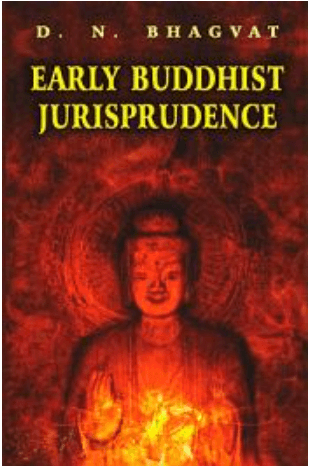
Early Buddhist Jurisprudence: Theravāda Vinaya-Laws
Durga N. Bhagvat
English
Book
Cosmo Publications
204 pages
344.8 MB
Introduction
The opening chapters establish the historical background of early Buddhist monachism. Bhagvat traces the development of ascetic life before Buddhism, beginning with Vedic and Brahmanical traditions, forest renunciation, Brahmacarya, Brahmavidyā, and the rise of śramaṇa movements. This framework is important because the Buddhist Saṅgha is interpreted not as an isolated invention, but as an institution emerging from earlier Indian ascetic and juridical patterns.
The central portion of the book analyzes the Vinaya as a legal system. Bhagvat classifies offences according to modern legal categories while retaining the internal logic of the Vinaya. The discussion covers sexual offences, murder, assault, defamation, theft, property damage, disputes, schism, offences against religious authority, and procedural violations. This section shows that Vinaya law was not merely moral advice, but a structured disciplinary code with graded offences, penalties, legal processes, and institutional enforcement.
The following chapters examine the origin, nature, evolution, and promulgation of Vinaya rules. Bhagvat argues that the rules arose from multiple sources: ancient custom, Brahmanical and ascetic traditions, public criticism, suggestions from lay supporters, practical difficulties in communal life, and misconduct within the Saṅgha. The study also explains how rules evolved through changing circumstances, monastic expansion, councils, reinterpretation, and the need to preserve institutional stability.
The chapter on jurisprudence is one of the most important parts of the work. It studies legal theory, trial procedure, confession, voting, majority decision, formal acts of the Saṅgha, judicial authority, penalties, and the role of Vinayadharas. Bhagvat presents the Saṅgha as a disciplined corporate body with republican and juridical features, where legal authority was exercised through communal procedure rather than absolute individual command.
The later chapters treat the Pātimokkha, fortnightly recitation, Vinaya administration in the Saṅgha, and the position of women under Vinaya law. These sections broaden the study from rules and offences to the institutional mechanisms through which discipline was maintained and transmitted.
Copyright Notice
This material is provided solely for academic research, study, and religious practice purposes under Article 25 of Vietnam's Intellectual Property Law. Reproduction, distribution, or commercial use is strictly prohibited.
If you are the author, translator, publisher, or rights holder and believe this content has been posted without proper authorization, please contact us and we will promptly review and remove or restrict access.
Documents
Early Buddhist Jurisprudence: Theravāda Vinaya-Laws
344.8 MB
Keywords
Theravāda VinayaBuddhist jurisprudencePātimokkhaSaṅgha administrationBuddhist monastic lawearly Buddhist monachismlegal procedure.
Sách đọc nhiều nhất

The Buddha’s Ancient Path
Piyadassi Thera
Book·10.7 MB
229 pages1979223
The Questions of King Milinda, Part II
F. Max Müller (Editor)
Book·20.8 MB
427 pages1894208

A Taste of Freedom
Venerable Ajahn Chah / Phra Bodhinyana Thera
Book·1.2 MB
104 pages1980207
Buddhist Meditation: An Anthology of Texts from the Pāli Canon
Sarah Shaw (General Editors: Charles S. Prebish and Damien Keown)
Book·17.5 MB
253 pages2006204