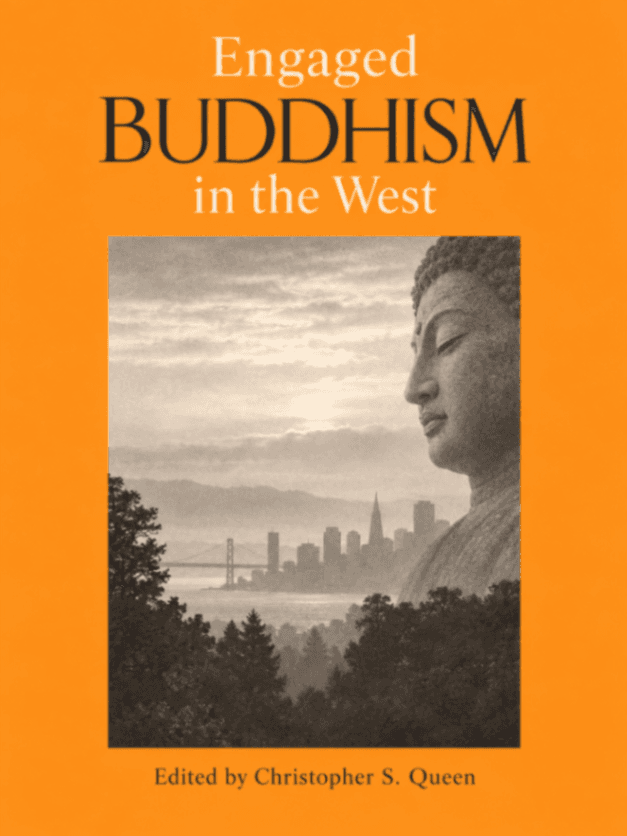
Engaged Buddhism in the West
Introduction
Engaged Buddhism in the West is a major edited collection examining the emergence, development, and institutional forms of socially engaged Buddhism in North America, Europe, Africa, and Australia. Christopher S. Queen brings together essays by scholars and practitioners who analyze how Buddhist teachings and practices have been adapted to contemporary concerns such as peacebuilding, environmentalism, racial justice, human rights, gender, sexuality, prison ministry, healthcare, education, work, and economic life.
The volume opens with Queen’s substantial introduction, “A New Buddhism,” in which he proposes socially engaged Buddhism as a significant modern development in Buddhist history. He examines the relationship between traditional Buddhist ideals of liberation and newer forms of collective, institutional, and political engagement. Rather than treating Buddhist practice only as an individual path to awakening, the contributors explore how concepts such as compassion, mindfulness, interdependence, nonduality, karma, and ethical responsibility can be extended to structural forms of suffering.
The first major section, “Engaged Buddhism as Peacemaking,” includes studies of Thich Nhat Hanh and the Order of Interbeing, the Buddhist Peace Fellowship, Bernie Glassman and the Peacemaker Order, and the peace activities of Nipponzan Myohoji. These chapters show how meditation, nonviolence, community formation, peace walks, social service, and public witness become forms of Buddhist practice. The chapter on Thich Nhat Hanh, for example, traces socially engaged Buddhism from Vietnam and the School of Youth for Social Service to the Order of Interbeing and Plum Village, emphasizing mindfulness, interbeing, reconciliation, and peacemaking.
Subsequent sections broaden the analysis to environmental activism, racial diversity, Tibet, Buddhist women, gay Buddhist communities, Asian Buddhist social action, healthcare, higher education, prison ministries, and right livelihood. The geographical scope then expands beyond North America to Britain, German-speaking Europe, South Africa, and Australia. Taken together, the essays portray engaged Buddhism not as a single movement or school, but as a diverse network of Buddhist practices responding to contemporary social suffering.
Copyright Notice
This material is provided solely for academic research, study, and religious practice purposes under Article 25 of Vietnam's Intellectual Property Law. Reproduction, distribution, or commercial use is strictly prohibited.
If you are the author, translator, publisher, or rights holder and believe this content has been posted without proper authorization, please contact us and we will promptly review and remove or restrict access.
Documents
Engaged Buddhism in the West
183.3 MB
Keywords
Sách đọc nhiều nhất
The Buddha’s Ancient Path
Piyadassi Thera
The Questions of King Milinda, Part II
F. Max Müller (Editor)
A Taste of Freedom
Venerable Ajahn Chah / Phra Bodhinyana Thera
Buddhist Meditation: An Anthology of Texts from the Pāli Canon
Sarah Shaw (General Editors: Charles S. Prebish and Damien Keown)