English
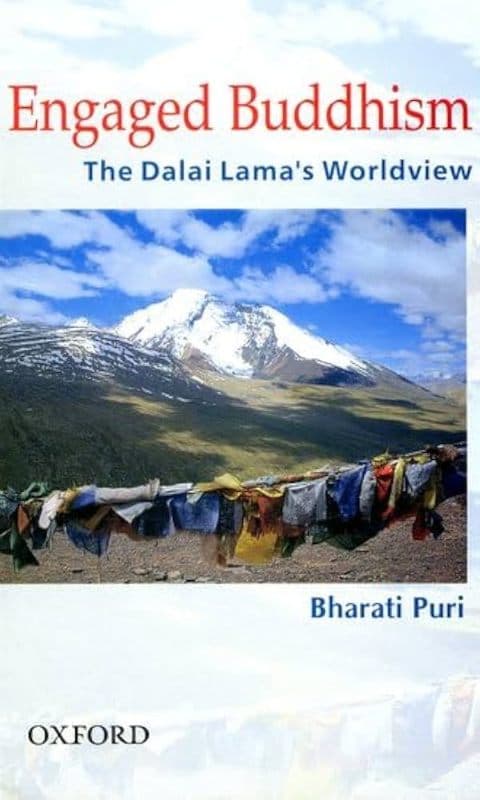
Engaged Buddhism: The Dalai Lama's Worldview
Bharati Puri
English
Book
Oxford University Press
2006
252 pages
271.2 MB
Introduction
Introduction. Engaged Buddhist Ethic: Theory, Praxis, and the Dalai Lama’s Weltanschauung
Defines Engaged Buddhism as the application of Buddhist wisdom and compassion to contemporary social, political, ecological, and ethical issues.
Challenges interpretations of Buddhism as merely world-renouncing, monastic, or socially passive.
Discusses Buddhist social ethics through pratītyasamutpāda, compassion, interdependence, karma, non-self, and the Middle Way.
Presents the Dalai Lama as a leading figure of Engaged Buddhism whose thought integrates inner transformation with social activism.
Introduces the book’s methodology: textual analysis of the Dalai Lama’s writings, comparative references to other thinkers, and support from a personal interview with the Dalai Lama.
Chapter 1. Bodhisattva and Satyagrahi: Evolving Dynamics in the Dalai Lama’s Formulation of Non-Violence
Compares the Dalai Lama’s Buddhist understanding of non-violence with Mahatma Gandhi’s ahimsa and satyagraha.
Examines compassion, human nature, conflict resolution, Tibetan autonomy, independence, and non-violent political strategy.
Chapter 2. Universal Responsibility in the Dalai Lama’s Worldview
Analyzes the Dalai Lama’s concept of universal responsibility as an ethical response to interdependence.
Discusses human rights, democracy, compassion, global ethics, and the moral responsibility of individuals and communities.
Chapter 3. “A Clean Environment is a Human Right Like Any Other”: Interlinking Eco Justice, Social Justice, and Environmental Protection
Explores the Dalai Lama’s environmental thought.
Connects Buddhist interdependence with ecological responsibility, social justice, Tibetan environmental concerns, sustainability, and human rights.
Chapter 4. The Dalai Lama on Religion and Humanism
Examines the Dalai Lama’s views on religion, secular ethics, interfaith dialogue, human dignity, compassion, and the role of spirituality in modern society.
Shows how his thought moves beyond sectarian Buddhism toward a universal humanistic ethic.
Conclusion
Synthesizes the Dalai Lama’s worldview as a form of socially engaged Buddhist ethics.
Emphasizes compassion, non-violence, universal responsibility, interdependence, and practical engagement with modern global crises.
Copyright Notice
This material is provided solely for academic research, study, and religious practice purposes under Article 25 of Vietnam's Intellectual Property Law. Reproduction, distribution, or commercial use is strictly prohibited.
If you are the author, translator, publisher, or rights holder and believe this content has been posted without proper authorization, please contact us and we will promptly review and remove or restrict access.
Documents
Engaged Buddhism: The Dalai Lama's Worldview
271.2 MB
Keywords
Engaged BuddhismDalai LamaNon-violenceUniversal responsibilityHuman rightsEnvironmental ethicsBuddhist social ethics.
Sách đọc nhiều nhất
The Buddha’s Ancient Path
Piyadassi Thera
Book·10.7 MB
229 pages1979223
The Questions of King Milinda, Part II
F. Max Müller (Editor)
Book·20.8 MB
427 pages1894208

A Taste of Freedom
Venerable Ajahn Chah / Phra Bodhinyana Thera
Book·1.2 MB
104 pages1980207
Buddhist Meditation: An Anthology of Texts from the Pāli Canon
Sarah Shaw (General Editors: Charles S. Prebish and Damien Keown)
Book·17.5 MB
253 pages2006204