
English
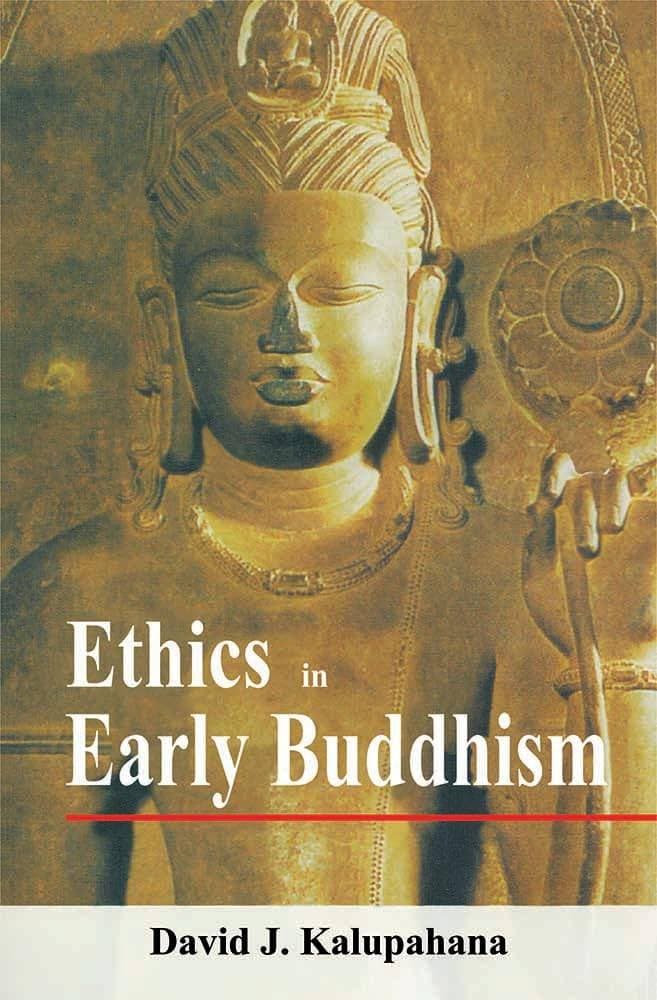
Ethics in Early Buddhism
David J. Kalupahana
English
Book
University of Hawai‘i Press
1995
150 pages
6.0 MB
Introduction
The preface explains that the work is divided into three main parts. Part One, “Historical Background and Problems,” surveys pre-Buddhist Indian moral theories and examines key philosophical issues such as knowledge, fact and value, world and will, and individual and society. This establishes the intellectual context against which early Buddhist ethics is interpreted.
Part Two, “The Moral Life, the Principle, and Justification,” studies the Buddhist path as a moral discipline through the Noble Life, the beginning of the way, the Eightfold Path, freedom, the moral principle, and the justification of moral life. Part Three, “Applications of the Principle,” applies Buddhist ethics to practical domains: society, economics, politics, law, justice, nature, and morals. The conclusion, “The Stream and the Lotus Pond,” brings together the book’s central argument about the dynamic and transformative nature of early Buddhist moral life.
Copyright Notice
This material is provided solely for academic research, study, and religious practice purposes under Article 25 of Vietnam's Intellectual Property Law. Reproduction, distribution, or commercial use is strictly prohibited.
If you are the author, translator, publisher, or rights holder and believe this content has been posted without proper authorization, please contact us and we will promptly review and remove or restrict access.
Documents
Ethics in Early Buddhism
6.0 MB
Keywords
Early Buddhist ethicsDavid J. KalupahanaBuddhist moral philosophyNoble Eightfold PathBrahmacariyaBuddhist virtuesMoral principleBuddhist societyBuddhist economicsBuddhist politicsNature and morals.
Sách cùng tác giả
Sách đọc nhiều nhất
The Buddha’s Ancient Path
Piyadassi Thera
Book·10.7 MB
229 pages1979223
The Questions of King Milinda, Part II
F. Max Müller (Editor)
Book·20.8 MB
427 pages1894208

A Taste of Freedom
Venerable Ajahn Chah / Phra Bodhinyana Thera
Book·1.2 MB
104 pages1980207
Buddhist Meditation: An Anthology of Texts from the Pāli Canon
Sarah Shaw (General Editors: Charles S. Prebish and Damien Keown)
Book·17.5 MB
253 pages2006204