
English
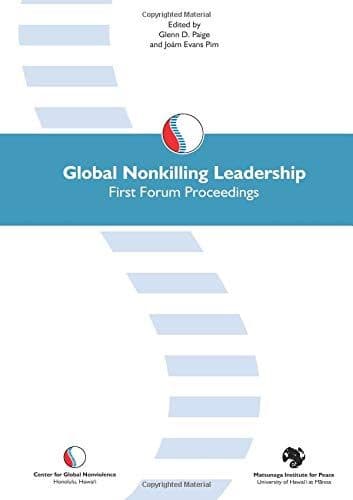
Global Nonkilling Leadership: First Forum Proceedings
Glenn D. Paige (editor) and Joám Evans Pim (editor)
English
Book
Center for Global Nonviolence. Honolulu, Hawaii
2008
341 pages
2.0 MB
Introduction
The volume opens with institutional information about the Center for Global Nonviolence and the Matsunaga Institute for Peace, followed by the title page identifying the work as the proceedings of the First Global Nonkilling Leadership Forum, held at Mu Ryang Sa Buddhist Temple, Honolulu, Hawaii, November 1–4, 2007. The book is published under a Creative Commons Attribution–Noncommercial–No Derivative Works 3.0 License, allowing free sharing under specified conditions.
Opening Materials
Acknowledgements
The acknowledgements explain that the forum was organized through cooperation among the Center for Global Nonviolence, the Spark M. Matsunaga Institute for Peace, and the Korean Buddhist Mu Ryang Sa Temple. The section also records institutional and individual supporters who made the forum and publication possible.
Affirmation of the Global Nonkilling Spirit
This statement functions as the moral and spiritual charter of the volume. It remembers those who have been killed, those who have killed, those who have refused to kill, and those who have worked to end killing. It calls for a measurable goal: a killing-free world grounded in reverence for life and infinite creativity.
For a Nonkilling World: Report of the First Global Nonkilling Leadership Forum
This report summarizes the purpose, participants, and conclusions of the forum. It states that more than thirty participants from twenty countries gathered to discuss the possibility of a nonkilling world. The report identifies six forum purposes, including building relationships among nonkilling leaders, demonstrating grounds for confidence in human nonkilling capability, sharing translation and community-awakening experiences, advising on a Global Nonkilling Leadership Academy, and exploring the creation of a Center for Global Nonkilling.
Blessings of Acharya Shri Mahapragyaji
This message frames ahimsa as life “par excellence.” It argues that without nonviolence and nonkilling, breath, water, food, society, and development lose their moral foundation. The message criticizes material and economic development without moral and spiritual development and calls for training in nonviolence.
Opening Remarks — Balwant “Bill” Bhaneja
Bhaneja presents nonkilling as a life-affirming concept and emphasizes that “nonkilling peace” must go beyond military definitions of peace. He identifies nonkilling as open-ended, measurable, and globally transformative. The remarks also frame nonkilling leadership as a shift from lethal command to nonkilling problem-solving.
The Global Nonkilling Spirit
This section explores nonkilling across religious, spiritual, and humanist traditions.
Hawaiian Spirituality of Nonkilling — Haaheo Guanson
This essay presents the Hawaiian concepts of HA, ALOHA, and PULE as spiritual foundations for nonkilling. Breath, peace, prayer, reconciliation, and cooperation are interpreted as elements of a Hawaiian spirituality of nonkilling.
Nonkilling in Buddhism — A. T. Ariyaratne
Ariyaratne connects nonkilling directly with the first of the Five Precepts: abstaining from destroying life. He emphasizes that the Buddhist precepts are not imposed by an external deity but are self-undertaken commitments. He also cites the Karaṇīyametta Sutta and loving-kindness meditation as positive expressions of nonkilling.
The Global Nonkilling Spirit: Sources of Nonkilling Inspiration — Mairead Maguire
Maguire reflects on her Christian background in Northern Ireland and her journey from anger at injustice to a commitment to nonviolence. She identifies the Cross, the Sermon on the Mount, and inner spiritual awareness as sources of nonkilling inspiration.
Nonkilling in Hindu Tradition — Balwant “Bill” Bhaneja
This chapter explains ahimsa as a central value in Hindu tradition from the Upaniṣads to Gandhi. It presents Hindu nonviolence as rooted in the unity of existence, the overcoming of otherness, and the interconnection of all beings.
Humanism, Nonkilling, and Leadership — George Simson
Simson argues that humanism and nonkilling are closely connected because humanism assigns high value to living human beings. The chapter emphasizes judgment, ethical responsibility, education, art, and social contracts as instruments for nonkilling leadership.
Roots of the Spirit of Nonkilling in Jainism — S. L. Gandhi
This essay presents Jainism as one of the strongest religious traditions of nonkilling. It explains ahimsa not only as abstention from physical violence but also from mental and verbal violence. The chapter highlights Mahāvīra’s teaching that all living beings desire life and that harming them is morally wrong.
Ants, Birds, Infants, and Humans: Notes on Islam and Nonkilling Politics — Chaiwat Satha-Anand
This essay uses Qur’anic and Hadith materials to examine Islamic resources for nonkilling. It discusses teachings related to ants, birds, infants, and human life, emphasizing proportionality, protection of the future, rejection of cultural violence, and the sanctity of life.
Nonkilling in the Jewish Tradition — Alice Tucker
This chapter reflects on Jewish teachings about life, murder, preservation of life, and moral responsibility. It discusses the commandment against murder and the Jewish principle of Pikuach Nefesh, the preservation or saving of life.
Tao (Compassion) and Nonkilling — Rhee Dongshick
This essay connects Taoist compassion with the spirit of nonkilling, presenting nonkilling as a path of harmony, balance, and restraint.
Is a Nonkilling Haitian Voodoo Religion Possible? — Max Paul
This chapter explores the possibility of interpreting Haitian Vodou through a nonkilling framework, expanding the interreligious scope of the forum.
The Challenge of Nonkilling Global Transformation
Nonkilling Leadership and the Global Condition — Mairead Maguire
This chapter reflects on global violence and the urgent need for leadership grounded in nonkilling, peace, and human dignity.
Nonkilling Leadership for No-Poverty Development — A. T. Ariyaratne
Ariyaratne connects nonkilling with development, poverty reduction, and community empowerment, drawing from the Sarvodaya Shramadana Movement in Sri Lanka.
A Nonkilling World Is Possible — Glenn D. Paige
Paige presents the central thesis that a nonkilling world is possible. He argues that killing is not an inevitable feature of human nature or politics and that political science can be reconstructed around the measurable goal of ending killing.
Significance of the Nonkilling Thesis
This section gathers international reflections on the political, ethical, educational, and cultural significance of nonkilling.
The Global Significance of the Nonkilling Thesis: The Ethics Link — Abdel-Salam Majali
Majali emphasizes the ethical importance of nonkilling as a global principle.
“Harmony Is Most Valued”: To Build a Harmony World — Zhao Baoxu
This chapter connects nonkilling with harmony, social order, and global coexistence.
Nonkilling as a Common Value and Global Program for Action — William V. Smirnov
Smirnov presents nonkilling as a shared human value that can be translated into a practical global program.
Achieving the Nonkilling Society in Nigeria: The Role of the Teacher — A. M. Wokocha
This essay emphasizes education and the role of teachers in cultivating a nonkilling society.
On the Global Significance of the Nonkilling Thesis — Jose V. Abueva
Abueva reflects on the political and civilizational relevance of Paige’s nonkilling thesis.
Translations and Cultural Experiences
This section documents the globalization of Nonkilling Global Political Science through translation and cultural adaptation. It includes reports on Arabic, Bengali, Chinese, Filipino, French, Galizan, Hindi, Japanese, Korean, Malayalam, Mongolian, Russian, Sinhala, Kiswahili, Tamil, and Urdu translations. The section shows that nonkilling is not intended as a narrow English-language concept, but as a translatable and culturally adaptable global idea.
Publication of English Editions
This section presents the history of English-language publication and circulation of Nonkilling Global Political Science.
From Oxford to Xlibris: Story of an American “Samizdat” — Glenn D. Paige
Paige recounts the publication history of the original work and its circulation outside conventional academic publishing structures.
Nonkilling Global Political Science’s Indian Edition — N. Radhakrishnan
This chapter describes the Indian publication context.
On Publishing the Philippine Edition of Nonkilling Global Political Science — Jose V. Abueva
This essay discusses the Philippine edition and its relevance for national and civic education.
The Nigerian Edition of Nonkilling Global Political Science — Fidelis Allen
Allen describes the Nigerian edition and its potential contribution to peace education and social transformation.
Community Awakening Experiences
This section presents examples of nonkilling work in specific societies.
Towards a Nonkilling Filipino Society — Jose V. Abueva
This chapter applies nonkilling ideas to the Philippine context.
Founding of the Centre for Global Nonviolence Nigeria — Fidelis Allen
Allen reports on institution-building in Nigeria.
The CCNGD: Philosophy, Structure, Progress and Outlook — Max Paul
This chapter discusses a nonkilling initiative in Haiti.
La société non meurtrière est-elle possible en Afrique des Grands Lacs? — Mabwe Lucien
Lucien examines the possibility of a nonkilling society in the Great Lakes region of Africa, including contexts affected by severe violence.
Lessons from Nonkilling Leadership Experiences
This section draws leadership lessons from major figures and movements.
Transforming Leadership — James MacGregor Burns
Burns introduces transformational leadership as a framework relevant to nonkilling social change.
Tolstoy and the Doukhobors — Koozma J. Tarasoff
This chapter studies Tolstoy’s nonviolence and the Doukhobor experience.
Nonkilling Leadership Lessons from Gandhi — N. Radhakrishnan
Radhakrishnan presents Gandhi as a model of nonkilling leadership rooted in truth, nonviolence, and social transformation.
Building Nonkilling Muslim Societies: Relevance of Abdul Ghaffar Khan — Syed Sikander Mehdi
This essay presents Abdul Ghaffar Khan as a Muslim leader of nonviolence and nonkilling.
Lessons from the Life of Martin Luther King, Jr. — Bernard LaFayette, Jr.
LaFayette draws lessons from Kingian nonviolence and civil rights leadership.
Nonviolent Buddhist Leadership of A. T. Ariyaratne — Arjuna Krishnaratne
This chapter examines Ariyaratne’s Buddhist-inspired leadership in the Sarvodaya movement.
Lessons from the Nonviolent Political Leadership of Gov. Guillermo Gaviria — Luis Botero
Botero presents Governor Gaviria as an example of nonviolent political leadership in Colombia.
Petra Kelly chapters — Nancie Caraway and Eva Quistorp
These essays reflect on Petra Kelly’s ecological, feminist, and nonviolent political legacy.
Ron Mallone and the Fellowship Party — Glenn D. Paige
Paige discusses Ron Mallone and political organizing for nonkilling values.
Leadership Lessons from the Sarvodaya Party of India — T. K. N. Unnithan
This chapter discusses Sarvodaya-inspired political leadership.
The Role of Nonviolence Advisor to the Governor of Antioquia — Luis Botero
Botero describes advisory work in nonviolent governance.
Advising Leaders on Nonkilling Politics — Chaiwat Satha-Anand
This chapter reflects on how leaders can be advised toward nonkilling political choices.
Introduction to Training Methods
The final substantive section focuses on practical training.
Educating Leaders for Global Understanding — Abdel-Salam Majali
This chapter emphasizes education for global leadership.
The TRANSCEND Approach to Simple Conflicts — Johan Galtung
Galtung presents conflict transformation through the TRANSCEND method.
Kingian Nonviolence Leadership Training — Bernard LaFayette, Jr. and Charles L. Alphin, Sr.
This chapter introduces Kingian nonviolence as a structured leadership training model.
Brief Overview of the Shantisena — N. Radhakrishnan
This essay explains Gandhi’s concept of a peace brigade.
The Shanti Sena of Gandhigram Rural University — Dennis August Almeida
This chapter presents an institutional example of Shanti Sena training and practice.
Closing Document
Charter for a World Without Violence
The volume concludes with the Charter for a World Without Violence, adopted in the context of the Nobel Peace Laureates’ campaign. The charter calls for a just, killing-free world in which everyone has the right not to be killed and the responsibility not to kill others.
Copyright Notice
This material is provided solely for academic research, study, and religious practice purposes under Article 25 of Vietnam's Intellectual Property Law. Reproduction, distribution, or commercial use is strictly prohibited.
If you are the author, translator, publisher, or rights holder and believe this content has been posted without proper authorization, please contact us and we will promptly review and remove or restrict access.
Documents
Global Nonkilling Leadership: First Forum Proceedings
2.0 MB
Keywords
NonkillingGlobal NonviolencePeace LeadershipNonkilling Political ScienceConflict Transformation.
Sách đọc nhiều nhất
The Buddha’s Ancient Path
Piyadassi Thera
Book·10.7 MB
229 pages1979223
The Questions of King Milinda, Part II
F. Max Müller (Editor)
Book·20.8 MB
427 pages1894208

A Taste of Freedom
Venerable Ajahn Chah / Phra Bodhinyana Thera
Book·1.2 MB
104 pages1980207
Buddhist Meditation: An Anthology of Texts from the Pāli Canon
Sarah Shaw (General Editors: Charles S. Prebish and Damien Keown)
Book·17.5 MB
253 pages2006204