
English
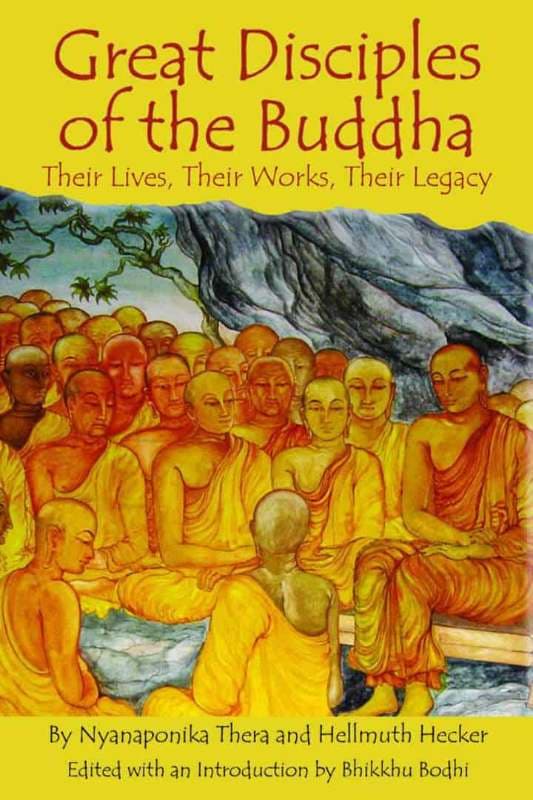
Great Disciples of the Buddha: Their Lives, Their Works, Their Legacy
Nyanaponika Thera and Hellmuth Hecker (Edited by Bhikkhu Bodhi)
English
Book
Buddhist Publication Society, Kandy, Sri Lanka, in collaboration with Wisdom Publications, Boston
1997
411 pages
54.9 MB
Introduction
The Editor’s Introduction provides the doctrinal framework of the book. Bhikkhu Bodhi explains the place of discipleship in Buddhism, the meaning of sāvaka, the distinction between ordinary disciples and noble disciples, the four stages of awakening, and the role of the Ariya Saṅgha. This section also clarifies that the book should be read as an exercise in contemplation and spiritual reflection, not only as objective historical scholarship.
The first major group of chapters presents the leading elder monks. Sāriputta is portrayed as the “Marshal of the Dhamma,” foremost in wisdom, doctrinal analysis, teaching, and systematic exposition. Mahāmoggallāna is presented as the master of psychic powers, showing the meditative and supernormal capacities associated with deep concentration. Mahākassapa is treated as the “Father of the Saṅgha,” especially important for austerity, leadership, and the preservation of the teaching after the Buddha’s passing. Ānanda is described as the Buddha’s attendant and guardian of the Dhamma, central to the preservation of the discourses.
The following chapters continue with Anuruddha and Mahākaccāna. Anuruddha is emphasized as foremost in the divine eye and as a model of meditative vision. Mahākaccāna is presented as the master of doctrinal exposition, especially known for expanding brief statements of the Buddha into detailed explanations. These chapters show how different disciples embodied distinct dimensions of the Buddhist path.
A major chapter is devoted to great women disciples. It includes figures such as Visākhā, Mallikā, Khemā, Bhaddā Kuṇḍalakesā, Kisāgotamī, Soṇā, Nandā, Sāmāvatī, Paṭācārā, Ambapālī, Sirimā, Uttarā, and Isidāsī. This section highlights wisdom, generosity, renunciation, grief transformed into insight, loving-kindness, discipline, and women’s spiritual attainment in early Buddhism.
The later chapters present Aṅgulimāla, Anāthapiṇḍika, and shorter lives of other disciples. Aṅgulimāla’s story illustrates radical moral transformation, from violence to sainthood. Anāthapiṇḍika represents the ideal lay patron, whose generosity and faith supported the Buddha and the Saṅgha. The shorter biographies broaden the portrait of early Buddhist discipleship by including additional lay and monastic figures.
The book concludes with notes, bibliography, contributors, and index, making it useful both for devotional reading and academic reference.
Copyright Notice
This material is provided solely for academic research, study, and religious practice purposes under Article 25 of Vietnam's Intellectual Property Law. Reproduction, distribution, or commercial use is strictly prohibited.
If you are the author, translator, publisher, or rights holder and believe this content has been posted without proper authorization, please contact us and we will promptly review and remove or restrict access.
Documents
Great Disciples of the Buddha: Their Lives, Their Works, Their Legacy
54.9 MB
Keywords
Great disciplesSāriputtaMahāmoggallānaĀnandaearly BuddhismPāli CanonBuddhist biography.
Sách đọc nhiều nhất
The Buddha’s Ancient Path
Piyadassi Thera
Book·10.7 MB
229 pages1979223
The Questions of King Milinda, Part II
F. Max Müller (Editor)
Book·20.8 MB
427 pages1894208

A Taste of Freedom
Venerable Ajahn Chah / Phra Bodhinyana Thera
Book·1.2 MB
104 pages1980207
Buddhist Meditation: An Anthology of Texts from the Pāli Canon
Sarah Shaw (General Editors: Charles S. Prebish and Damien Keown)
Book·17.5 MB
253 pages2006204